“Having used [Espa] for a week, I’ve found it to be fresh, intriguing, and, most important, useful—and yes, it feels a little like having a trusty human helper on call.”
TY @harrymccracken@FastCompany for the thoughtful piece on @EspaLabs ! 🙌
https://t.co/1A0u8h61Bz
Introducing Espa.
Your AI assistant for work and life — manages your inbox, drafts in your voice, and handles the schedule so you don’t have to.
Try it free → https://t.co/2emmZ2ixpu.
We @foundersfund are happy to have recently doubled down on @Lighter_xyz
They’ve built an incredible perp trading experience with ultra-low latency, a verifiable security model via zk proofs, and, most importantly, a world-class team who we’re continually impressed by.
Excited to share more publicly what @benhamner and I have been working on:
https://t.co/QXvodhsM5e
We are building a knowledge graph for GTM data & have early customers such as @elastic, @figma and @Snowflake
Congratulations @Lighter_xyz on the official launch of their public mainnet!
Kudos to the team for putting their heads down and building in a fiercely competitive perp dex market
As an early user and investor in Lighter, I have nothing but praise for the team who have done an incredible job of building a platform that has converted a CEX heavy user such as myself to use their seamless trading product
Not enough people seem to mention feedback-prioritising, integrity-first teams as a key factor of achieving pmf in crypto. The Lighter team fits into this category
Looking forward to embarking on this next chapter of growth
The history of taxation is the history of humanity.
With the introduction of Gutenberg’s printing press, governments implemented standardized tax policies, but citizens could now publicly critique these same policies in a manner more widespread than ever before
During the age of exploration, advances in navigation and banking changed the very nature of commerce, adding more complexity to tax policies in the form of duties and customs to support mercantile economies
With the Industrial Revolution came the social contract theory as society shifted from the agrarian to the urban, and new schools of thought on taxation developed that are carried with us to present day
Even the digital revolution transformed the nature of taxation, spurring international collaboration and governance as the global economy flourished and evolved
In the midst of the AI revolution, how will we shape taxation?
Civilizations rise and fall by how they tax.
It’s time to write the next chapter.
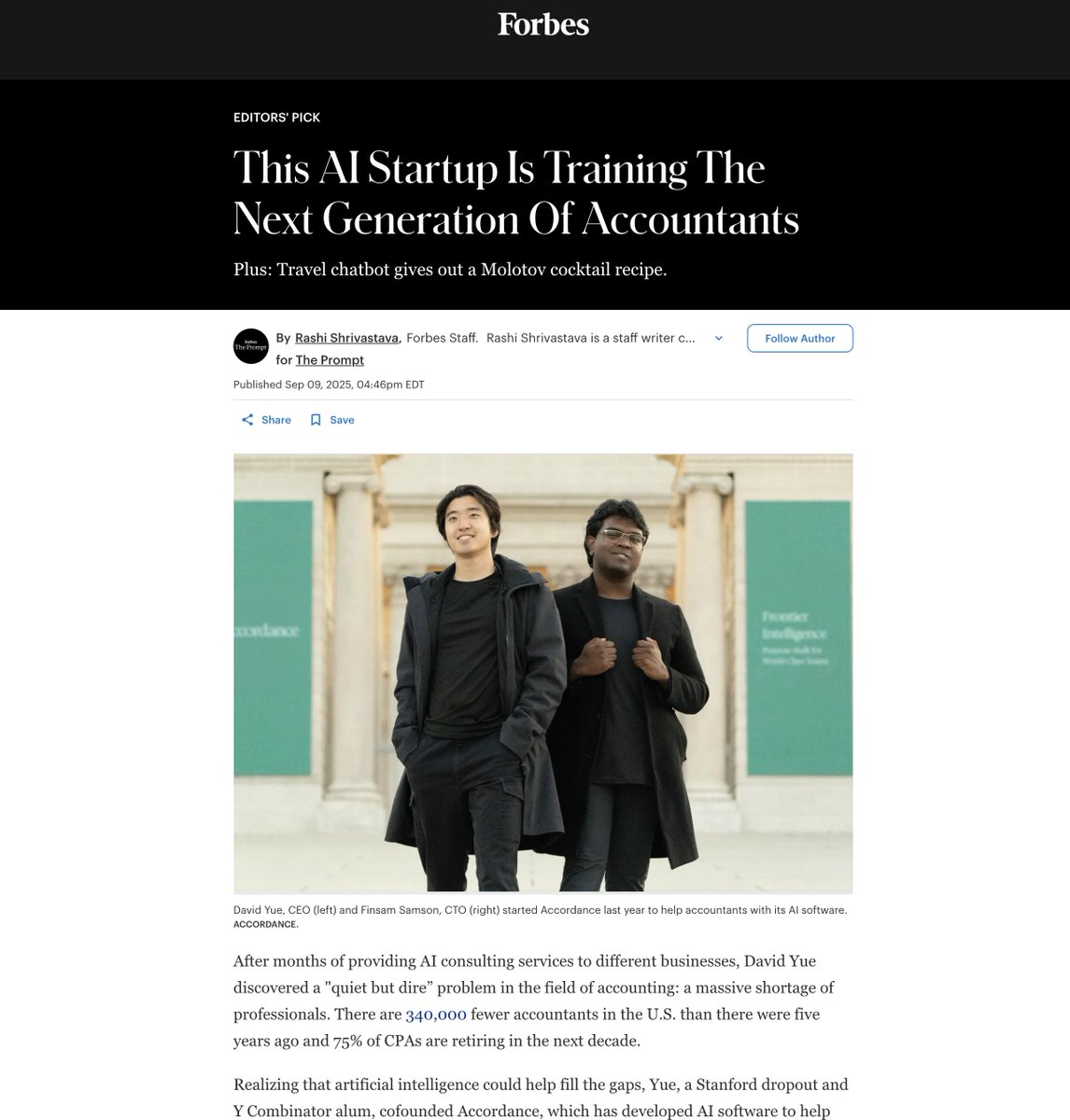
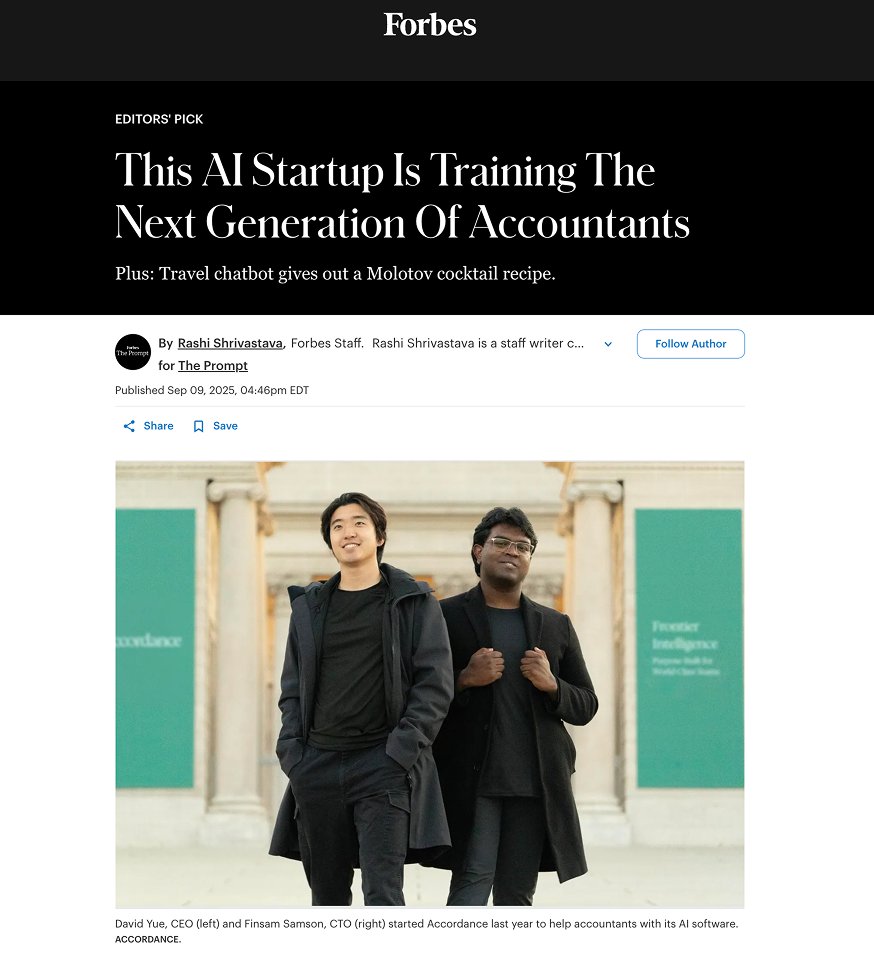
Introducing Accordance — Frontier Intelligence for Tax.
We work with global leaders at the forefront of taxation, supporting the most complex advisory work and navigating through regulatory environments that are constantly shifting. Born out of Stanford AI Laboratory/SAIL, our team is composed of world-class experts in taxation and AI, working on innovations around the clock that are changing the nature of the tax practice. We are backed by the most pre-eminent visionaries in technology and commerce, and we’ve already revolutionized the tax practice for thousands of professionals at the forefront of the most demanding and complicated tax issues.
It has been a true privilege for David and I to be working with our world-class team so far, but this is just the beginning. Finsam signing off. Ad astra.
Dear friends, I am incredibly honored to finally unveil what we've been working on in stealth: Accordance.
When Finsam and I first started our journey bringing AI out of the research lab, we discovered an industry filled with some of the most thoughtful, principled professionals we'd ever met: tax and accounting practitioners who became our teachers, our guides, and ultimately our partners.
As our entire team spent thousands of hours over the last few years climbing the learning curve, what we've discovered is that we're solving something much bigger than we initially realized. We began to see what keeps everyone up at night, and it wasn't what we expected. 75% of senior accounting professionals are retiring in the next decade, with only a 50% replacement rate. Meanwhile, regulations multiply and edge cases explode in complexity. The profession isn't just facing a labor shortage - it's facing an expertise crisis.
That's when it clicked - our mission at Accordance matters more than we ever imagined. Most people think "AI for accounting and tax" means automating routine work - but we're doing the opposite. We're building the smartest tax & accounting AI that can handle the most sophisticated advisory work - the stuff that normally takes decades of experience. It's letting junior staff punch way above their weight and giving seasoned experts superpowers they've never had. We're not replacing professionals; we're amplifying their expertise at the exact moment the profession needs it most.
The outcomes we're seeing are remarkable. But none of this would have been possible without our world-class team that sharpens iron with iron, our supporters who've been with us every step of this journey, and every professional who opened their doors and trusted us with their most complex challenges.
We're grateful to have you on this mission with us.
Big news: we’re now officially part of @CoreWeave, the #1 AI Cloud Platform.
This acquisition marks the start of something much bigger and we’re beyond excited to innovate and scale together.
More on what’s next from our founder, @l2k: https://t.co/Rs3cft9S62
Accounting is the bedrock of business, and taxation the foundation of governance.
Excited to announce our work with @OpenAI to build something unprecedented: AI that masters all tax & accounting regulations globally while reasoning with expert domain knowledge using OpenAI’s Reinforcement Fine-Tuning.
Working with OpenAI’s team and our in-house tax experts, we’ve achieved a 40% improvement over base models with Reinforcement Fine-Tuning—significantly outperforming all other leading models on TaxBench.
Some relationships start with a deal. Others start with a hackathon and an unexpected iPad bill.
15 years ago, I met @l2k when he and @yanda built something awesome at a hackathon I hosted—and that moment kicked off a friendship and partnership that has lasted ever since.
Lukas doesn’t just build great companies—he shows up for people. I learned that firsthand, and it’s shaped how I think about partnerships.
From a packed garage to one of the most essential ML platforms—now joining @CoreWeave.
I wrote about the journey and what makes this moment special. Read it here: 👇
🔗 https://t.co/jRJvYOzHsX
Today we announced that we are being acquired by @CoreWeave, the AI Hyperscaler. 🪄🐝
We could not be prouder or more excited to join forces with this team.
Our CEO, @l2k, wrote a blog post with more details:
https://t.co/mTLuSlgAyQ
Today we announced that we are being acquired by @CoreWeave, the AI Hyperscaler. 🪄🐝
We could not be prouder or more excited to join forces with this team.
Our CEO, @l2k, wrote a blog post with more details:
https://t.co/mTLuSlgAyQ
Had a few closed door conversations with smart people concerned about AI this week. Here’s what I wish I told them:
- there is an opportunity for prophets and critics but they’ve got spend time with the actual tools to get an intuition for what’s possible, rather than what you’d assume based on reading old science fiction. Frankenstein is a terrific book partly based on how concerned people were about electricity. It captures our fears about the nature of being human but didn’t help anyone really come up with better policies for dealing with electricity. I worry that a lot of AI critics are doing the same thing.
- the tools are surprisingly accessible. I didn’t predict this but all of the big AI companies are spending an incredible amount of money to make their technology easy for people to use and sharing more about how they do it than I would have guessed. That’s not out of the goodness of their heart--they’ve got commercial reasons. But that is something you can use to your advantage!
- the tools are also oddly cheap! For the price of flying out to San Francisco, you can run a whole series of experiments with the current tools to actually see what is possible, report on it, and then run another set of experiments.
- the manifestos and policy papers are very good but everyone is still figuring out use cases so don’t spend all of your time worried about them. Remember ChatGPT’s success was a surprise. And the amazing NotebookLLM podcast I was showing off was subfeature of a subfeature. I think most at Google would admit they were surprised!
- you can find out about the limitations of the tools by trying them out yourself rather than reading about the limitations. And if you play enough with them, you’ll start to build guesses about the ways they will and won’t get better. You’ll also see how hallucinations are both overhyped and still kind of under-studied.
- I’m not a blind optimist. I would just love a world in which critics and prophets on the left and right illustrated their concerns with little demos and informed intuitions. There are lots of reasons to be worried, and lots of ideas that need to be reconsidered! But they should be grounded with the direction that the tools are going in right now, and the speculation should be on the second and third order effects of actual tools (which already are superhumanly intelligent in some ways), rather than an imaginary superhuman intelligences.
The Cambrian Explosion of models is here.
Over just one month, 20+ cutting-edge models were released by @meta, @google, @cohere, @DbrxMosaicAI, and they now take up 60% of the top 10 @lmsysorg Chatbot Arena Leaderboard!
Here’s a quick deep dive with Martian on these models, in case you missed them
🧵
In the past week I have witnessed 3 startups having a very poor experience and regretting taking money from well known firms. I can't emphasize how important it is for founders to focus on the person they will be working with and less so on the brand of the firm.
How to think about raising venture capital for your startup
Most fundraising advice is written by investors for founders
Here's a thread of my best advice from founder to founder: