I was asked to give a talk about my PhD workflow for the new students in our lab. So I put together a few slides about my approach to time management, preparing for
weekly progress meetings and staying on top of the literature. The slides are available at https://t.co/YGG7bVQUR9
Many congratulations to @wuningxi my PhD student @turinginst and @WarwickDCS on passing her thesis defence with minor corrections and flying colours! Her topic is on Detecting Semantic Similarity: Biases, Evaluation and Models.
@bianca_oli_per @deviparikh More calendars give you more detail at the cost of increased complexity. You want to be able to assign a task to a calendar without thinking and quickly identify productivity patterns from one glance at your calendar. Only use a complex solution if there's a clear advantage.
I was asked to give a talk about my PhD workflow for the new students in our lab. So I put together a few slides about my approach to time management, preparing for
weekly progress meetings and staying on top of the literature. The slides are available at https://t.co/YGG7bVQUR9
@bianca_oli_per @deviparikh It depends on your own situation and preference. For a small number of projects (e.g. work and PhD), you could use separate major/minor calendars for each project (work-major,work-minor,...). For >3 projects, I would stick with major/minor calendars regardless of the project.
@deviparikh I initially considered having a corresponding “done” calendar for each category, but didn’t want to end up with too many different calendars. I suppose just adding "major-done" and "minor-done" calendars could be a good compromise. I’ll give it a try :)
Very happy, honoured and pleasantly surprised to be on the list of "Outstanding Reviewers" for #acl2020nlp!
[Aim for next year: get in the list of "Authors" 😛]
#NLProc#ACL2020
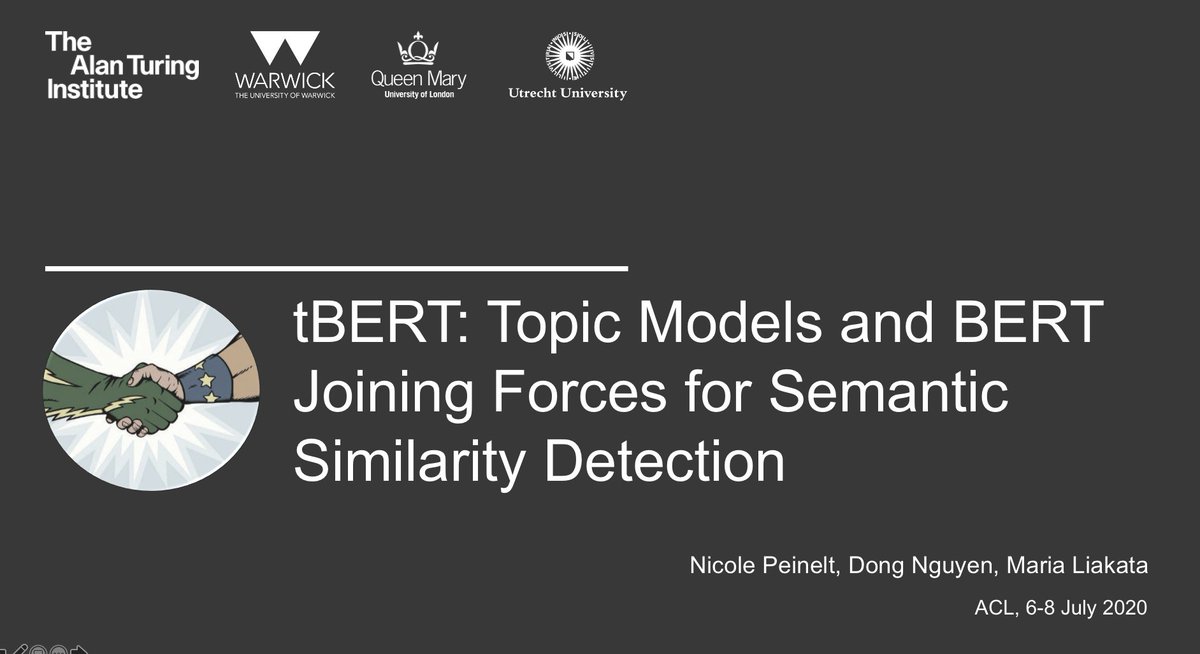
The 2nd Q&A session for our #acl2020nlp paper 'tBERT: Topic Models and BERT Joining Forces for Semantic Similarity Detection' (https://t.co/qGdUtwvzr0) is starting. You can join here: https://t.co/bIbuSrEomW.
Join our Q&A session now with @wuningxi and @dongng for our paper on "tBERT: Topic Models and BERT Joining Forces for Semantic Similarity Detection”
https://t.co/hQNIuvR3Gu
Well done to @wuningxi on the acceptance at #ACL2020 of our paper with @dongng: "tBERT: Topic Models and BERT Joining Forces for Semantic Similarity Detection” #NLProc
Join my @turinginst AI fellowship project and do an PhD in Longitudinal #NLProc methods from user generated content with applications in mental health @QMCogSci@QMUL https://t.co/zmzP6SALh1 Funding for 3 PhD positions available. Deadline May 2nd. #TuringAIFellows#PhDposition
NEW: Call for #COVIDー19 rapid response data science taskforce now open to anyone in the UK.
Submit a short Expression of Interest (EOI) by Friday 3 April 13:00 BST
Apply here: https://t.co/kUii5m5NvA
Join us and help the #NHS
Delighted to announce that from today I have started as full Professor of NLP #NLProc at Queen Mary University London @QMCogSci@QMUL. News on how to apply for PhD and Postdoc positions associated with my @turinginst AI fellowship to follow very soon. #TuringAIFellows
It's official! The 2nd AthNLP - Athens Natural Language Processing Summer School will take place from 26 August - 1 September 2020 at @NCSR_Demokritos campus in Athens!
Watch this space for updates on the call for participation & registration. #AthNLP2020 https://t.co/vJij95A1Wf
Aspiring data scientists: here is an opportunity to work on data mining, machine learning, and data science projects with social impact. Work with global non-profit organisations and government bodies to make a real-world difference. https://t.co/EMVP8Mezii
@datascifellows







![adtsakal's tweet photo. Very happy, honoured and pleasantly surprised to be on the list of "Outstanding Reviewers" for #acl2020nlp!
[Aim for next year: get in the list of "Authors" 😛]
#NLProc #ACL2020 https://t.co/DVdrqs5KPR](https://pbs.twimg.com/media/EckoJM0WoAENSb2.png)