So excited to be part of Warp founding team and partnering with Kevin, Sol & DJ on building out Warp to accelerate scientific discovery starting with helping drug discovery! Checkout https://t.co/E3pI8UeuEM
There are too many robot companies. I kept having questions like:
• Does Tesla build everything in-house?
• Who uses grippers vs. dexterous hands?
• Who trains on robot data vs. human data?
• Where does NVIDIA fit into the stack?
So I built Robot Overflow, check it out 👇
Today, we’re excited to launch the Datology Curation Studio, customizable frontier data curation for every team training its own models.
Data quality is the ultimate compute multiplier, and Curation Studio makes it easy for everyone.
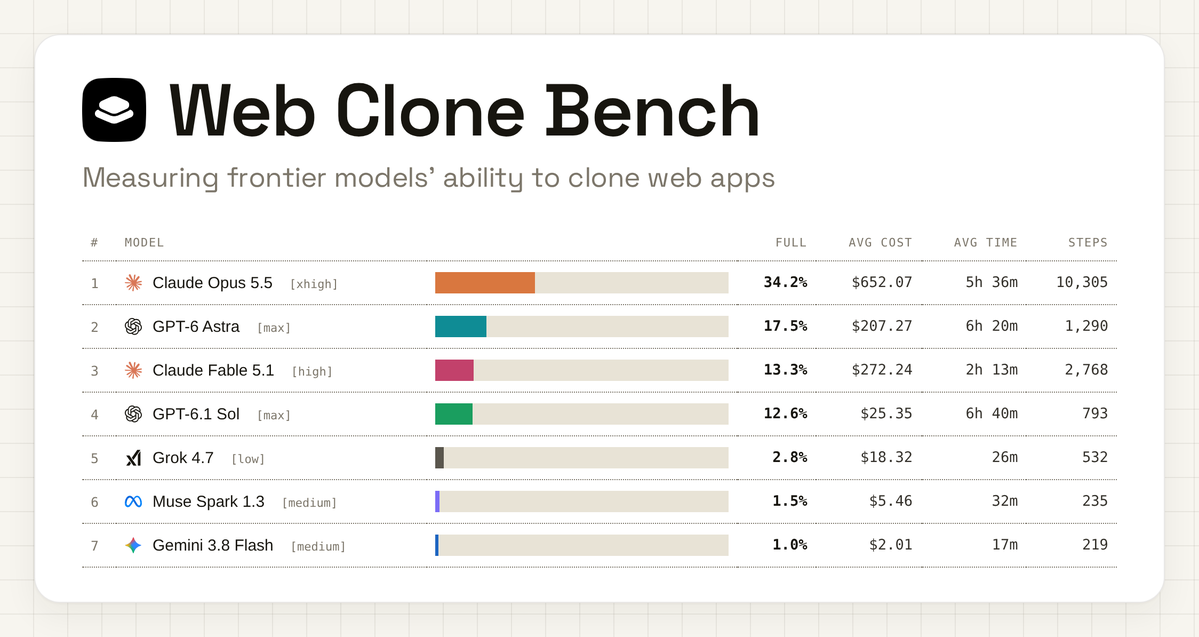
Today we're launching WebCloneBench: a benchmark which measures a model's ability to explore, copy, build and test various web apps.
For each task, we give the model a reference site from one of Gmail, Google Sheets, Jira, DocuSign, Shopify Admin, Craigslist, Figma, Slack and Zendesk. It is instructed to build a fully feature-complete clone of every part of the application with an 8 hour time limit.
Thanks to @hi_angelinayang and Two Set AI for having me on yesterday! I shared how we trained N2, our latest frontier-level computer-use model
Recording is up if you’re curious about the recipe!
https://t.co/D8f5YiKBBJ
Tomorrow, 10am PT: Skanda Vaidyanath from Yutori on how they trained Navigator n2, a 27B computer-use model that leads 4 of 5 industry benchmarks at $1.46 per task.
Free, live, with Q&A. https://t.co/CRSXZW9Lwn
1/ Computer-use agents ≠ GUI agents.
Clicking is only one way to use a computer.
The best agents will code, call tools, use the CLI, and click—using everything a computer provides, and choosing the right interface for each step.
Computer-use in 2026
"What's left? The obvious answer is longer tasks. More steps, more hours. An agent that clicks for longer.
I think this is the wrong answer, ..."
"They can code. They can click. They can't choose."
"Choosing has to be trained, and it can only be trained where it matters."
Frontier models: $13 to $40+ per task on OSWorld 2.0.
Yutori's Navigator n2: $1.46. 🎯
Served on Crusoe by a 14-person team with no inference stack of their own.
"Because Crusoe maximizes throughput, every token costs less." - @DhruvBatra_, @yutori_ai
↪ https://t.co/tDukqvJBn7
n2 can drive your Mac!
Use Yutori's MCP to run our latest Navigator computer-use model locally.
Here it is in iMovie, cutting a quick video recap from our recent event.
Horsepower helped us communicate the value add of a new technology (steam engines) relative to a familiar status quo (workhorses).
What's that unit of measurement for agents?
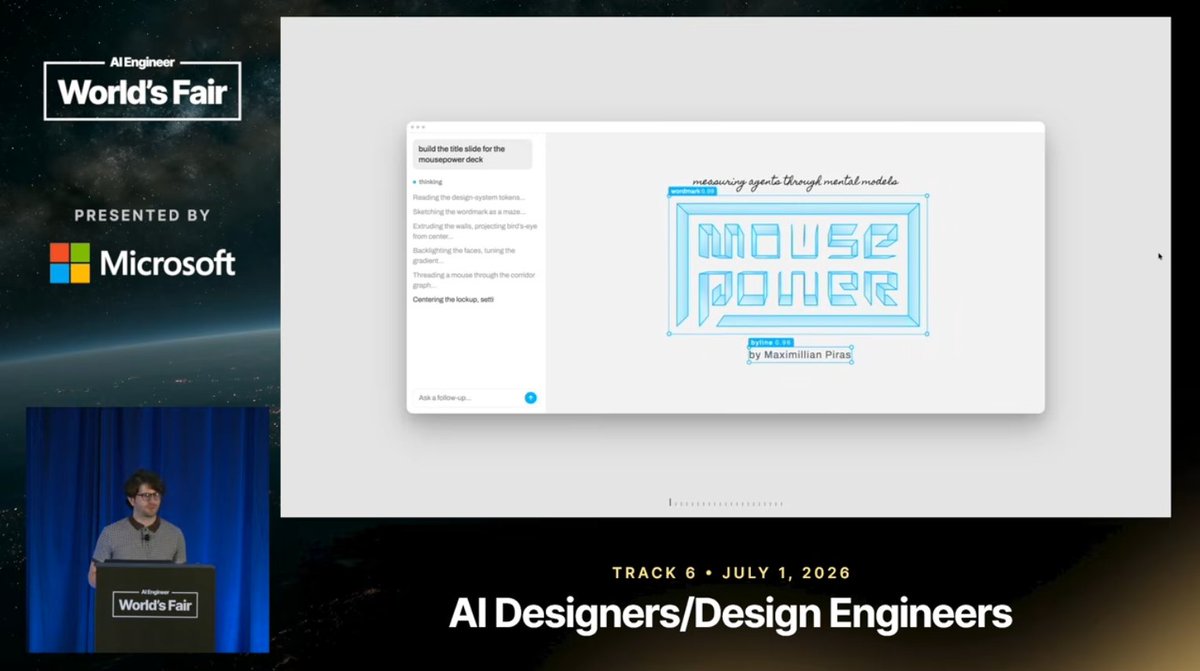
Excited to have my Mousepower talk live on @aiDotEngineer's YT channel (link below), but I have retrospective thoughts on this topic & here is what I'd change if I gave the talk again today:
1. Thesis wasn't stated simply enough: value of agents is limited by our ability to measure them, otherwise we can't justify the ROI of their token cost
2. Need an explicit connection to the discourse on verifiable domains, which we need not be limited to today's set as understanding customer mental models unlocks new ways to verify value (e.g. horsepower)
3. After reading a nice post by @jon_stokes on verifiable domains, I'm specifically interested in the n-order F/X of their "optimization pressure"
4. Also rambled too much, perhaps a function of the topic being too underbaked... will see if GPT voice can coach me for next time
Follow up incoming (someday).