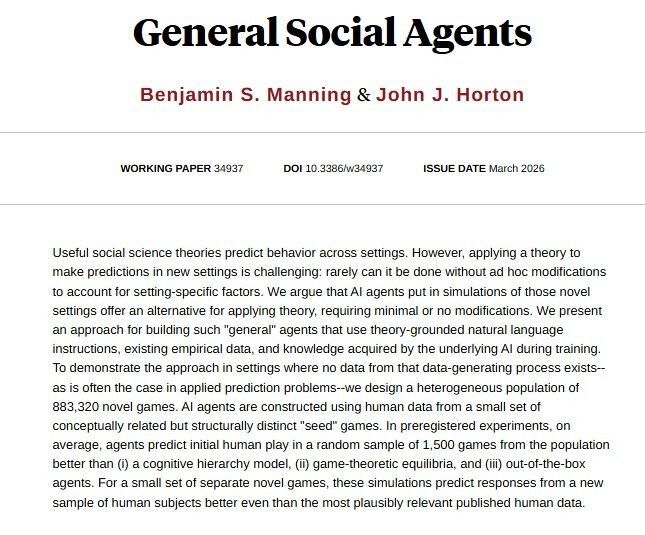
AI agents put in simulations of novel settings offer an alternative for applying theory, requiring minimal or no modifications, from @BenSManning and @johnjhorton https://t.co/dtF1DfRLuC
强烈推荐Gilbert Strang新出的《线性代数与数据学习》(Linear Algebra and Learning from Data)。
有一定数学基础���想入门机器学习领域的老铁会发现什么叫醍醐灌顶。这本书是建立已有数学知识跟人工智能之间的一道桥梁。
没学过高等数学的同学,也可以看他的Linear Algebra for Everyone。
链接:https://t.co/8LjVxCf6Na
One of my favorite papers on the randomness of "meritocracy:" Participants in a famous classical music competition perform in random order, but this order affects the experts’ rankings, which in turn determine the musicians’ long-term career outcomes. Many such cases...
New Paper: Is AI Conscious? A Primer on the Myths and Confusions Driving the Debate
AI sparks claims about machine minds—but are today’s systems really conscious? We cut through the myths + misconceptions.
#AI#Consciousness#Philosophy#AIEthics#LLM
https://t.co/IOXAYll8fs
What types of personality traits are associated with pro/anti reactions to AI?
Pro-AI: Openness, Extraversion, and Conscientiousness
Anti-AI: Neuroticism
"Consciousness" has been the taboo "C-word" in AI.
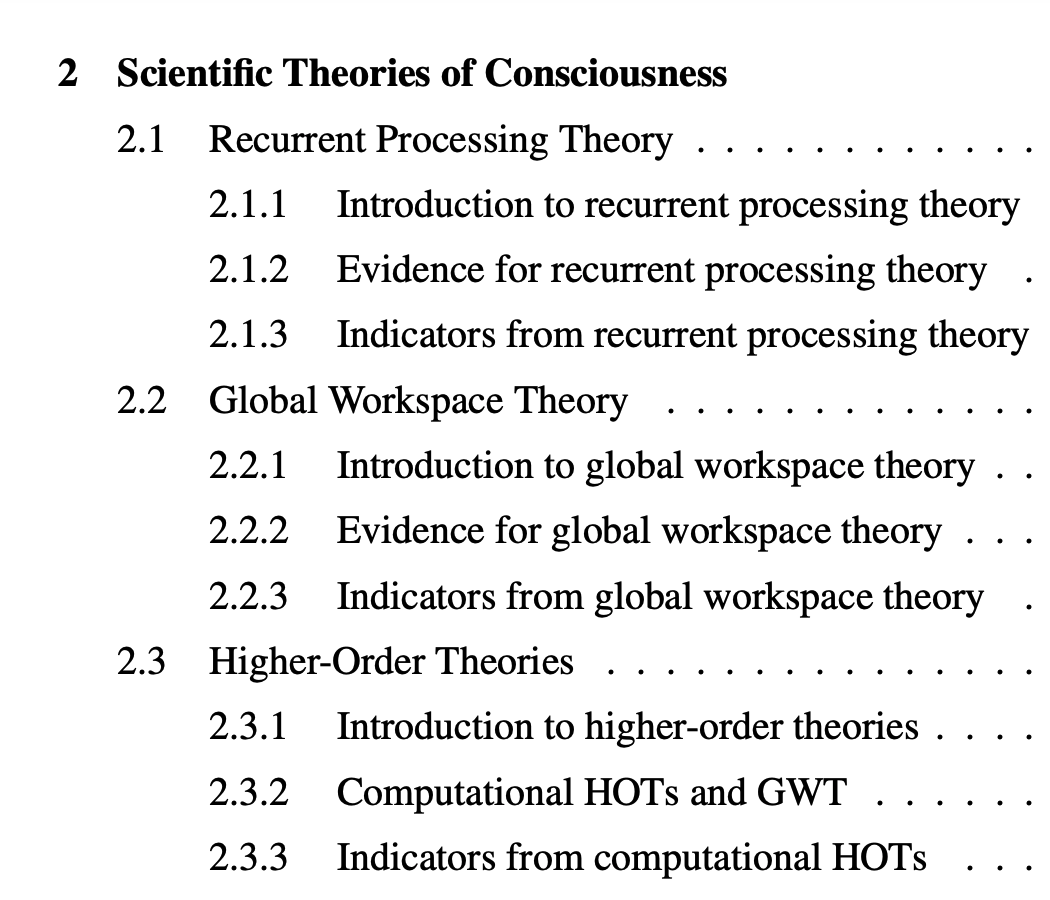
This 88-page paper, coauthored by Turing Prize laureate Yoshua Bengio, is a systematic survey of the scientific theories of consciousness, as well as possible implementations in today's AI stack.
I commend their courage to address such a controversial topic that most researchers shun. Here's what the paper concludes: quote "Our analysis suggests that no current AI systems are conscious, but also shows that there are no obvious barriers to building conscious AI systems."
It's a long read - will share notes later, bear with me.
Paper: https://t.co/dA6RZDAqhr
Excited to announce the publication of my new book Game Theory for Applied Econometricians: Data analytics with R: https://t.co/oCKkNYYLl3 #rstats#econtwitter
A beta version of my slide deck for my upcoming lecture on Geoeconomics at Oxford this Friday is now online:
https://t.co/tOk7nC1IC5
I’m looking for feedback: What else should I include? Are there any important citations I might have missed?
Please note: I don’t have room for more than 50 text slides, and I want to highlight how machine learning can be a powerful tool in this field, so I need to be selective.
Still, any suggestions are most welcome, especially as I’m considering turning this into a longer course.
@chris_d_clayton, @m_maggiori, @JSchreger, @lugaricano, @CathrinMohr, @Ch_Trebesch, @VGB32058943: you might find this of some interest.
In this article, Magness and Makovi have done a public service. They have accidentally shown how nonsense is being published in major economics journals.
As such, there are broader lessons to be learned from the Synthetic Marx Affair. Here goes… 1/15
1/
How can I put this?
"Expected utility maximizers don't maximize utility."
Why? Because utility is not usually an ergodic quantity in the mathematical models used by economists, and maximizing its expected value doesn't mean much in the real world.
This tome of a book is excellent. I've always liked Stiglitz, but wished his books did more academic deep dives. This book does that, presenting the current research on inequality, as well as the corresponding models plus variations. Highly recommend.