I'm not sure how insulting her helps anyone. Of all the Ministers, I have found her to be the most willing to TRY. Maybe that's why she is a soft target. No one has this figured out, least of all Africa . I will say though, I do wish the best minds were allowed contribute, the best operators were allowed to implement and the best startups were allowed to showcase. It's something I am always advocating for
AI agents got five times better at real computer work in twelve months. Most businesses still cannot use them. The gap between those two facts is not a technology problem.
Stanford's 2026 AI Index dropped this week. One stat in it deserves more attention than it got: AI agents moved from a 12% success rate on real computer tasks last year to 66% this year. In the same week, Microsoft pushed AI agents straight into the Windows 11 taskbar. Click an icon, get an agent that can browse, fill forms, run reports, work with other software.
The reflexive reaction to numbers like that is to wait. "Let's see if it gets to 90%." "Not reliable enough yet." "Give it another year."
That instinct is wrong. And it is going to cost a lot of operators a decade of compounding.
Here is what I learned the hard way at Daily Sale [one of Zimbabwe's largest e-commerce businesses, which I built before my current company]. When we first tried to plug an AI agent into our WhatsApp sales operation, I assumed the project was going to be about training the AI. Teaching it our products, our prices, our scripts. Two months of model work and we'd be done.
That is not what happened.
The first two months had almost nothing to do with the AI. They were spent documenting how my team actually operated. Things our agents had been doing on instinct for years — when to push for the close, when to back off, how to handle a customer who'd been quoted by a competitor, what to do when someone went silent for 48 hours — none of it was written down. It lived in three or four people's heads. The "AI project" turned into the "finally write down our business" project.
The agent could do everything we eventually asked of it. The bottleneck was never the model. It was that we did not have a clean enough description of our own work for any outsider to take it on. AI or human.
That is the deeper reframe I want to leave you with:
What you are really doing when you "adopt AI" is documenting your business well enough that something outside your own head could run it. The agent is just the new employee who finally exposes how badly the org chart was written.
Now the steelman, because I want to be honest.
Yes, capability still matters at the edges. There are real tasks AI agents cannot reliably do — high-judgement calls, complex negotiations, anything that requires deep, novel context. The 66% is an average, not a guarantee for your specific workflow. If your business is mostly edge cases, you genuinely do have to wait a bit longer.
But for the 80% of operational work most SMEs run on — answering common customer questions, capturing orders, chasing follow-ups, generating routine reports, scheduling, basic bookkeeping — the floor is already high enough. Reliability is no longer the blocker.
Your documentation is. Your processes are. Your willingness to write down what your business actually does, instead of running it on memory and trust, is.
For African operators, this cuts both ways.
The advantage: we run lean. Fewer middle-management layers. Less inherited bureaucracy. Fewer entrenched tools that need to be undone before AI can plug in. A five-person business can rewrite its operating manual in a weekend.
The disadvantage: most of us run on memory, relationships, and instinct. Very little is written down. The tribal-knowledge problem is bigger inside African SMEs than inside Western enterprises, not smaller — because we never had the consultants and process auditors to force documentation on us. What lived in a senior partner's head in London lived in a manager's head in Harare. The difference is London wrote it down fifteen years ago because a compliance officer made them. We didn't.
That has to change. And it has to change in 2026, not 2028.
Because here is the asymmetric bet. The operators who spend the next 90 days writing down how their business actually works — not buying AI tools, just writing — will be ready to deploy any agent on the market within a quarter. The ones who wait for "AI to mature" will discover, two years from now, that the bottleneck was never the AI. It was them.
And by then the people who started documenting in April 2026 will already be two iterations ahead — not because they had better tools, but because they started with better descriptions of their own work.
Here is the question I'll leave you with:
If a smart, capable new hire walked into your business tomorrow morning, how long would it take them to be genuinely useful without interrupting you every ten minutes for context?
The answer to that question is also the answer to how AI-ready you actually are.
#AI #AIAgents
The AI economy isn't being built in Silicon Valley. It's being built in bedrooms.
Last week, from a desk in my home office in Harare, I shipped a feature that would have needed a team of ten engineers and a year of runway five years ago. One person. One laptop. One quiet room with the curtains half-drawn against the afternoon sun.
That isn't a humblebrag. It's a structural change most people haven't caught up to yet.
For two decades, the story of the "new economy" was geographical. You had to move. San Francisco. New York. London. Bangalore if you wanted to write the code. The place you were born determined the ceiling on what you could build. Talent was everywhere, but opportunity was concentrated inside a few zip codes.
AI broke that.
Not because of some slogan about democratisation. Because of a boring, measurable shift: the cost of turning an idea into working software collapsed from millions to almost nothing. A 2014 startup raised $5M before it had a single paying customer. A 2026 founder ships the product on a Tuesday afternoon between school runs.
The economics of starting something finally moved to where most of the world actually lives — which is at home, in a small city, inside a life with real constraints.
I'm writing this to announce a channel I'm building to document exactly that shift. It's called Built From Home — AI, apps, and real businesses built from a home office in Harare. New video every Friday. It's my honest attempt to put the unglamorous reality of the new AI economy on camera: the setup, the mistakes, the wins, the power cuts.
But this post isn't a pitch for a YouTube channel. It's a reframing I want you to take with you.
The winners of the next decade will be operators, not geographies.
The builder in Lagos who can use three AI tools well will outship the team in Palo Alto that still treats software as a three-month sprint. The SME owner in Nairobi who wires an AI agent into her WhatsApp will out-revenue the franchise down the road that pays a receptionist to miss half her calls. The 19-year-old in Accra teaching himself to build agents on a cracked second-hand laptop has a better shot at freedom than his uncle who moved to London in 2008 to "find work."
This is not cope. I'm not saying Lagos is the new Silicon Valley. I'm saying the question has changed.
The old question was: Where do I need to be to build something valuable?
The new question is: What am I going to build from exactly where I already am?
Now the steelman.
Capital still flows to the Bay. Distribution advantages are still real. Enterprise contracts don't land in your inbox because you have a good idea and a humble desk setup. Bandwidth matters. Power matters. Community matters. I know. I've lost full days of work to load-shedding this year.
And honestly — most people who say "you can build from anywhere now" are selling something. The AI tools aren't free. The learning curve is steep. The loneliness of building alone in a room in a country that isn't watching is real and underestimated.
So take the reframe with a shot of salt. Geography isn't dead. It's just been re-priced.
But the direction is clear, and it's one-way. The centre of gravity of who c
Capital still flows to the Bay. Distribution advantages are still real. Enterprise contracts don't land in your inbox because you have a good idea and a humble desk setup. Bandwidth matters. Power matters. Community matters. I know. I've lost full days of work to load-shedding this year.
And honestly — most people who say "you can build from anywhere now" are selling something. The AI tools aren't free. The learning curve is steep. The loneliness of building alone in a room in a country that isn't watching is real and underestimated.
So take the reframe with a shot of salt. Geography isn't dead. It's just been re-priced.
But the direction is clear, and it's one-way. The centre of gravity of who can start a business is moving out of the office parks and into kitchens, garages, and back bedrooms — in Harare, in Hanoi, in Helsinki, in Houston. The AI economy isn't arriving in Africa. It's being built here. In living rooms. On battery backups. By people who don't wait for permission.
So the question I'll leave you with:
What are you building right now — or planning to build in the next six months — that you wouldn't have even attempted five years ago?
Reply with one line. I read everything. And if it resonates, come watch me try to build one of those things myself, in public, every Friday.
#BuildInPublic #AI
Meta just rewrote the rules for WhatsApp Business. And it quietly validated the design decision we made at Wondabox from the first week we started building.
In January, Meta changed its WhatsApp Business API terms. The headline: general-purpose chatbots — the ones designed to replicate the WhatsApp experience itself, handle small talk, play the part of a digital friend — are no longer allowed on the platform.
At first this looked like a cleanup move. In practice, it is a reclassification of what WhatsApp is for. WhatsApp is a commerce channel, not a chat toy. Meta is protecting the funnel. They want businesses on the platform moving customers through a decision — an order, a booking, a support resolution — not hosting open-ended conversation loops that decay engagement over time.
A lot of chatbot builders spent the last three years treating WhatsApp as an AI playground. They built personas. They built characters. They built "talk to your brand" experiences. Most of that is now non-compliant.
When we started building Wondabox, we had a choice. We could build a general conversation agent — the kind VCs were falling over themselves to fund in 2023 — or we could build something narrower: an AI agent whose only job was to move a customer from "interested" to "paid and delivered."
We chose narrow. Not because it was cooler. Because we had just come off scaling Daily Sale [one of Zimbabwe's largest e-commerce businesses], and we knew exactly where the money was being lost.
It was not in the chat. It was in the handoff between chat and order.
So Wondabox was built around four specific jobs: reply to a product inquiry, answer the common objection, capture the order with the right fields (name, product, location, delivery preference), and follow up when the customer goes quiet. That was it. No personality. No chit-chat. No pretending to be a human friend.
That narrow scope turned out to matter more than we realised at the time.
When the policy change landed in January, the 190+ active merchants running their sales through Wondabox did not have to rebuild anything. The design already matched where Meta was heading. We were not replicating the WhatsApp experience. We were extending it — turning a conversation into a transaction.
The broader lesson here is not really about WhatsApp. And it is not even about AI.
It is about platform risk.
Every founder building on somebody else's infrastructure — WhatsApp, Instagram, Shopify, TikTok, a payment rail, an API — is one policy update away from a rebuild. The question is not whether the platform will change the rules. It will. The question is whether your product was designed around the platform's marketing promise or around the platform's actual business model.
Meta does not make money from users who chat. Meta makes money from businesses that transact. If you built for the first, the policy shifts eventually hurt you. If you built for the second, the policy shifts usually strengthen your moat.
That applies far beyond WhatsApp.
The Shopify app ecosystem re-sorts every two years based on what Shopify decides it wants merchants doing. The Google Play store rules evolve around what Google can monetise. The AI model providers are going to keep changing their terms of service as their business models mature.
The operators who survive those shifts are the ones who ask a boring question early: what is this platform actually for, in the eyes of the company that runs it? Then they build on that answer — not on the marketing pitch.
Most builders skip this question because it is less exciting. The pitch is: "build whatever you dream." The reality is: "build within the shape of what the platform is willing to pay to protect."
For African SMEs especially, this matters. You do not have the capital to rebuild a product every 18 months because a policy changed in California. Your design choices need to hold up under five policy shifts, not one.
Now, the counterpoint, because I've thought about it.
Narrow design is not always the right answer. If a platform is early and still figuring out its model, narrow can lock you out of categories that later become huge. We got lucky in one sense: WhatsApp's intent was clear from the start. It was always a commerce-adjacent channel, never a social network in the Facebook sense. So designing around commerce was not a gamble — it was a reading of where the owner wanted the platform to go.
But when the platform's business model is obvious, designing around it is not playing it safe. It is playing it smart.
Here is the question I want to leave you with:
If the platform you are building on changed its rules tomorrow, would your product still have a reason to exist?
That is the question we are asking every sprint now.
#BuildInPublic #AfricaTech
Three-quarters of AI's economic gains are being captured by just 20% of companies.
That number landed this week from PwC's 2026 AI Performance Study — and I've been sitting with it since.
Because the gap isn't explained by which company has better AI tools. The tools are increasingly the same. Anthropic, Google, open-source models — everyone can access roughly the same technology now. And the prices are falling every single quarter.
So why is the value concentrating into so few hands?
PwC found the answer in a single word: intent.
The companies in the top 20% are using AI primarily to grow — to reach more customers, open new markets, handle volume that was previously impossible. The other 80% are using AI mainly to cut — reduce headcount, lower support costs, do the same things slightly cheaper.
Same tools. Completely different outcomes.
This is not a small distinction. It changes everything about how you deploy the technology.
Let me give you a concrete example from our own journey.
When we first brought AI into the Daily Sale [one of Zimbabwe's largest e-commerce businesses] WhatsApp sales operation, we faced a clear choice. We could use it to reduce our team — fewer agents needed, lower payroll, cleaner numbers on a spreadsheet. That was the "cut" option, and on paper it would have looked efficient.
We didn't do that.
Instead, we used the AI to handle the conversations our team was physically incapable of handling. The 2am messages. The fifty simultaneous inquiries during a big campaign. The follow-ups that nobody remembered to send. The instant first-response that made a customer feel seen before a human even logged on.
Our human agents didn't disappear. They moved up — to the harder conversations, the exceptions, the relationship-building that a machine still can't do well. Revenue grew. Team stayed whole. Volume we could never have handled before became handleable.
The AI did the same thing in both scenarios. The direction we pointed it in was different.
Here is the reframe I want you to sit with:
Most businesses default to defensive AI because it's easier to measure and easier to justify to a board or a partner. "We saved 2 hours a day on customer support." That saving is real. But the deeper question is: what did you do with those 2 hours?
The companies capturing the most AI value right now are not just removing cost. They are asking: what can we now do that we genuinely could not do before? Then they build for that answer.
For African SMEs, the stakes in getting this right are especially high.
African businesses have always operated lean. We were never given the option to build bloated middle-management layers and then automate them away. We built resourceful, tight structures out of necessity. That means the Western narrative of "use AI to cut headcount" doesn't even apply to most of us — we don't have the headcount to cut.
But the growth narrative? That one fits perfectly.
An AI that handles inquiries in languages your team doesn't speak. That operates in a time zone your agents are asleep in. That manages campaigns during the hours you're handling logistics. That follows up on every single lead instead of only the ones your team gets to by end of day.
That is a growth story. And it is available to you right now, with the same tools the Fortune 500 is using — at a fraction of the price.
Now the honest counterpoint, because I've been on the ground long enough to know this isn't simple.
The barriers are real. Nine in ten African organisations are currently struggling with a shortage of AI-related skills. Most SMEs don't have clean data, documented processes, or teams trained to deploy AI at scale. That is true, and I won't minimise it.
But I don't think the answer is "wait until you're ready." The businesses that are going to be in that top 20% in three years are not waiting. They are starting where the customer interaction already exists — one workflow, one channel, one real problem — and getting good at it before expanding.
For most African businesses, that starting point is already there. It's the WhatsApp conversation. The inquiry you're replying to four hours late. The order you're capturing into a notebook. Start there. Make that one interaction excellent. Then grow from it.
The 80% are cutting. The 20% are building.
Which question are you asking of your AI?
#AI #Africa
Speed is not the competitive advantage. Trust is.
Every AI product released this year promises to make you faster. Reply faster. Decide faster. Close deals faster.
I've watched enough businesses try to do this wrong to know: speed without trust doesn't just fail to work — it actively destroys the thing that was working before.
Let me show you what I mean with a concrete example.
When we were scaling Daily Sale [one of Zimbabwe's largest e-commerce businesses], we had a WhatsApp sales team handling hundreds of conversations a day. At one point, we tried to speed up the process — shorter replies, quicker closes, push customers to a decision in fewer messages.
The conversion rate dropped.
Not because customers didn't want to buy. They did. But the moment the conversation felt transactional — when it stopped feeling like someone who actually knew their problem was talking to them — they hesitated. Sometimes they just went quiet.
In African markets, the sale doesn't happen at the checkout. It happens when the customer decides to trust you. Everything after that is paperwork.
So when we finally built AI into the process, we made a deliberate decision: the AI was not there to be faster. It was there to be more consistent — to remember what the customer asked, to match the tone they came in with, to follow up at the right time with the right message. To behave like someone who was paying attention, even at 2am.
That is a fundamentally different goal from "reply in 3 seconds instead of 10."
Here is the reframe I want you to sit with:
Most AI rollouts fail not because the technology is bad, but because the question was wrong. The question businesses ask is: "How do I use AI to do this faster?" The right question is: "How do I use AI to do this in a way the customer trusts?"
These are not the same question, and they do not lead to the same decisions.
Speed optimisation means automating the output. Trust optimisation means automating the relationship — the context, the memory, the personalisation, the follow-through.
A customer who trusts you will wait. A customer who doesn't trust you will not give you a second chance, no matter how fast you replied.
This matters even more in markets where digital trust is still being built. When someone in Harare or Lagos or Accra shops online, they have had real experiences with late deliveries, wrong items, no-refund policies, and businesses that disappeared after payment. Every interaction you have with them is being weighed against that history. Speed does not erase that. Consistency does.
Now — the counterpoint, because I've thought about it:
Yes, speed matters. If a competitor replies in one minute and you reply in four hours, you will lose deals. Response time is a floor, not a ceiling. You must clear it.
But clearing the floor is not a strategy. Every serious business operating in 2026 will have fast AI responses. The floor is rising every quarter. Speed will become table stakes, not a differentiator — exactly like how having a website used to be an advantage and now it's just expected.
The businesses that will stand out in 18 months won't be the fastest. They'll be the ones whose AI makes the customer feel like they are dealing with someone who actually knows them.
That is a higher bar. It requires more thought to build. But it is a sustainable advantage.
Because customers don't stay loyal to the tool that replied fastest. They stay loyal to the relationship that made them feel seen.
Here is my question for you:
When you think about your AI strategy — the chatbot, the agent, the automation — are you measuring it by how fast it responds? Or by how much your customers trust it after the first interaction?
Those two metrics will lead your business in very different directions.
#AI #Africa
Claude AI + Microsoft Word is a productivity combo most people are sleeping on.
Here's what it can do that will change how you write forever:
Draft entire documents from one sentence. Rewrite in any tone. Summarise 20 pages into 5 bullets. Fix grammar and sharpen your message. Build reusable templates on demand.
The bottleneck was never ideas — it was the time between thinking and writing. Claude removes it.
#Claude #MicrosoftWord #AI #Productivity
Africa never built the thing we're all trying to replace.
That is the most underrated competitive advantage on earth right now.
In the 1990s, when mobile phones arrived, the West had a problem: they had spent decades building landline infrastructure. Millions of telephone poles. Underground cables. Huge telecom companies with massive sunk costs and shareholders to protect. Moving to mobile meant cannibalising a $100 billion asset base.
Africa didn't have that problem.
We had no landlines to protect. No copper cables to write off. No telecom giant lobbying politicians to slow the transition. We went straight to mobile. Within ten years, Kenya had M-Pesa — arguably the most sophisticated mobile money system on the planet, built for people who had never had a bank account.
Not despite the gap. Because of it.
I think about this constantly when I talk to African business owners who are nervous about AI. They say: "We're not ready." "We need to catch up first." "AI is for the big companies in America."
Let me challenge that framing.
Right now, Western enterprises are spending billions of dollars trying to connect their 20-year-old SAP systems to new AI tools. They are paying consultants to reconcile databases that haven't talked to each other in a decade. They are retraining sales teams that built their entire careers around workflows that are now obsolete. They are negotiating with shareholders, unions, and middle managers who all have a stake in how things were done before.
That is not a head start. That is a trap.
Here in Africa, most of the SMEs I work with don't have a Salesforce contract. They don't have a legacy CRM [a software system that tracks customer relationships] with eight years of poorly organised data. They don't have an IT department defending a system nobody loves. They have WhatsApp, a mobile phone, and a real business problem to solve.
That is exactly the right starting point for building AI-first.
An AI agent [software that can take actions on its own — reply to customers, capture orders, follow up on leads — without a human doing each step manually] does not require you to have run a Western-style enterprise first. It requires internet access, a smartphone, and a real customer to serve. Most African SMEs already have all three.
The businesses being built in Lagos, Nairobi, Harare, Accra right now — the ones that embed AI from day one — will operate with the leverage that Western companies are spending millions trying to achieve. Not as a workaround. As the native state.
The leapfrog is happening again. And most people have not noticed yet.
I know the counterargument. I've heard it at investor meetings and at conferences. They say Africa still has infrastructure problems — power cuts, expensive data, unreliable logistics. These are real.
But none of those problems require you to have built legacy software first. They require practical solutions, and AI is one of the most practical tools that has ever existed for under-resourced operators.
An AI that handles customer replies 24 hours a day does not need uninterrupted power — it runs in the cloud. An AI that captures orders without a human agent doesn't need cheap data — it just needs one WhatsApp message. The infrastructure gap does not cancel the AI opportunity. It changes where the value lands.
So here is what I genuinely think the next five years look like for African operators:
The businesses that start building with AI now — really building, not just following trends on LinkedIn — will be running 10-person teams that feel like 50-person teams. They will expand across borders using AI that understands their language, their market, their customer's behaviour. They will build brands that global investors cannot ignore, not because they raised a big round first, but because they have real, profitable systems underneath them.
The ones who wait to "catch up" to the West before they start? They will be playing the same game, two laps behind, on a track that is already changing shape.
You skipped landlines and went straight to mobile. You skipped brick-and-mortar and went straight to selling on WhatsApp. This is the same moment, happening again — and the window is open right now.
Here is what I am curious about: What is the old system you are NOT carrying into this next era — and is that silence actually your biggest advantage?
#AI #AfricaTech
Just connected Claude AI to WordPress — and it's a game changer 🤯
Claude can now draft posts, rewrite content, suggest SEO improvements, and respond to comments — all from within your site.
AI isn't replacing content creators. It's removing the bottleneck between your ideas and publishing them. 🚀
#Claude #WordPress #AI #ContentCreation
Everyone is asking: will AI replace my employees?
Wrong question.
If you run a small business in Africa, you probably don't have too many employees. You have too few. The ones you do have are doing three jobs each — replying to customers, chasing payments, managing stock, handling deliveries. All at the same time.
The real question is: what happens when your 3-person team can operate like a 10-person team?
That is the shift that is actually coming for African SMEs.
In 2026, businesses in richer markets are using AI agents to cut whole departments. But that's their problem — they built bloated, over-hired structures and now need to shrink them.
African businesses built lean by necessity. We never had the option to hire 20 people for a job one sharp person could do. That discipline is now an advantage.
An AI agent that handles customer replies across WhatsApp, Instagram, and email simultaneously — that is not replacing a person. That is giving one person the reach of five.
The businesses that win the next 5 years won't be the ones who hired the most. They'll be the ones who figured out how to do more with less, faster than anyone else.
African SMEs have been doing exactly that for decades.
AI just gave us a new tool.
#AIAgents #AfricaTech
We built Daily Sale into one of Zimbabwe's largest e-commerce businesses. Nationwide delivery. Real volume. Real logistics.
And then we almost killed it — not because of competition, not because of funding. Because of WhatsApp.
We had hundreds of customer messages coming in every day. Late replies. Missed orders. Agents burning out copying and pasting the same product details over and over. Customers who were ready to buy, but gave up waiting.
The painful truth: we weren't losing sales because of a bad product. We were losing sales because our system couldn't keep up with the conversations.
So we built a fix. An AI layer on top of WhatsApp that replies instantly, answers product questions, captures the order, and follows up — without a human needing to be awake.
That fix became Wondabox.
Today, 190+ African SMEs run their sales through it. They're not big companies. They're real people — a clothing brand in Harare, a furniture seller in Lagos, a beauty supply shop in Nairobi — all using WhatsApp like they always have, but now with an AI that never sleeps and never misses a message.
The lesson we learned the hard way: for African businesses, the bottleneck isn't the product. It isn't even the market. It's the conversation. The moment between "I'm interested" and "I'll pay" — that's where the money is being left on the table every single day.
We built Wondabox to close that gap.
If your business lives on WhatsApp (and most African businesses do), take a look: https://t.co/AEu4nYEVad
#BuildInPublic #AfricaTech
190+ African SMEs now run their sales through Wondabox. No Shopify. No expensive CRM. Just WhatsApp + an AI agent that replies, captures orders, and follows up — while the owner sleeps. Built from Zimbabwe. → https://t.co/NVjucbECuv #BuildInPublic
Claude just shipped inside Word.
Excel. PowerPoint. Word.
Microsoft's full Office now runs Claude natively.
Meanwhile your "AI strategy" is still copy-pasting into ChatGPT tabs.
The gap isn't access — it's integration.
Who in Africa is building this layer? 👇
African startups pulled $705M in Q1 2026 — up 26.5% YoY. Egypt $190M. South Africa $157M. Kenya $94M. Founders here have the constraint edge: build for $30 Android, or don't. #AIinAfrica#Africa
The map of African AI is being drawn right now.
A 1MW sovereign datacenter in Kigali. WAXAL opening 27 African languages. NITDA × NKENNEAi on infra.
Not a single node. A grid.
The window to own the stack on top of it: 18-36 months.
#AIinAfrica#AgenticAI
Africa holds ~0.5% of global compute. That's shifting fast.
WAXAL — 27 African languages, open. NITDA × NKENNEAi on African-language infra. A 1MW datacenter in Kigali with 256 GPUs this year.
Window to own African AI: 18-36 months.
#AIinAfrica#AIEconomy
$17B industry. Amazon. Jumia. Flipkart.
Ordinary people earning by sharing links — from their phone.
Zimbabwe's turn. Pick one product. Share your link with 5 people today.
https://t.co/IQSBiqXpN0
#Wondabox#SideHustle#Zimbabwe
GITEX Africa 2026 just wrapped.
800+ startups. 400+ investors. AI drew the biggest checks.
Africa is building while the world debates.
This is why I built https://t.co/NVjucbECuv
Who's paying attention?
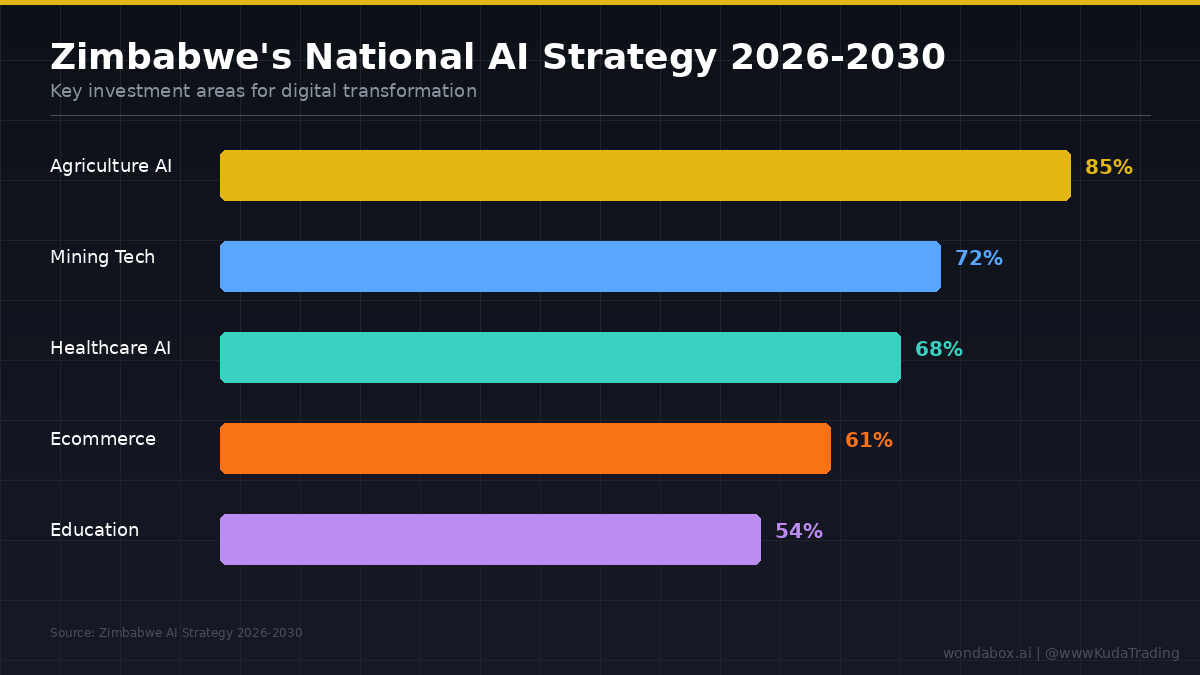
Zimbabwe just dropped a National AI Strategy for 2026-2030.Agriculture. Mining. Healthcare. Ecommerce. Education.While the West debates regulation, Africa is building.This is why I built wondabox.aiWho's paying attention?
@PempheroMphande How does having a maid = racism. I have observed thst black maids are often treated better by white people for the very reason thst they don't want to appear like they are enslaving them. I don't think this picture supports your argument







![wwwKudaTrading's tweet photo. Meta just rewrote the rules for WhatsApp Business. And it quietly validated the design decision we made at Wondabox from the first week we started building.
In January, Meta changed its WhatsApp Business API terms. The headline: general-purpose chatbots — the ones designed to replicate the WhatsApp experience itself, handle small talk, play the part of a digital friend — are no longer allowed on the platform.
At first this looked like a cleanup move. In practice, it is a reclassification of what WhatsApp is for. WhatsApp is a commerce channel, not a chat toy. Meta is protecting the funnel. They want businesses on the platform moving customers through a decision — an order, a booking, a support resolution — not hosting open-ended conversation loops that decay engagement over time.
A lot of chatbot builders spent the last three years treating WhatsApp as an AI playground. They built personas. They built characters. They built "talk to your brand" experiences. Most of that is now non-compliant.
When we started building Wondabox, we had a choice. We could build a general conversation agent — the kind VCs were falling over themselves to fund in 2023 — or we could build something narrower: an AI agent whose only job was to move a customer from "interested" to "paid and delivered."
We chose narrow. Not because it was cooler. Because we had just come off scaling Daily Sale [one of Zimbabwe's largest e-commerce businesses], and we knew exactly where the money was being lost.
It was not in the chat. It was in the handoff between chat and order.
So Wondabox was built around four specific jobs: reply to a product inquiry, answer the common objection, capture the order with the right fields (name, product, location, delivery preference), and follow up when the customer goes quiet. That was it. No personality. No chit-chat. No pretending to be a human friend.
That narrow scope turned out to matter more than we realised at the time.
When the policy change landed in January, the 190+ active merchants running their sales through Wondabox did not have to rebuild anything. The design already matched where Meta was heading. We were not replicating the WhatsApp experience. We were extending it — turning a conversation into a transaction.
The broader lesson here is not really about WhatsApp. And it is not even about AI.
It is about platform risk.
Every founder building on somebody else's infrastructure — WhatsApp, Instagram, Shopify, TikTok, a payment rail, an API — is one policy update away from a rebuild. The question is not whether the platform will change the rules. It will. The question is whether your product was designed around the platform's marketing promise or around the platform's actual business model.
Meta does not make money from users who chat. Meta makes money from businesses that transact. If you built for the first, the policy shifts eventually hurt you. If you built for the second, the policy shifts usually strengthen your moat.
That applies far beyond WhatsApp.
The Shopify app ecosystem re-sorts every two years based on what Shopify decides it wants merchants doing. The Google Play store rules evolve around what Google can monetise. The AI model providers are going to keep changing their terms of service as their business models mature.
The operators who survive those shifts are the ones who ask a boring question early: what is this platform actually for, in the eyes of the company that runs it? Then they build on that answer — not on the marketing pitch.
Most builders skip this question because it is less exciting. The pitch is: "build whatever you dream." The reality is: "build within the shape of what the platform is willing to pay to protect."
For African SMEs especially, this matters. You do not have the capital to rebuild a product every 18 months because a policy changed in California. Your design choices need to hold up under five policy shifts, not one.
Now, the counterpoint, because I've thought about it.
Narrow design is not always the right answer. If a platform is early and still figuring out its model, narrow can lock you out of categories that later become huge. We got lucky in one sense: WhatsApp's intent was clear from the start. It was always a commerce-adjacent channel, never a social network in the Facebook sense. So designing around commerce was not a gamble — it was a reading of where the owner wanted the platform to go.
But when the platform's business model is obvious, designing around it is not playing it safe. It is playing it smart.
Here is the question I want to leave you with:
If the platform you are building on changed its rules tomorrow, would your product still have a reason to exist?
That is the question we are asking every sprint now.
#BuildInPublic #AfricaTech](https://pbs.twimg.com/media/HGDA6OPX0AAyD7m.jpg)