True for thin wrappers. But for a lot of AI startups the harness is the product, with domain evals, fine-tuned small models, caching and routing to drive down cost per task. I think it ends up as our agents talking to theirs over A2A, not calling their tools over MCP
I came to the conclusion that most SaaS should become an MCP server.
we’re getting the economics of AI software backwards. A lot of AI startups are building their own chat interfaces, agents, and workflows, essentially reselling tokens from the big labs at low to negative gross margins.
What if SaaS companies did the opposite?
Take HR software. Instead of building an AI assistant, become the best MCP server for HR. Expose tools to:
- Benchmark salaries against proprietary market data
- Run compensation reviews and calculate pay equity
- Model salary increases against a department’s budget
- Recommend promotions based on company policies
- Update employee compensation in the HRIS
- Manage approvals, permissions, and audit trails
Let ChatGPT, Claude, or Copilot handle the conversation, reasoning, and orchestration. Let the customer pay for the tokens.
The SaaS company keeps the valuable stuff: proprietary data, integrations, business logic, permissions, compliance, and the system of record.
You still charge a SaaS subscription, but you’re no longer paying to generate every answer. You can ship faster, with fewer engineers, and potentially restore software-like gross margins.
The next generation of SaaS might not have much of a UI at all. Just an incredibly good MCP server.
Weird phases we’re in, 1:
Agents are making it easier than ever to create beautiful, interactive UIs. Yet we’re moving toward a future where software may become increasingly headless, with users interacting with their agents instead.
The question is how long this transition phase will last, and whether software companies should continue investing in building their own UIs.
The part that excites me most is where this points. A laptop can now do real speech and language work, and fine-tuning small models keeps getting easier. I think a lot of software is heading toward models each person tunes to themselves, on their own machine.
I could have built a whole new inventory app. But working with clients has taught me that people don’t want a new tool. They want the one they already use to get easier. So Vialog just edits the spreadsheet she already has.
Built Wispr Flow for lab inventory.
I was talking to a friend who works in a lab, and she told me she updates the freezer spreadsheet by hand all day. Gloves off, walk to the laptop, type, gloves back on. So now you just say “moved the HeLa vial to rack 3” and Excel changes. All local.
Sounds like a fun role. I remember Grant Lee's episode on Lenny's podcast, where he shared how he was very intentional about sourcing the right creators, talking to them one-on-one, and explaining Gamma to them. It's like building a relationship with them and treating them like your users – ideally, they should be actual users who genuinely love using your product.
Great talk by Lee, especially relevant for anyone building harnesses or always-on agents like Grok Bot.
Key takeaways for me:
- Delegate to subagents for anything that could bloat the main agent's context window, whether that's parsing videos, facilitating computer use, or executing shell tools. While I've considered subagents for basic workflows like exploring files, I hadn't thought to use them for shell commands. However, for always-on agents, protecting the main agent's context window is essential.
- Pre-warm the prompt cache when users open the chat or start typing. This is key to ensuring the agent responds quickly to the first message after a long break. This concept can also be extended to pre-warming the VM.
- Summarize chats after a period of inactivity while the cache is still warm. Note: My own inference suggests this achieves two things: 1) It prevents a costly cache miss upon the user's return, and 2) It keeps the context bounded, minimizing the chance of an agent compacting during an active turn and potentially improving the execution quality of the next task since it's outside of the 'dumb zone'
How do always-on, proactive agents like @Bot work?
Watch my lecture at Stanford CS146S:
2:35 How we got here
6:13 What changed in the models
10:06 Inside an always-on agent
18:07 The harness
27:26 Context engineering
34:26 Where this is going
I think one of the biggest advantages you can give yourself today is using AI to dramatically accelerate your rate of learning.
That means not just learning how to learn effectively (spaced repetition, active recall, etc.), but also treating AI as a personal tutor.
For example, if you’re listening to a podcast and someone brings up a concept you’re unfamiliar with, pause and talk it through with AI. Ask questions, challenge your understanding, and go down rabbit holes.
It’s like having unlimited office hours with a professor who’s always available, infinitely patient, and willing to explain anything at your level
Went to a networking event and met a bunch of folks who then introduced instinct to a medical student. The student was mind blown and really loved the fact that instinct is on iMessage. As someone who’s used OpenClaw and GrokBot, instinct seemed just like another personal AI assistant. But to someone outside of tech, it’s such a delightful experience - seamless onboarding and instant aha moment (the student asked for nearby restaurant recommendations and instinct replied fast + the messages were broken up into scannable chunks). Now I understand why they are growing 10% every day without any marketing spend. I will remember that student’s reaction and it shall be the benchmark for apps I build.
I find it interesting that Cursor and Claude are converging on Cloud projects. It makes a lot of sense. The way the orchestrator chat is set up between the two is different though. In Claude, the orchestrator’s environment is constrained to protect its context as much as possible. It does not have shell access and can’t read files directly. It can only read via a helper agent or worker thread.
Been seeing posts about https://t.co/GEpzGstPML on my timeline, so I checked it out. It's clear the chat was built with accessibility in mind. What I really like though, is the chat send animation. The bubble moves from the composer into the thread as the transcript scrolls up with it. That spatial continuity feels really nice. Similar to iMessage. Here's a side-by-side with ChatGPT. @shadcn could this be an opt-in prop on the new chat components?
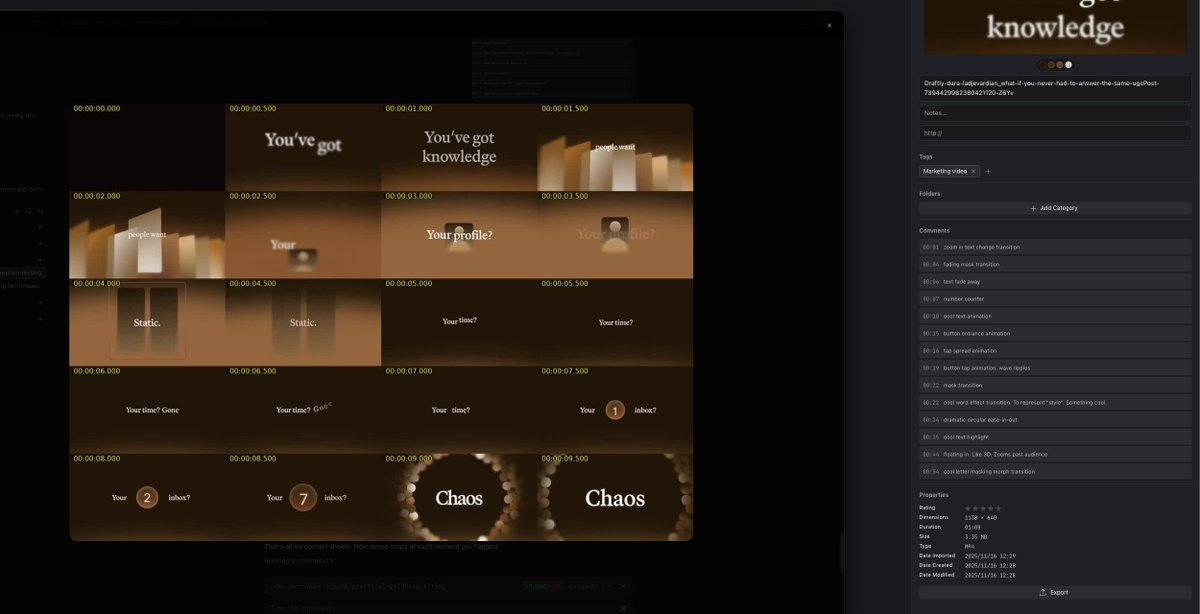
Getting Opus 5.5 to study some of the SaaS promo videos I've bookmarked and annotated. Curious to see if it can create equally tasteful videos. I'm confident it can, given the human judgement + taste (in this case communicated through annotations)
So I just discovered Claude now has a feature that's like ChatGPT sites, but better. Why is no one talking about this?
I created a hosted artifact/page that shows me what my agents are shipping and what needs my attention. This isn't a new idea; people have built local apps like this before. But the cool part is that the page is hosted, and you can pull it up directly from the Claude mobile app or https://t.co/yeFzuDYZiV, which means I can monitor my agents on the go. The comment feature is also really neat for triggering the Claude chat directly. You can create inbox-style apps where you leave notes and have the agent respond to them directly.
Shall play more with the design artifact next (Claude's Figma-style canvas). I've already used it for design and it's amazing, but I want to try it for research, with my agents building HTML explainers, diagrams and animations right on the canvas
Early prototype of a site for browsing soul.md files for personal AI agents
I thought it’d be cool to give personal AI agents MBTI personalities, but LLMs don’t seem to follow MBTI traits particularly well. More importantly though, I’m not sure we actually want an AI assistant to inherit all the tendencies that come with a human personality type
What seems more useful is just defining how it interacts with you: whether it’s warm or direct, how it gives advice, its energy, tone, humor, how proactive it is, etc
Shall redesign the site around configuring those traits