@TGE_LDNM Despite what the populists may think, Australia, and in particular Sydney and Melbourne, are two of the best places to live in the world. No competition for the quality of life
1/ $QNT was never a bet on crypto adoption in the usual sense.
It was a bet on what happens after institutions adopt DLT.
When institutions build their own ledgers, the scarce layer is not another chain.
It is the neutral standard connecting them.
A decade in the making, we have published an ISO standard for blockchain interoperability.
This is a milestone I've been working towards since 2015, Remitt was founded with the conviction that blockchains could transform financial services but only if the industry solved interoperability and harmonised around global standards. Without that, blockchain would remain fragmented, siloed, and locked out of mainstream institutional adoption.
In April 2016, we published what was the world's first proposal for a blockchain standard (https://t.co/SL83Yl4Ejr) a bold move at a time when the industry was still largely focused on proofs of concept and competing protocol narratives, not standardisation.
The idea was simple but ambitious: if blockchains were going to serve global markets, they needed a common framework that transcended any single protocol or vendor.
Central to this thinking from the very beginning was the concept of a multi-gateway architecture, leveraging the know-how of 20 years of experience in cybersecurity to frame the principle that interoperability shouldn't depend on a single bridge or point-to-point connection, but on a layered gateway model that could abstract away the differences between underlying DLTs and connect them through a common interface. This was the architectural foundation of what would become Overledger, and it was also the design philosophy we brought to the standards process.
The belief was that a viable international standard for blockchain interoperability had to be protocol-agnostic and gateway-driven, enabling any DLT to communicate with any other DLT (any-to-any) and with existing networks, without requiring those ledgers to change how they operate. The standard and the technology were born from the same insight.
That same year, I worked closely with the team from @standardsaus (Standards Australia), who had the foresight in 2015 to champion the initiative at the international level. Together, we pushed for ISO to establish a dedicated Technical Committee for blockchain and not to be absorbed into an existing committee, but to stand on its own as a recognition that this technology warranted its own global standards programme. The industry demand was there, the use cases were multiplying, and the fragmentation was becoming a real barrier.
In September 2016, the New Work Item Proposal (NWIP) received global approval, and ISO formally gave the green light to establish a new Technical Committee (https://t.co/7biJjvHRk9). TC 307 — Blockchain and Electronic Distributed Ledger Technologies — was born (https://t.co/5SsFPIw0HH). The inaugural meeting was held in Sydney in April 2017, and from that moment the real work began.
As the standards work progressed internationally, the mission at Remitt was evolving too. What started as an effort to use blockchains for financial services and solve interoperability grew into something far larger, a full enterprise infrastructure platform for connecting any blockchain to any network. Remitt became Quant, and we built Overledger, the world's first blockchain operating system to deliver on that original vision. The multi-gateway architecture that informed the standards thinking became the core of Overledger's design: a technology layer that sits above all blockchains, providing institutions with a single integration point to access any DLT, any network, and any existing system. The interoperability challenge that drove the standards work was the same challenge we set out to solve commercially and the two efforts reinforced each other throughout.
For close to a decade since TC 307's formation, subject matter experts across the world have contributed their time and expertise to Working Group 7 — Interoperability is the committee I chair.
International standards are not built quickly they are built through consensus, technical debate, and relentless refinement. The same methodology and rigour that created the Internet, through publishing standards. The result is a published international standard for blockchain interoperability.
🔗 https://t.co/GRoR7fXNLQ
A huge thank you to @isostandards as the international standards developing organisation, to the team at @standardsaus who started the initiative in 2015 and worked tirelessly to get TC 307 approved and established globally, and to every subject matter expert who contributed to Working Group 7 over the years. This would not exist without that collective effort.
From a blog post proposing the world's first blockchain standard in 2016, to a published ISO standard in 2026 and from Remitt to Quant, from an architectural concept of multi-gateway interoperability to Overledger and a global standard, this has been a decade-long journey of building both the standards and the technology to make blockchain interoperability a reality for institutions worldwide.
There is still much more work ahead. More standards to develop, more to evolve, and more to build. But today, we mark a significant milestone.
#Blockchain #ISO #Interoperability #Standards #TC307 #DLT #Quant #Overledger
The best thing exchanges could do is delist all but 100 tokens, make it competitive to stay listed on the exchange and stop dividing the melting ice cube of retail capital across thousands of worthless assets.
It’s no secret at this point that Quant uses Coinbase custody for its treasury and token lockups🔒
The real question: How much QNT is truly locked or under treasury control?
On-chain data can’t give an exact number but it shows the bigger picture. 🧵👇
cheqd is busy getting ready for next year. Oracle launch on the horizon, and major steps forward on the agent side.
Network traffic is growing exponentially, momentum is strong, and doors are opening with names like GSMA, Telefónica, JP Morgan and Barclays.📈
cheqd is busy getting ready for next year. Oracle launch on the horizon, and major steps forward on the agent side.
Network traffic is growing exponentially, momentum is strong, and doors are opening with names like GSMA, Telefónica, JP Morgan and Barclays.📈
📞Call centres are a key support channel, but authenticating customers over the phone is slow and vulnerable to fraud. The recent Proof of Concept from @GSMA Foundry, @TelefonicaTech, @tmtid_limited and @dock_labs demonstrates a better way.
https://t.co/uffFNYgplP
Quant Network: The Next Apple ?
Apple won by making the complex simple. $QNT
Blockchain will enter everyone’s life only through those who manage to do the same…
It may sound almost obvious, but it's always been this way:
The technology that changes everything isn’t the one that makes the most noise.
It’s the one that removes noise.
And if you look closely, this really seems like one of those stories.....
Enjoy the read
https://t.co/TpOmJgYETi
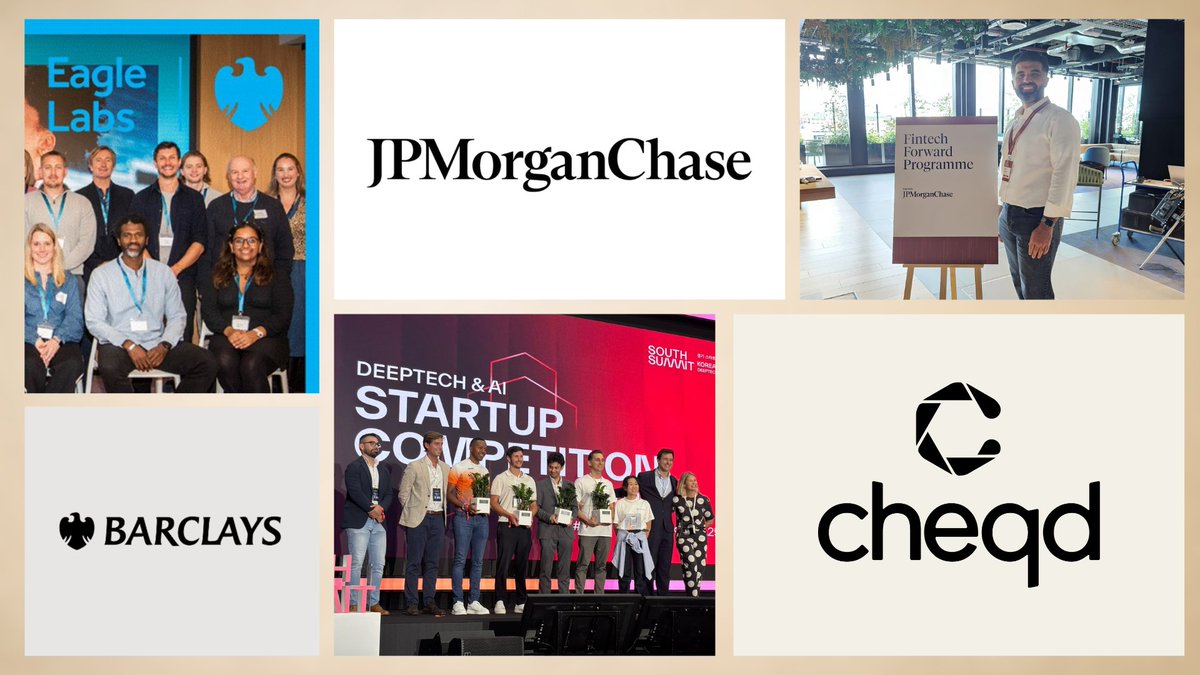
The past few months in $CHEQ land..
🟠 @jpmorgan asked $CHEQ to participate in their Fintech Forward Programme
🟠 Selected to join the @Barclays Eagle Labs Scaleup Programme
🟠 Won the "Most Scalable Award" at South Summit Korea 2025 competition
🟠 Mentioned by @Deloitte as a top reusable decentralized identity management solution
🟠 Proposal to decrease $CHEQ inflation has now passed
This has early $1 $QNT vibes all over it..
$CHEQ
After @Sibos, it's become more clear how Quant Network is on the rise, working with multiple international banks, including the European Central Bank, on use cases that will soon become mainstream.
$QNT