Rujira is becoming the fee machine across all major networks (BTC, XRP, BCH, LTC, XMR, ZEC, etc) that $RUJI stakers have patiently been waiting for and anticipating for years
A new month, you know what that means.
Giving away three 50k account size @breakoutprop evaluations.
To be entered, like, share, and leave a comment. Winner's picked on the 13th.
You can use the code HORSE to get a discount and then keep the change. 😎
Historic day for Polkadot.
In its new crypto assets interpretation (Rel. Nos. 33‑11412 / 34‑105020), the SEC classifies DOT as a “digital commodity” and, under that framework, does not treat DOT itself as a security under the federal securities laws. DOT now appears alongside BTC, ETH, and other digital commodities.
A major step for regulatory clarity around DOT.
@TheWeb3Cloud Been direct staking for the last 5 years, the available UI have come along way to make it easier than ever! Shout out to @NovaWalletApp although I do miss the OG .js
Polkadot just did its first-ever halving, capped supply at 2.1 billion, and the market barely noticed.
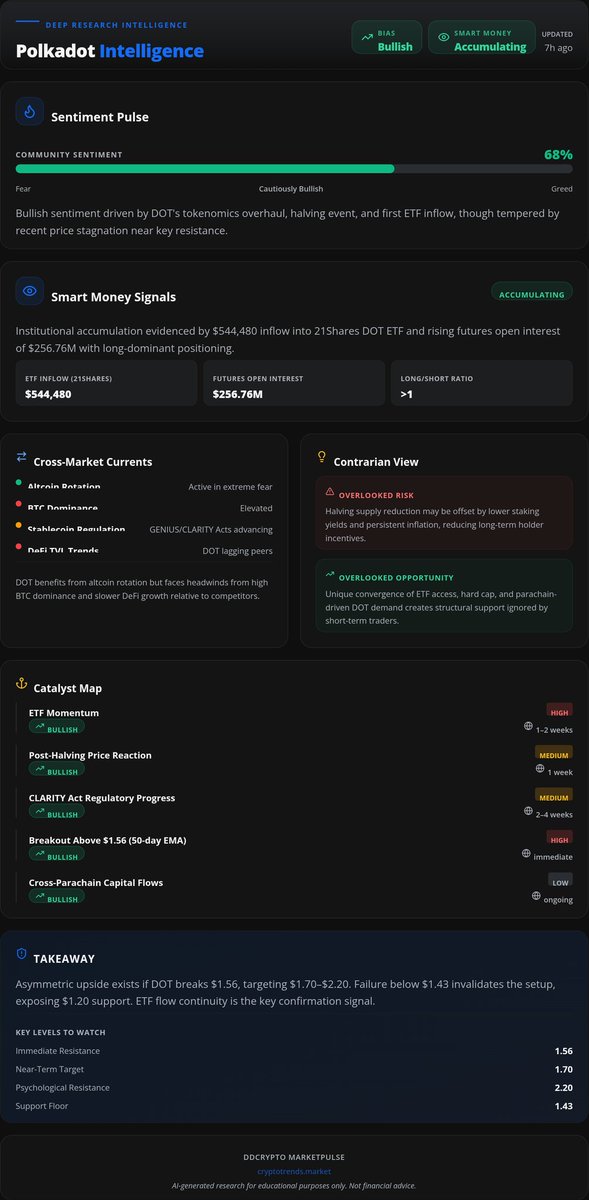
Polkadot's tokenomics overhaul went live on Pi Day (March 14), slashing emissions by 53% and introducing a hard cap of 2.1 billion $DOT. The price surged 12% today, trading volume is up 304% month-over-month, and the first U.S. spot DOT ETF $TDOT launched on Nasdaq just 10 days ago. Social dominance spiked 146% week-over-week, yet DOT sits 97% below its all-time high. This is a structural repricing event flying under most people's radar.
AltRank: #6 (up from #109 one month ago)
24h price change: +13.5%
Trading volume: $415M (up 304% from prior month)
Emissions cut from 120M DOT/year to 55M DOT/year
Social dominance: +146.87% week-over-week
21Shares $TDOT ETF saw $544K in first-week inflows
If you're staking DOT and not compounding your rewards, you're leaving returns on the table.
Polkadot pays out every era (~24 hours). That's 365 chances a year to grow your stake automatically.
Is your reward destination set to Compound? Check at https://t.co/RXV480eKoI
Polkadot JAM is a major upgrade planned for the @Polkadot ( $DOT) ecosystem.
JAM stands for Join-Accumulate Machine, it is designed to replace the current relay chain and act as a new execution layer for the network.
The goal is to make Polkadot more flexible and able to run many different types of applications.
With JAM, developers will be able to build systems for DeFi, AI services, games, and virtual worlds, all running on the same shared infrastructure.
The design focuses on scalability, interoperability, and trustless security.
Promotional materials around JAM often highlight very high performance targets, sometimes mentioning up to 1,000,000 transactions per second (TPS), showing the ambition to support large-scale Web3 applications in the future.
In simple terms, JAM is intended to turn Polkadot into a general-purpose computing layer for Web3, where different types of decentralized applications can run together on one network.
Is this an economic response to Polkadot’s new economic shift?
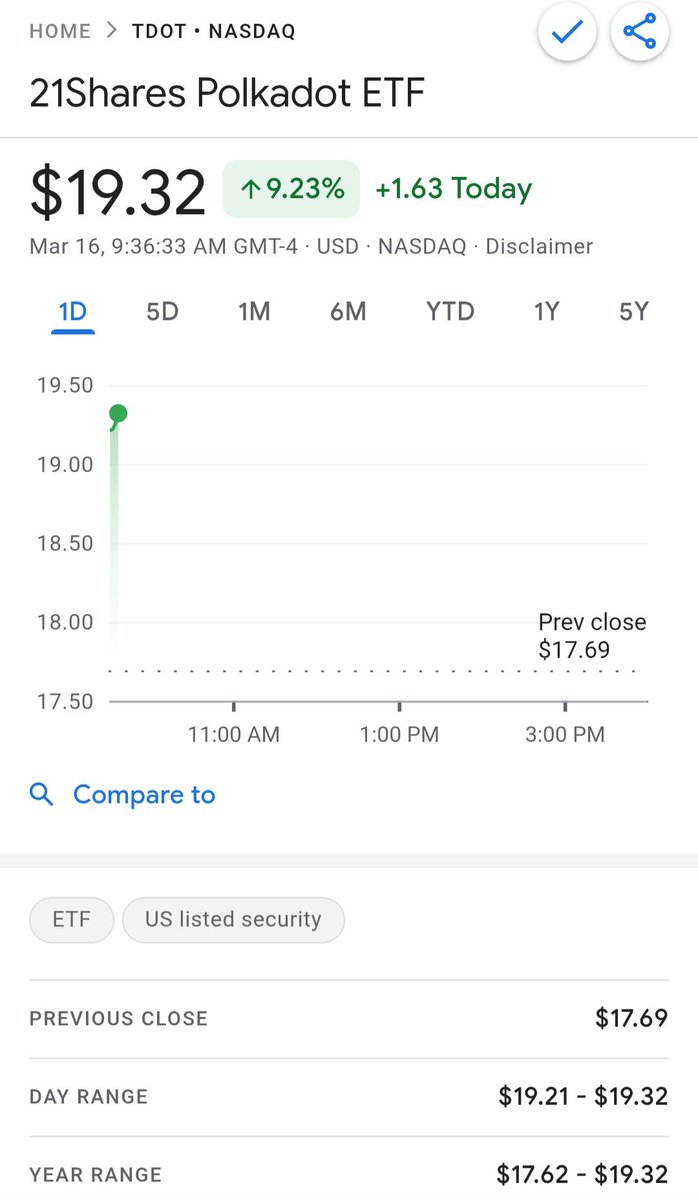
The 21Shares Polkadot ETF ($TDOT) on Nasdaq is trading around $19.32, up 9.23% from the previous close of $17.69.
On its own, the number means little.
But the timing raises an interesting question.
Polkadot has just entered one of the most significant economic transitions in its history.
Issuance has been reduced by 53.6%, introducing stronger supply discipline and a defined long term 2.1B DOT cap.
Validator participation is also becoming more capital intensive, while staking mechanics are evolving to reduce risk and improve liquidity for nominators.
In other words, the protocol is actively reshaping how value moves through the network.
At the same time, traditional markets now have direct exposure to that system through a Nasdaq listed ETF backed by real DOT.
So the question becomes:
Are traditional markets beginning to respond to Polkadot’s evolving economic design?
Or is this simply early market noise?
Time will answer that.
$DOT
In the quoted post @__dakine highlighted market activity around the @Polkadot ( $DOT) ecosystem using data from the @21shares_us Polkadot ETF ( $TDOT).
The screenshot shows $TDOT trading at about $19.32, up 9.23% (+$1.63) during the day.
The daily-based chart displays a sharp jump from the previous close of around $17.69, rising quickly after the market opened.
This kind of move is often described as a upward price jump, where the price opens significantly higher than the previous close.
The launch of the $TDOT ETF by 21Shares on Nasdaq provides a regulated way for traditional investors to gain exposure to Polkadot without holding the token directly.
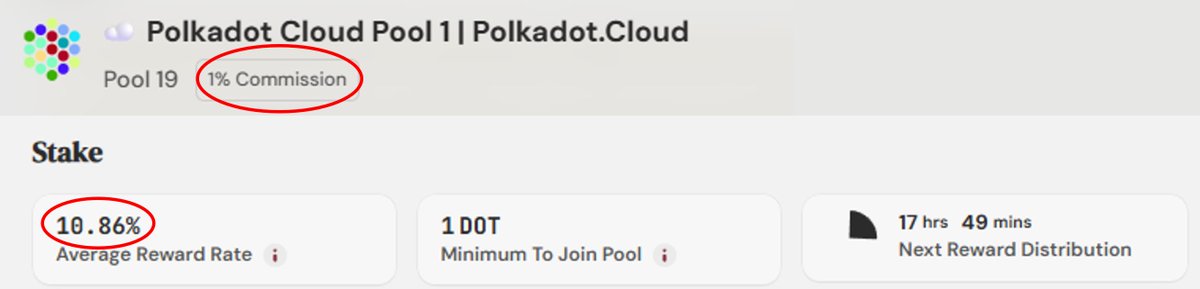
$DOT | With post-Polkadot halving and ETF approval: Staking remains incredibly attractive💎
@Polkadot staking:
🔹 10% Staking Rewards
🔹 1% Commission
Can you name a single "real-world" financial product offering this kind of yield with such low fees?
#Web3 is a technology that is bringing massive innovation to sectors such as finance
JAM transforms @Polkadot from a blockchain into something far bigger - a global decentralized computer.
Not just blocks and transactions, but a permissionless environment where any computation can run on shared, secure infrastructure.
That’s a fundamental shift for Web3. ⚙️🌐
#Polkadot #JAM #Web3
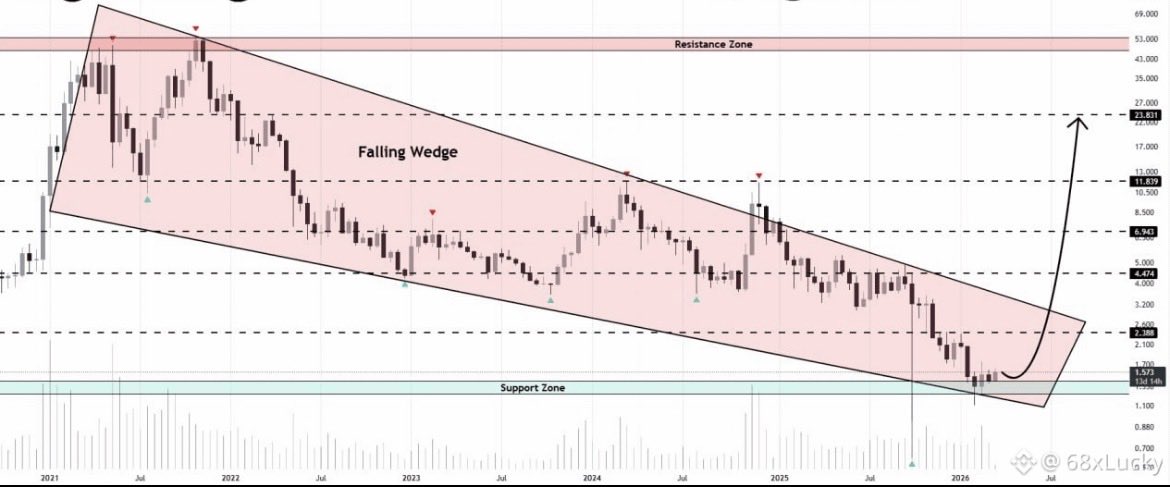
$DOT is $1.50. Down 97% from its all-time high. And I'm more bullish on Polkadot than I've been in years.
Before you call it copium, hear me out. Because I'm not going to pretend the path here was clean.
I've followed Gavin Wood dev trajectory since 2016. Not the token. The person. What I've learned is you don't bet on roadmaps. You bet on people who ship things the market doesn't understand yet.
Gavin wrote Solidity. Then decided it wasn't good enough and built Substrate. Then decided Substrate wasn't the endgame and designed JAM. Every time, the industry caught up 3-5 years later and called it innovation. The problem was never the tech. It was that Polkadot built a supercomputer and handed people a command line.
And then OpenGov made it worse.
In 2022 the treasury spent $13 million. In 2023 that tripled to $33 million. In 2024 it exploded to $133 million. A 10x increase in two years. Nearly half went to marketing and outreach. Sports sponsorships. Influencer deals. Motorsport wraps. Esports proposals. Airport billboards. Millions on ads that produced no measurable adoption.
All approved by token holders with no marketing expertise, no framework, and no strategy. OpenGov became an open bar.
Ecosystem revenue dropped 57%. The treasury's main account broke below $100 million. Major project founders publicly denounced the ecosystem. And every dollar spent required liquidating DOT on the open market... creating the exact sell pressure that was destroying the token.
$133 million in annual spending. $112 in daily network fees. Let that sink in.
OpenGov proved that a DAO with a quarter-billion-dollar war chest and no strategy is worse than a startup with $5 million and a plan.
So why am I bullish?
Because the people who actually know what they're doing took the wheel back.
Gavin came back as CEO of Parity in August 2025. Not to write another whitepaper. To build products. The spending era of sports kits and car wraps is over. The community started rejecting bloated proposals. Whales woke up. Marketing bounty refills got voted down.
The tokenomics got a hard reset. Supply capped at 2.1 billion forever. Emissions cut 53.6%. Unbonding dropping from 28 days to 24 hours. That's not a narrative. That's a structural reduction in the sell pressure that helped bleed DOT from $55 to $1.50.
But supply fixes don't matter without demand. Parity is now building the Polkadot App. A native stablecoin. And Proof of Personhood...not the Worldcoin "scan your eyeball for a corporation" version. Contextual aliases using zero-knowledge cryptography. Every app sees a different unlinkable identity. No KYC. No biometrics. Three years of R&D shipped into the protocol itself.
If you don't think that matters you haven't looked at how broken airdrops, governance, and onboarding still are across every chain.
Here's what's different now versus a year ago. The treasury firehose is off. The inflation bleed is cut in half. The founder is back running the company. And for the first time Parity is building things end users will actually touch.
DOT at $1.50 prices in a dead chain. I'm betting it's a market that hasn't noticed the adults came back to the room.
Bet on people.