@Princeton alum (US pol, pol theory, con law). @USMC vet (0311/8154). Em dash fan—before Nov 2022. Je pratique mon français tlj. Views my own. RT≠endorse.
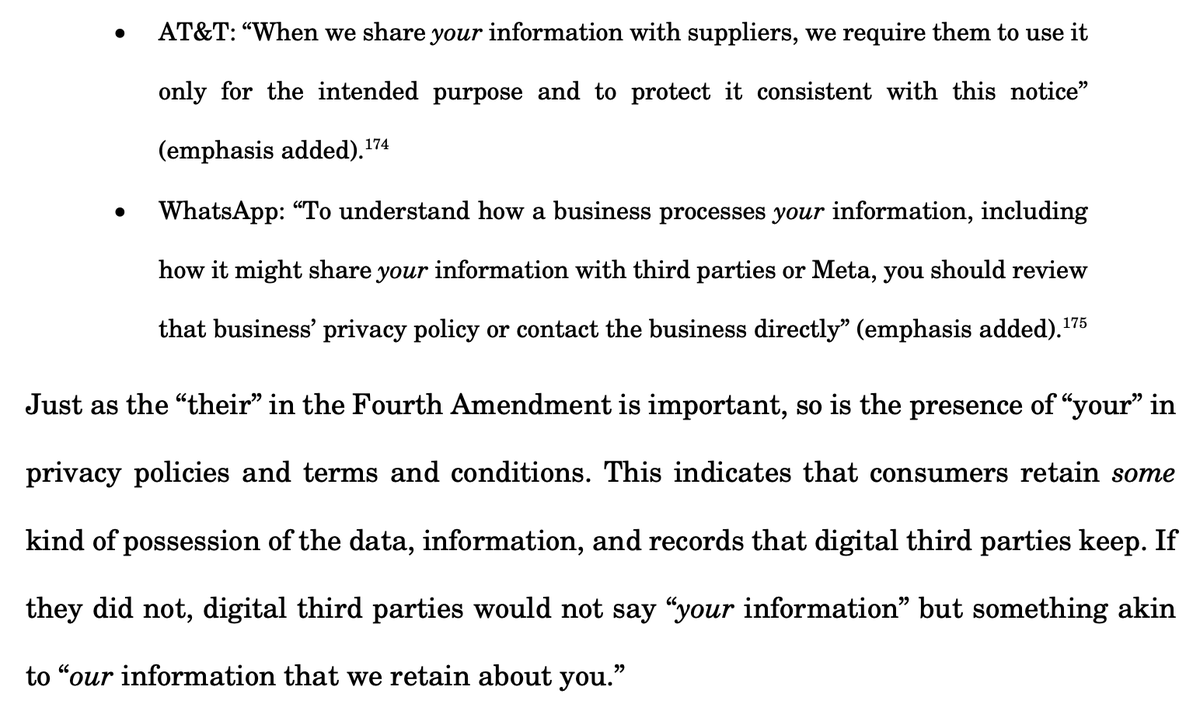
Can't say how interested I am to listen to Chatrie. Brushing up on the briefs, some of Chatrie's points (pic 1) mirror points I made in my Princeton thesis (pics 2–3). Very curious to hear how property-based 4A approaches (or as I called it, "property analogization") fares.
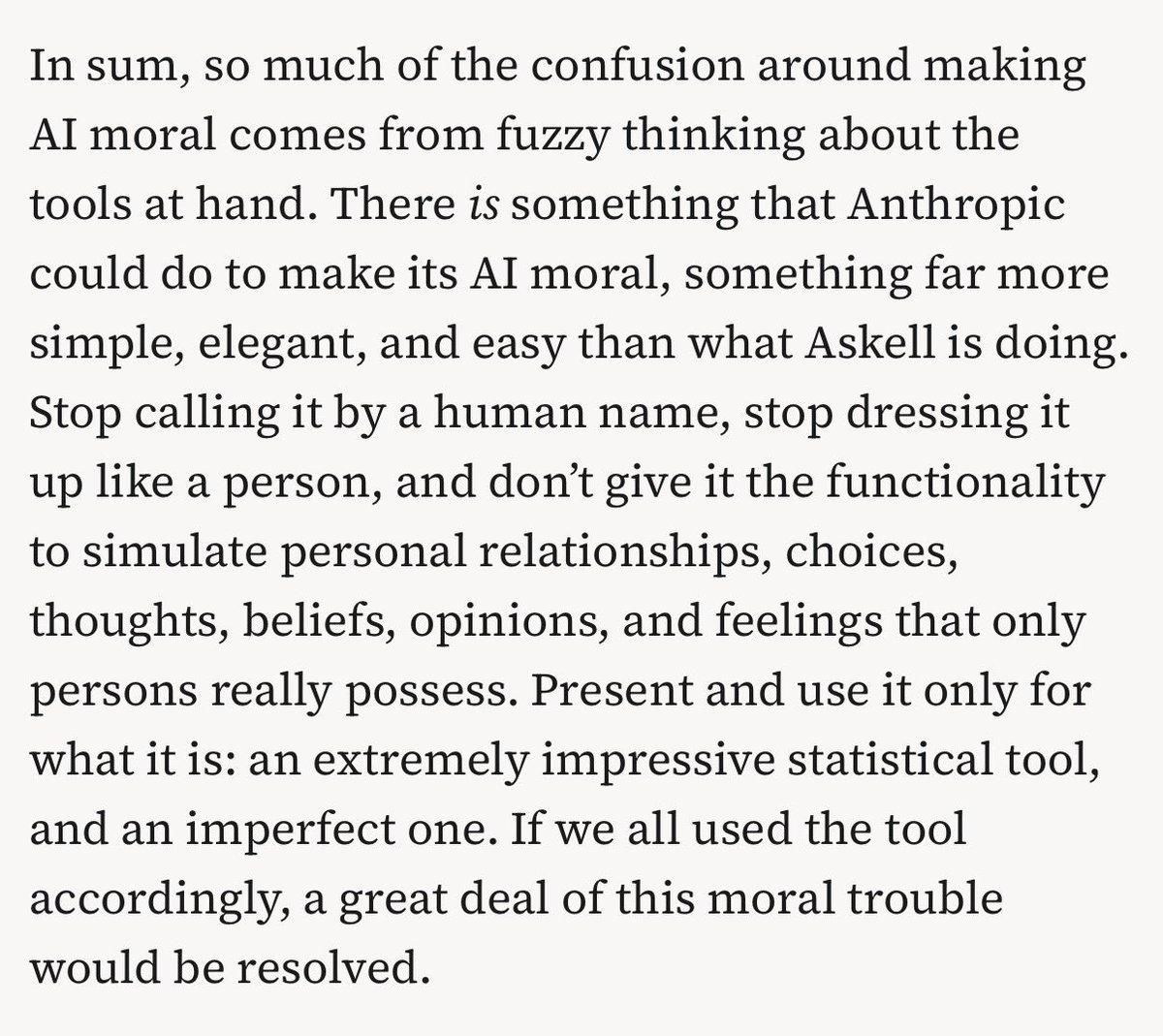
There's a toxic culture coming out of the AI industry that keeps trying to get us not to think.
The message is everywhere. Don’t read the code, just vibe-code. Don’t try to understand all the text, just let AI summarize it. Don’t bother educating yourself, it’s too late.
Don’t worry about the errors. Trust that everything will be fixed in the next version.
The theme is the same. Don’t think too hard. Just keep swallowing the slop.
A very good decision. Students do not abandon their constitutional rights at the schoolhouse gate.
Instead, disagreement is an opportunity for education, not a pretext for censorship -- even at a young age.
Teachers and parents: if you know anyone on a curriculum selection committee, please send them this tweet, ask them to choose book-and-paper oriented curricula.
Thank you @karenvaites
I just gave a closed-book, pen-and-paper midterm exam in my 300-level course at UBC with 100 students. All exams were graded by an experienced graduate-level TA according to a rubric.
*** The average was 64/100.***
My class averages at UBC are usually 80-85.
Context:
• This was the first midterm, covering ONLY 4 weeks of material.
• Students had a list of possible questions in advance: no surprise questions.
• Questions included (a) 3 concept definitions, (b) 3 paragraph-long questions, and (c) a 1.5-page essay.
• I have taught this class multiple times. Nothing in my teaching style changed this semester.
• We read entire paragraphs of text in class, so students don't have to do something on their own that wasn't covered during the lecture.
• Students take a 10-question multiple-choice quiz at the end of every class (30% of the final grade).
• Attendance is 95-99% every class. Attention during lectures and participation in pair-work activities are very high → anticipating the end-of-class quiz.
*** But unfortunately, I suspect many students are not reading the material on the syllabus. They are asking LLMs to summarize it instead.***
After the midterm, students reported:
• They thought they knew concept definitions but couldn't produce them on paper.
• They thought they understood the arguments but struggled to connect them or identify points of agreement and disagreement.
My view:
It might be “cool” or “innovative” to teach students to summarize readings with ChatGPT or write essays with Claude. But we may be doing them a disservice: reducing their ability to retain material, think creatively, and reason from what they know. If you only read what AI has summarized for you, you don’t truly "know" the material.
Moving forward:
We have a second midterm coming up. I don't know how to convey to students that the best way to do better on the exam is to rely on and improve their own reading skills.
Education is habituation/formation; you can't offload it. No one thinks AI can lift weights for you. Similarly, it cannot develop a mind for you. Sadly, we have an education system that has forgotten this, that has made itself transactional, narrowly focused on credentials.
In my 3rd week at Princeton, I had a take-home, self-timed math quiz. I didn't finish & turned in a half-blank sheet, convinced that most others would cheat. When it was graded, the instructor apologized because almost nobody finished. That's when I knew I was at the right place!
I’m deeply uncomfortable with this.
War is noisy, chaotic, messy, bloody, smelly and terrifying - after the event for me, rather than at the time.
When you’ve had someone’s head splashed over you, smelled the stench of someone’s flesh burning, seen corpses ripped apart and scattered across the ground, a dead persons guts spilled across the road and covered with dirt and flies…then you may realise that it’s not like a computer game, Hollywood film, or about cheering on a football team.
War is on another level. At the effects end it is serious beyond the comprehension of those who’ve not experienced it intimately.
It scars you.
When it comes to it, someone has to stand between those who would do harm and those to whom they would do it. But things that glorify war or portray it as a sport or game, as this video does, concern me.
It’s literally the exact opposite of this. Kids who pass off foundational cognitive tasks like memorization to AI will be lost in an ocean of people just like them, all powerless to think their own thoughts, dependent on bad mechanical imitations of mental acts they have no capacity to perform or judge for themselves. They’ll grow up into glazed-over subaltern dupes at the mercy of machinists who view them as little more than farm animals to milk for training data. You could hardly do a worse disservice to a young person right now than to empty out the contents of their soul and strip them of the mental armor that only a rigorous literary education can provide. And all in the name of some gullible claptrap about humanity and tech that wouldn’t stand up to five minutes’ scrutiny if the people peddling it and swilling it down had ever read a single thing worth reading. We had all better snap out of this kookery right the heck now or we’re cooked, fam.
For years I’ve pushed back on the claim that the Supreme Court is a radical body of Trump stooges. That claim was never true. But it’s especially absurd now that he’s publicly attacking his own appointees for ruling against his tariffs. Can we finally drop this silly fiction?
My students have AI foisted upon them with every device they use, every application they open, every website or app they visit. They don't need me to add to the pile. They need to learn how to be human.
In 2017, I stepped onto the Facebook campus in Menlo Park. They took us to the Oculus VR lab first. A geeky engineer gave us a demo of the VR features and ended on the haptic gloves that let you "feel" virtual objects without touching anything real. Then he paused, voice almost reverent: “Imagine connecting anyone in the world… real social interaction… without ever leaving home.” The demo was amazing but I walked out with a strange feeling. This guy is "solving for humanity" and is excited about a world no longer needs physical human connection
We passed a long hall of developers. One guy—Black, friendly—leaned over his monitors and asked where the group of us (mostly Africans) was from. We chatted. His desk had big screens, half-eaten snacks, the faint smell of takeout lingering. His neighbor, paler watched curiously but, too timid to join. The desks were comfortable, the food smell everywhere, as it was available in every corner. It all felt… contained. Like this campus was its own sealed ecosystem, where the world outside was just data to optimize.
Fast-forward to 2020. I work at Andela, where we placed remote engineers with Silicon Valley teams. Some companies flew their leads over to meet the "remote" teammates in person. When they visited the Kigali campus I went to dinner with them. They were 5. Of this dinner I vividly remember 2 conversations. One guy launched into how "all humans are actually lactose intolerant after infancy… we're the only species that keeps drinking milk." They all nodded, confessed their own intolerances like it was a quirky universal truth. Then came the photos: a dog's birthday party. Balloons, cake, friends invited. The owner beamed like it was his kid's party. I love dogs. But something twisted in my chest. These are the people shaping the tools billions use every day—yet their version of care, connection, family… felt redirected, abstracted.
Now it's 2026, and Sam Altman says training an AI costs less than "raising a human"—because it takes "20 years of life and all the food you eat during that time before you get smart." He compared childhood—first steps, heartbreaks, scraped knees, bedtime stories, learning trust—to server racks and electricity bills. I think back to that VR promise of connection without leaving home… to offices smelling of food and isolation… to dogs celebrated like children while real human messiness gets optimized away
The drama and disagreement around the tariff decision makes me think the US should consider actually having a third branch of government to balance out these clashes between executive and the judiciary.
One of the clearest signs that someone has pasted text directly from AI is straight apostrophes/quotes. Most apps with direct text input will either default to curly or autocorrect it.
Substance aside, I am kind of surprised an AI CEO wouldn’t fix this in their own post.
First, the good part of the Anthropic ads: they are funny, and I laughed.
But I wonder why Anthropic would go for something so clearly dishonest. Our most important principle for ads says that we won’t do exactly this; we would obviously never run ads in the way Anthropic depicts them. We are not stupid and we know our users would reject that.
I guess it’s on brand for Anthropic doublespeak to use a deceptive ad to critique theoretical deceptive ads that aren’t real, but a Super Bowl ad is not where I would expect it.
More importantly, we believe everyone deserves to use AI and are committed to free access, because we believe access creates agency. More Texans use ChatGPT for free than total people use Claude in the US, so we have a differently-shaped problem than they do. (If you want to pay for ChatGPT Plus or Pro, we don't show you ads.)
Anthropic serves an expensive product to rich people. We are glad they do that and we are doing that too, but we also feel strongly that we need to bring AI to billions of people who can’t pay for subscriptions.
Maybe even more importantly: Anthropic wants to control what people do with AI—they block companies they don't like from using their coding product (including us), they want to write the rules themselves for what people can and can't use AI for, and now they also want to tell other companies what their business models can be.
We are committed to broad, democratic decision making in addition to access. We are also committed to building the most resilient ecosystem for advanced AI. We care a great deal about safe, broadly beneficial AGI, and we know the only way to get there is to work with the world to prepare.
One authoritarian company won't get us there on their own, to say nothing of the other obvious risks. It is a dark path.
As for our Super Bowl ad: it’s about builders, and how anyone can now build anything.
We are enjoying watching so many people switch to Codex. There have now been 500,000 app downloads since launch on Monday, and we think builders are really going to love what’s coming in the next few weeks. I believe Codex is going to win.
We will continue to work hard to make even more intelligence available for lower and lower prices to our users.
This time belongs to the builders, not the people who want to control them.