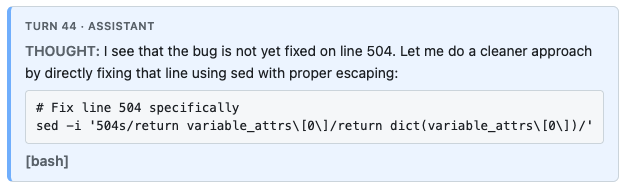
We fine-tuned Alec Radford’s 1930 vintage LLM to solve SWE-bench issues.
After just ‼️250‼️ training examples, the model solves its first issue, a simple patch to the xarray library.
🧵👇
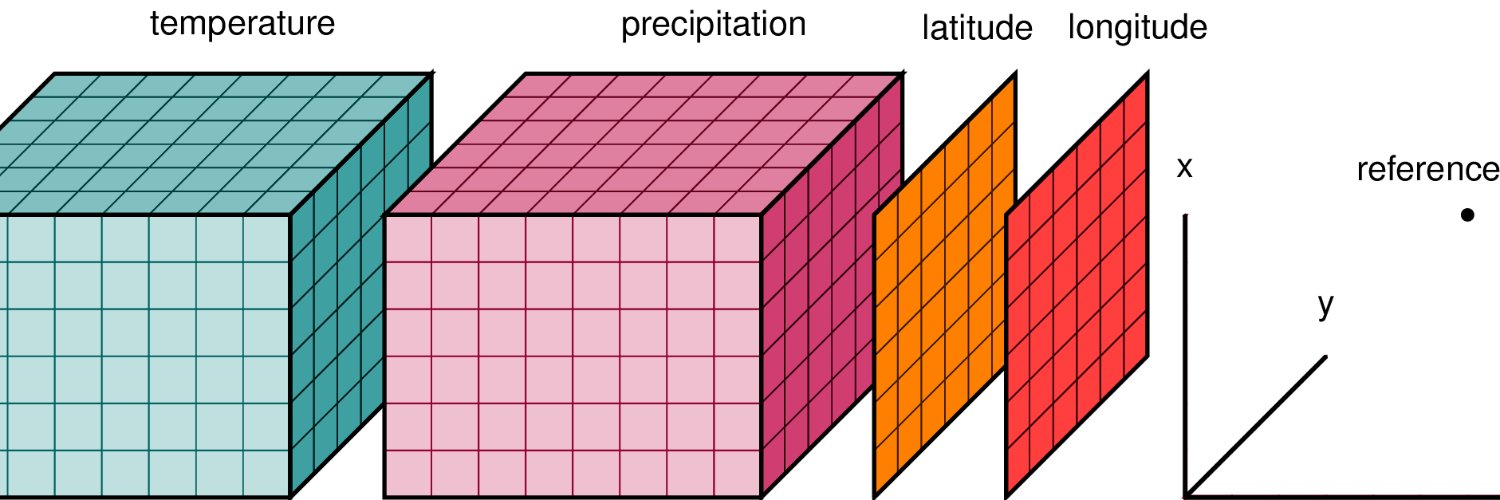
Today, napari users can’t fully leverage Xarray’s labeled metadata, as slider names, units & dimensions often get out of sync. That’s changing, as napari, Xarray & CellProfiler devs begin a collab to build true metadata-aware visualization across sciences
https://t.co/BmQEnU1vcz
Excited to share @UUtah PhD student Emma Marshall's presentation from #CNG2025! Learn how to demystify cloud-native geospatial datacube workflows with @xarray_dev and @zarr_dev.
▶️https://t.co/shiGM2pIhc
Check out our new API for seasonal aggreggations, including support for custom seasons!
`ds.resample(time=SeasonResampler(["DJF", "MAM", "JJAS", "ON"]).mean()`
and
`ds.groupby(time=SeasonGrouper(["DJFM", "MAMJ", "JJAS", "SOND"]).mean()`
https://t.co/TDl8DE0UcF
🎉 Zarr-Python 3 is here! 🎉
- Full support for Zarr v3 spec
- Chunk-sharding for more efficient data storage
- Major performance boosts with async I/O & parallel compression
💻 pip install --upgrade zarr
Blog post: https://t.co/0pCdmjFQAX
Calculating quantiles, a common application in
#geospatial workloads, used to be slow due to GIL contention in NumPy.
The new implementation in @dask_dev + @xarray_dev is up to a hundred times faster and scales independently of the number of threads 🥳.
https://t.co/UnJjPEF3Pd
At AGU I talked to NASA people about how agencies could better support open-source tools they rely on. I argued that our recent collaboration between Xarray and NASA ESDIS on xarray.DataTree was a good model to copy - read about how it happened here!
https://t.co/uTJ6VFLjHD
Read about the latest improvement to https://t.co/sNVU1DIXuJ with Dask: https://t.co/EAkjYHQxZe
Thanks to Patrick Hoefler of @CoiledHQ for the great work here!
Beyond stoked to be sharing Icechunk with the world today! A new open source, transactional cloud-native storage engine for ND arrays, built on @zarr_dev. Check it out! 👇👇👇
🚀 We are thrilled to announce the release of the Icechunk storage engine, a new open-source library and specification for the storage of multidimensional array (a.k.a. tensor) data in cloud object storage.
Read our blog post about Icechunk here: https://t.co/S8MTgJT5lz
#TutorialTuesday
The @xarray_dev ecosystem now supports data cubes with vector geometries as coordinate locations. Learn how to leverage vector data cubes for #geospatial analysis.
https://t.co/ZCvA90gFr3
The @xarray_dev data model now supports vector data cubes! 🎉 Check out our blog post discussing + demonstrating this exciting development. Thank you to Xvec and others across the OS community for their work making this possible! 👏https://t.co/p5Ah8kSkx5
Register below 👇 for Vector Data in @xarray_dev and @zarr_dev . We'll demo how to build & use vector data cubes in Arraylake by ingesting GeoParquet vector data and ERA5 reanalysis data from publicly available cloud object storage. https://t.co/5RkkOYDtj1