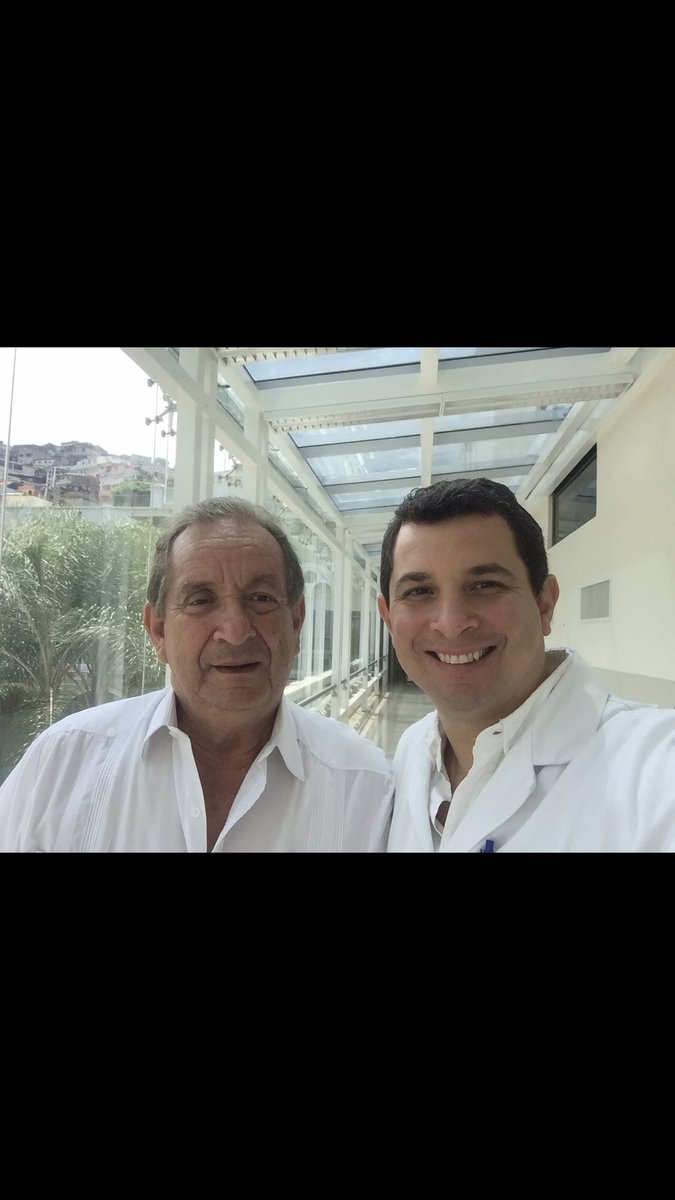
Mi papi. Nino Antonio Cassanello Layana. Mi ídolo, mi vida, mi todo. El era la medicina. Por el soy médico. El arte de la semiología médica. Internista. Sin temor a nada, ni nadie. Sembró en todos aquellos que lo rodearon. Hoy recibo esos afectos.
Let's talk about Jean-Martin Charcot, the "Father of Neurology"! He casts a shadow too wide to cover in one #tweetorial. First, let's talk about his training and legacy as a teacher (and stay tuned for more about him later).
#neurotwitter#neurology#medicalhistory
1/10
Which brings me to this amazing painting, A Clinical Lesson at the Salpêtrière, depicting Wittman, Babinski (holding her), and many other famous neurologists including Marie, Tourette, Parinaud, and Vigouroux.
9/10
🇬🇧 | El King's College Hospital en Londres ha inaugurado un jardín en la azotea para pacientes de cuidados críticos. Su primera paciente dijo que el espacio al aire libre le dio «un verdadero impulso para seguir adelante».
Antiplatelet therapy after stroke is not:
Aspirin for everyone.
DAPT for everyone.
Or clopidogrel because the patient had a stroke on aspirin.
It is a 3-question decision.
What is the mechanism?
What is the clock?
What is the bleeding risk?
That is the whole game.
Minor non-cardioembolic stroke or high-risk TIA, early presentation, low bleeding risk?
Think short DAPT.
Aspirin plus clopidogrel.
Usually 21 days.
Then single antiplatelet.
Not 3 months by habit.
Not lifelong because the first prescription was never reviewed.
Mild to moderate stroke or high-risk TIA with selected high-risk features?
Ticagrelor plus aspirin may enter the discussion.
But it is not simply stronger clopidogrel.
It is a selected-patient decision, with bleeding and dyspnoea on the other side of the scale.
Severe symptomatic intracranial stenosis?
This is the 90-day exception.
Aspirin plus clopidogrel may be justified, but only as part of aggressive medical therapy:
statin, BP, diabetes, smoking, lifestyle.
DAPT alone is not a treatment plan.
Lacunar stroke?
Respect SPS3.
Long-term aspirin plus clopidogrel is not wisdom.
It is bleeding dressed as prevention.
ESUS?
Do not guess with anticoagulation.
Start antiplatelet, investigate properly, and reclassify the mechanism when evidence appears.
AF-related stroke?
Antiplatelet therapy is not enough.
The patient needs an anticoagulation strategy when safe.
Stroke on aspirin?
First ask:
Was it really aspirin failure?
Or was it:
missed AF,
intracranial stenosis,
carotid plaque,
non-adherence,
wrong dose,
cancer-associated stroke,
or uncontrolled risk factors?
Never escalate before you re-diagnose.
The clean bedside rule:
DAPT is a bridge.
SAPT is the destination.
Anticoagulation is a different road.
Mechanism decides the map.
In stroke prevention, the most dangerous antiplatelet error is not choosing the wrong tablet.
It is forgetting to write the stop date.
#Neurotwitter #MedX #Stroke #Aspirin
The mean age of physicians who leave clinical practice in the US is now 48.1 years, 9 years younger than observed in a similar cohort in 2008.
The biggest causes cited were stress and the hassles of practice.
11% of women decided not to even enter practice.
What are your thoughts about this?
https://t.co/eXmYbeOoOF
💉 How our understanding of glucose control has shifted from “normalize at all costs” to a far more nuanced physiological approach.
🩸 glucose targets in critical illness are context dependent.
Achieving “normal” glucose safely is extraordinarily difficult.
The landmark Leuven trials demonstrated that tight glucose control reduced organ dysfunction, infections, ICU acquired weakness, and even long term mortality when severe iatrogenic hyperglycemia from early parenteral nutrition was avoided.
But then came NICE-SUGAR.
A study that fundamentally changed global ICU practice.
In NICE-SUGAR, intensive glucose control increased mortality, largely attributed to severe hypoglycemia and problematic glucose monitoring strategies.
The contrast between Leuven and NICE-SUGAR remains one of the most important lessons in critical care methodology.
The authors highlight several practical bedside principles:
✅ avoid severe hyperglycemia
✅ avoid hypoglycemia
✅ avoid large glucose variability
✅ avoid insulin boluses
✅ use accurate arterial sampling when possible
✅ continuous IV insulin infusion is preferred over intermittent correction scales
One particularly important physiological concept discussed is the relationship between nutrition and glycemic injury.
The paper strongly reinforces evidence against early full parenteral nutrition in acute critical illness.
Why?
Because feeding itself can generate:
⚠️ iatrogenic hyperglycemia
⚠️ insulin resistance
⚠️ metabolic stress
The discussion about autophagy is especially compelling.
The review proposes that excessive early nutrition and excessive insulin exposure may suppress adaptive cellular repair pathways during acute illness.
That idea fundamentally reframes ICU metabolism.
Perhaps the most modern part of the review is its exploration of future ICU glucose strategies:
🧠 continuous glucose monitoring
🧠 closed loop insulin systems
🧠 SGLT2 inhibitors
🧠 GLP1 agonists
🧠 ketogenic and fasting mimicking approaches
This signals a major conceptual transition.
The article also provides a very pragmatic bedside framework: 📌 if accurate monitoring and validated protocols are unavailable, a more liberal glucose strategy is safer.
That message is profoundly important globally.
Because protocols that work in high resource ICUs with:
• arterial blood gas analyzers
• experienced ICU nurses
• computerized insulin algorithms
• frequent monitoring
may become dangerous when exported into environments lacking those safeguards.
This review ultimately reminds us that: critical care physiology is rarely binary.
The answer is not: “tight control good” or “tight control bad.”
The answer is: 🩺 physiology + protocol quality + monitoring capability + nutritional context.
That is modern intensive care medicine.
📖 Gunst J, Med Clin N Am 110 (2026) 429–443 https://t.co/Fv8LSCpMhv
💚 El Racing vuelve a Primera División 14 años y 600 partidos después (4-1)
Los verdiblancos, fundadores de LaLiga, regresan a la elite acompañados por 22.000 almas
📝 https://t.co/AZEYvPzgJz
#RacingRealValladolid
Les doy el ejemplo de nuestra Residencia de Medicina Crítica con el procedimiento más invasivo que hacemos:
Traqueostomía Percutánea (híbrida en realidad)
1. Hacemos un taller de simulación con tráqueas de cerdo
1. Los R1 ayudan a hacer 10 traqueostomias percutaneas, previamente estudiada la técnica
2. Los R2 hacen las traqueostomías percutaneas (después de haber ayudado 10 veces en su R1)
Yo siempre estoy ahí e intervengo si veo que algo se puede complicar (no pueden dilatar después de un rato, no pueden insertar la cánula, se tardan mucho, etc), no después de que se complica, ahí también entraría.
Así cuando salen ya tienen 20 traqueostomías hecha, que es justo el punto donde disminuyen las complicaciones y ya las pueden realizar solos en sus hospitales y entrenar a más personas
Esto NO es sacado de la manga, puede revisar la base: https://t.co/C4yZqbuZVl
@gbiondizoccai Maria Schlumpf, Andreas Gruentzig's assistant, fashioning the 1st PTCA balloons on the kitchen table in Andreas' apartment. The apartment was also Andreas' wife's office: she was a psychologist and saw patients there. Quite an enterprise! #AngioHistory