The discussion about the classics in economics is pushing some economists to position the field closer to hard sciences such as physics.
That's sweet.
But while I agree that economics shares many features with the hard sciences, we also need to acknowledge two things.
First, economists are often late adopters to hard-science ideas.
The switch to "big data," which was popular in physics in the early 2000s, became a thing in economics in the 2010s. Networks, which exploded in physics in the late 90s, became more prominent in economics after the 2008 financial crisis. Neural networks, which were a thing in physics in the 80s, have only more recently become a thing in economics.
Second, and more importantly, many economists reject the principle of interdisciplinary consistency, the idea that fields of science need to "match." This is the notion that physics must be consistent with chemistry, chemistry with biology, biology with psychology, and so on. Many colleagues have told me directly that this consistency is not a requirement for economics. They believe the field is unique and exempt from this principle.
But I disagree. I think that to be a science every field must accept interdisciplinary consistency. That is accepting that other disciplines produce knowledge that cannot contradict that created by your discipline.
Interdisciplinary consistency is in fact a core aspect of scientific identity. Accepting that we are scientists first and members of a discipline second is an ante people expect others to pay to join the room of the "hard-sciences." It is a hard pill to swallow, because there is a lot of knowledge in other fields that each discipline must be consistent with. In the case of economics, this ranges from knowledge on the biological constraints on human cognition and behavior as well as work on macroecology and evolution. The beauty of interdisciplinary consistency, however, is that--when it works--it leads to more general answers. Answers involving mechanisms that are valid across fields.
I personally think economists have a lot to contribute to science. I've been part of the field for 20+ years and I know it is filled with brilliant people. But I am not sure if all of them are ready to accept themselves as scientists first and economists second. I've sometimes had that conversation.
And that’s the real challenge. If economics truly wants to sit at the table with the hard sciences, it has to embrace the same rules of the game, including the sometimes uncomfortable reality that it also has to align with knowledge from other fields.
So, are we ready to make that leap? To stop being a hard science by analogy? I hope so. Because the answers we’re looking for might just be waiting for us in the spaces between disciplines.
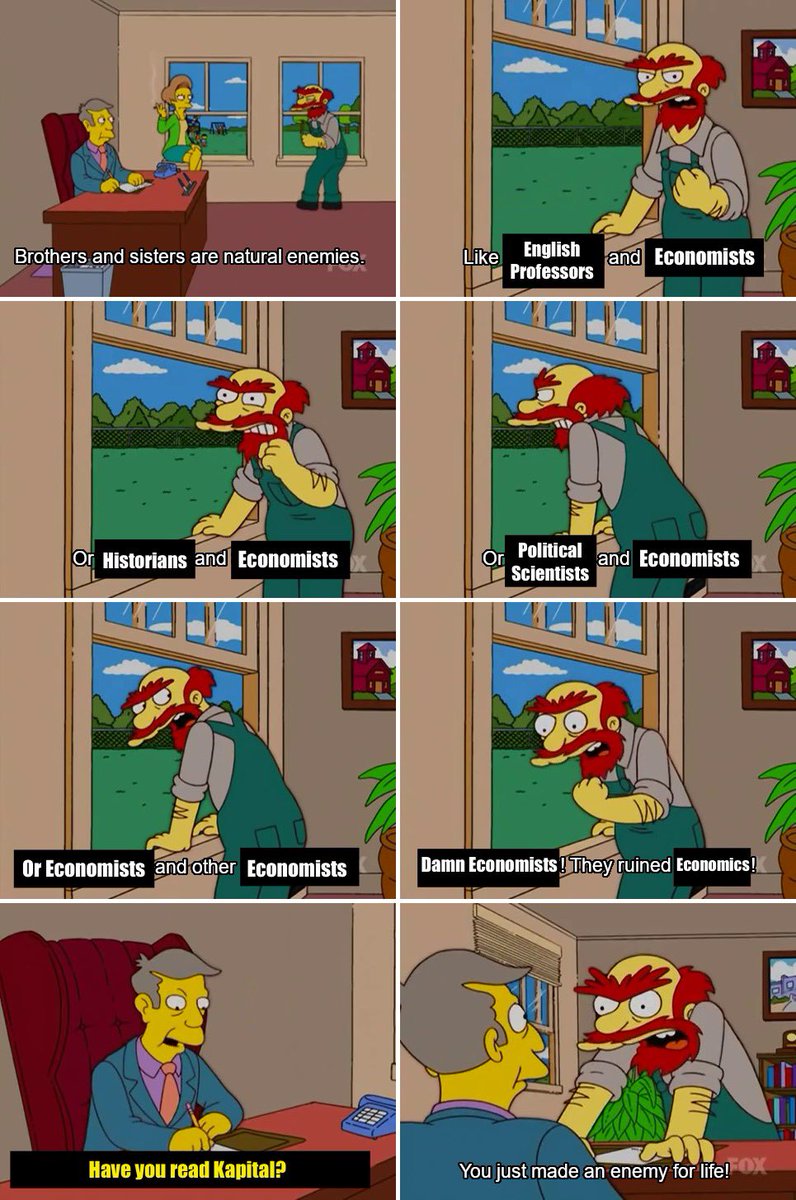
Not only do economists not read Marx, Today’s mainstream economists don’t read or know shit about Veblen, Kalecki, Sraffa, Keynes, Robinson, Minsky, Galbraith, Means, Berle, Polanyi, Weber, Boulding, Daly, Sen, etc etc etc
After a BSc in Astronomy I did a two-year Economics MSc at LSE in 2016-18. The MSc is designed to get non-economists up to speed.
I was not required to read any books beyond modern methods texts. 95% of instruction was math under strict and often unrealistic assumptions
The reason you don’t’ study Smith or Marx as an economics major is purely an ideological one, and people pretend it’s due to ñ “advances” in econ methods. I remember people in my fellowship being shocked, after reading Smith, that he didn’t advance status quo capitalism as being
many have been asking me why economics is not a real discipline. it is not a real discipline because it hasn't properly historicized it's own methods of knowledge production. this was made clear by the economist who hadn't read marx or smith.
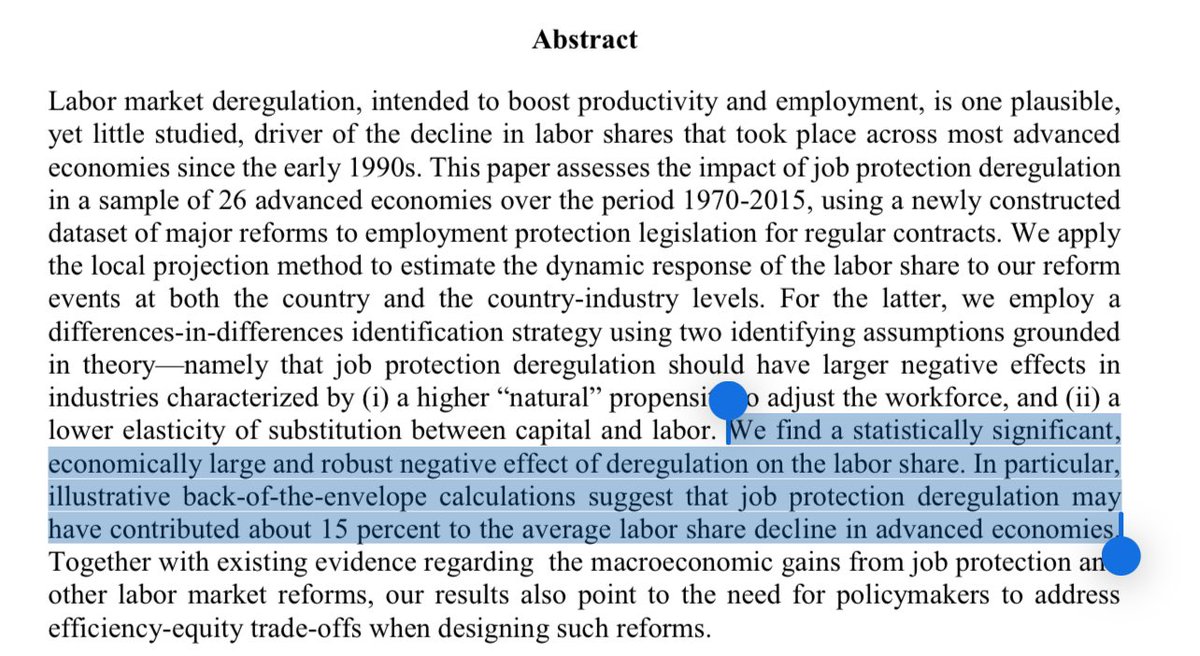
IMF researchers again discovered PK findings with a 50-year delay:
"We find a statistically significant, economically large and robust negative effect of deregulation on the labor share. "
The English PhD discourse is basically a Rorschach test. You see how few people understand what goes into a doctorate. You see how few people think about the humanities as a key to being human. It's really sad to see people reduce all education to its market value. I don't want
Pour ceux qui pensent que soigner l'autre qui souffre n'est pas une justification suffisante en soi, voici quelques ordres de grandeur sur les dépenses de santé et l'Aide Médicale d’État (AME).
Les gens qui votent RN sont juste de pauvres gens, perdus dans des déserts médicaux, loin des services publics.
Oui...
Mais non.
La preuve : dans ces campagnes perdues, tout le monde ne vote pas J. Bardella.
Choisir un bulletin RN reste un acte très particulier.🧵⤵️
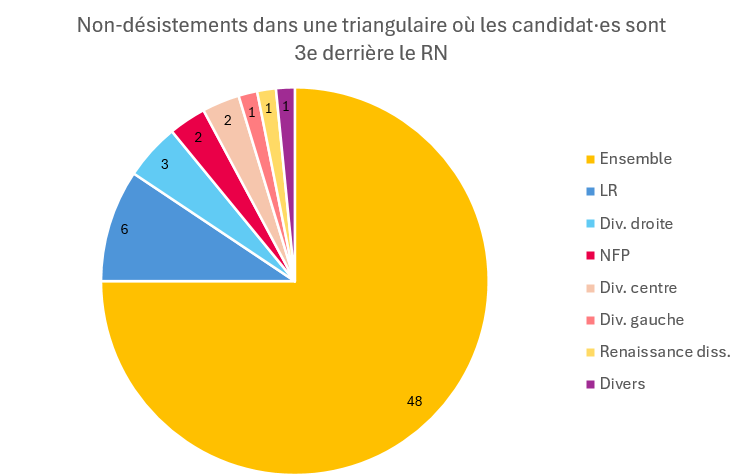
L'ex majorité présidentielle maintient 48 candidats arrivés en 3e position dans une triangulaire.
Il faut être clair : c'est 48 députés RN en plus à l'Assemblée !
Interpellons-les pour qu'ils renoncent à cette folie.
👇 #ElectionsLegislatives
Là-dessus, il faut lire "Ceux qui restent" de @BenoitCoquard : "les campagnes" en général, ça ne correspond pas à une réalité sociologiques ; il faut faire une distinction entre des espaces ruraux attractifs (qui bénéficient du tourisme, de l'arrivée de néo-ruraux, de
Une équipe #Inserm a utilisé des outils de #psychologie cognitive traditionnellement utilisés pour étudier la rationalité chez l’humain afin d’analyser le raisonnement de différents grands modèles de langage, tels que #ChatGPT. 🧠
Lire l'article : https://t.co/JxBayD7QX7