🧵 My 3rd book is now out! It is on the fascinating history of math.
How did people throughout history think about math?What problems did they care about? How did they express them? How were they solved?
This book includes a lot of historical math.
https://t.co/WQ3RRI6J4T
@CharleySeymour6 Maybe some day! But not soon. Got other things in the list first :-)
Btw I clicked your profile and saw that you taught high school math in Tucson. That’s great, I have family there. My cousin’s daughter graduated from Tanque Verde High School.
Chill, it’s only been 3 hours. He’s 5 years old so it takes time.
Anyways, we started with bijections and cardinality, moved on to countable versus uncountable infinities, Cantor’s diagonal argument, Hilbert’s Hotel, ordinal arithmetic and transfinite induction. I’m trying to get to the aleph hierarchy before bedtime, but he’s really struggling with the axiom of choice and Zorn’s lemma.
I think I’ll wait until the morning to cover the continuum hypothesis—don’t want to give him bad dreams, ya know.
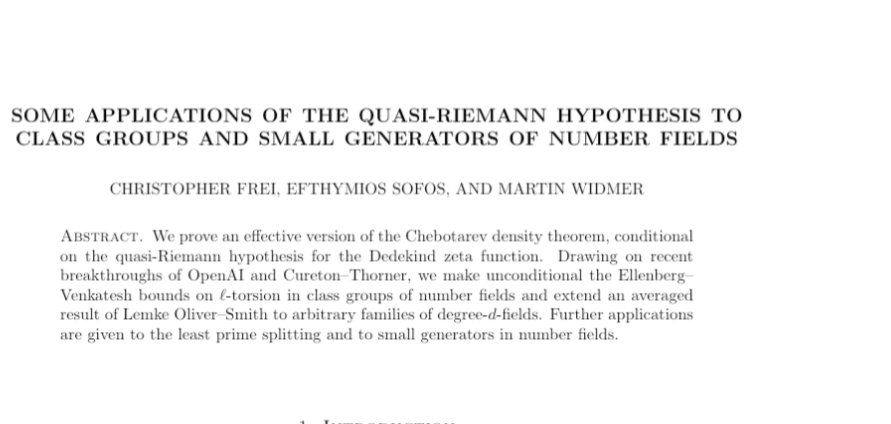
Some fascinating developments following OpenAI's shock breakthrough proof of the Quasi-Riemann Hypothesis, which was released publicly on October 6:
1. Building on OpenAI's proof, a recent Hexagon preprint (released on October 12) by Cureton and Thorner establishes that ALL finite-order Hecke L-functions are zero-free to the right of 1 - 1/6000.
2. And now, today, an arXiv preprint by Frei, Somos and Widmer uses this result to prove unconditionally the 2007 Ellenberg–Venkatesh bounds on ℓ-torsion in class groups of number fields.
I was amused to see the AI declaration in the second paper: "No artificial intelligence tools were used in this work."
We want to support the mathematics community in turning progress in AI into deeper human understanding and new discoveries. To support that goal, we are contributing $5 million to a new Simons Foundation initiative to help mathematicians examine, understand, and build on results produced by AI, including the results we recently published.
The funding, managed and awarded by the @SimonsFdn will support workshops, conferences, and special programs. We will also provide access to our models and computing resources to Simons Foundation-supported researchers.
I love math, and I thought this was a beautiful interview.
My mom is allergic to math, and she thought this was a beautiful interview.
So I think many people will find value in this conversation. I listened to it yesterday, but I suspect the video version will be more poignant
During K-12 school, I didn’t particularly like math. It was only when I took college-level math courses that I fell in love with the subject.
Now that AI is making the fun and fascinating parts of math much more accessible, I hope far more people will also come to love math.
@Satyaki_R@golchha_J It’s mostly silly stories IIRC, but I also think that’s the book that comes closest to what you’re after. (Please let me know if you find a better one!)
you could be living in sacramento
you could be sacramentomaxxing
we have the the kings, old sac, the waterfront
you will build your life in sacramento, california
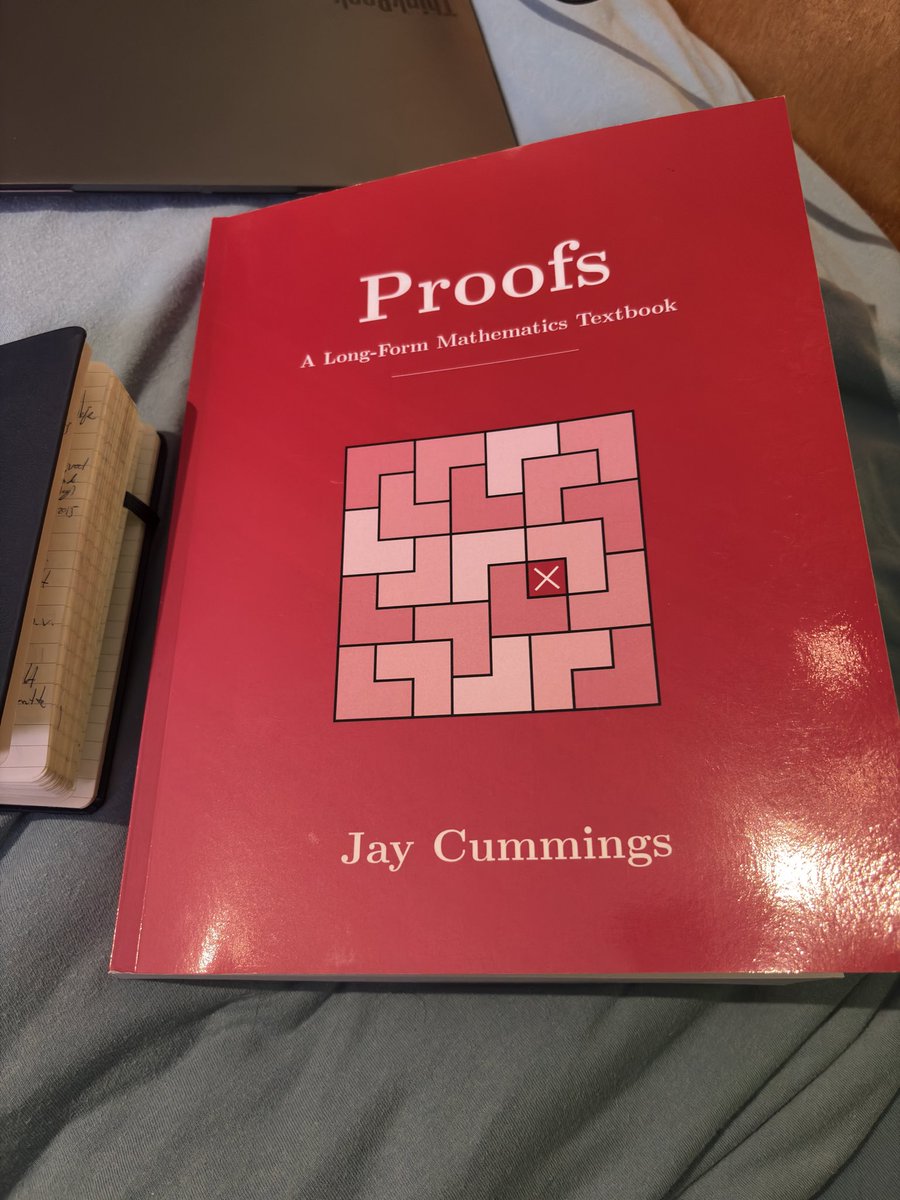
Just getting started on @LongFormMath’s Proofs, already much more lively than how proofs were taught in high school. Looking forward to the rest of it!
10 remarks on AI and math that can be true all at once:
1. The recent progress is stunning and exciting.
2. The Quasi-Riemann Hypothesis is arguably Fields-medal level.
3. Mathematics is being transformed and there is no way back.
4. OpenAI doesn't give a fuck about the future of mathematics.
5. Half-baked unreadable preprints claiming major results can effectively stall mathematical progress.
6. Some mathematicians are responding with naive, overly defensive comments.
7. The social-media wankers framing this as "OpenAI tramples gatekeeping" have no experience of mathematical research.
8. The product of mathematics is clarity and understanding. Not theorems, by themselves.
9. Mathematics is a critical infrastructure of human cognition. The human need for understanding isn't obsolete and it can't be offloaded to machines.
10. We haven't "solved" mathematics and we won't get there before the Sun burns out.
A younger me would have been very interested in learning about advanced topics in math, but nobody around me knew those topics or had time to share them with me. If I had AI to chat with, I very likely would have asked it to teach me things.
Similarly, for many people in the world, even buying math books and other resources is challenging.
Also, people who love to teach math now have new resources to do a better job at it.
Lastly, AI will be discovering new and beautiful things. Which both increases the quantity of fun, fascinating things to study, and also produces a lot of new things which in some ways is more exciting than studying very old math
Very exciting prospects for applied math! And AI holds the promise of enabling scientists to more capably work with these deeper areas of math.
I hope OpenAI leans much more in this direction, where the benefits extend to humanity more broadly.
“okay, so what? it’s just math.”
no, you don't get it.
here’s what OpenAI’s math breakthroughs could eventually help make possible in the real world:
Vlasov–Maxwell → stronger foundations for fusion research, whose ultimate prize is virtually limitless clean energy to power civilization
Calderón’s Problem → portable body scanners using electrical signals, making medical imaging cheaper and easier to access
Maximum-Cardinality Matching → faster searches for compatible kidney swaps across large donor pools, helping hospitals coordinate lifesaving transplants
Inverse Elasticity Problem → scans that map tissue stiffness, helping doctors locate suspicious growths inside the body
Mumford–Shah Conjecture → better tools for spotting tissue changes in brain scans, helping doctors identify signs of disease
Bose–Einstein Condensation → stronger foundations for quantum sensors that could help vehicles navigate without GPS
Simple Stochastic Games → better safety checks for self-driving cars and robots before dangerous mistakes reach the real world
Matrix Multiplication → cheaper AI and bigger scientific simulations using the same computers
Edit Distance → faster DNA comparisons, helping researchers study genetic changes linked to disease
The k-Server Problem → robots that waste less movement and energy, making warehouses more efficient and goods cheaper to move
a reminder that math is the foundation of science.
so accelerating mathematical discovery could compress centuries of scientific progress into years.
insane timeline to be alive for!
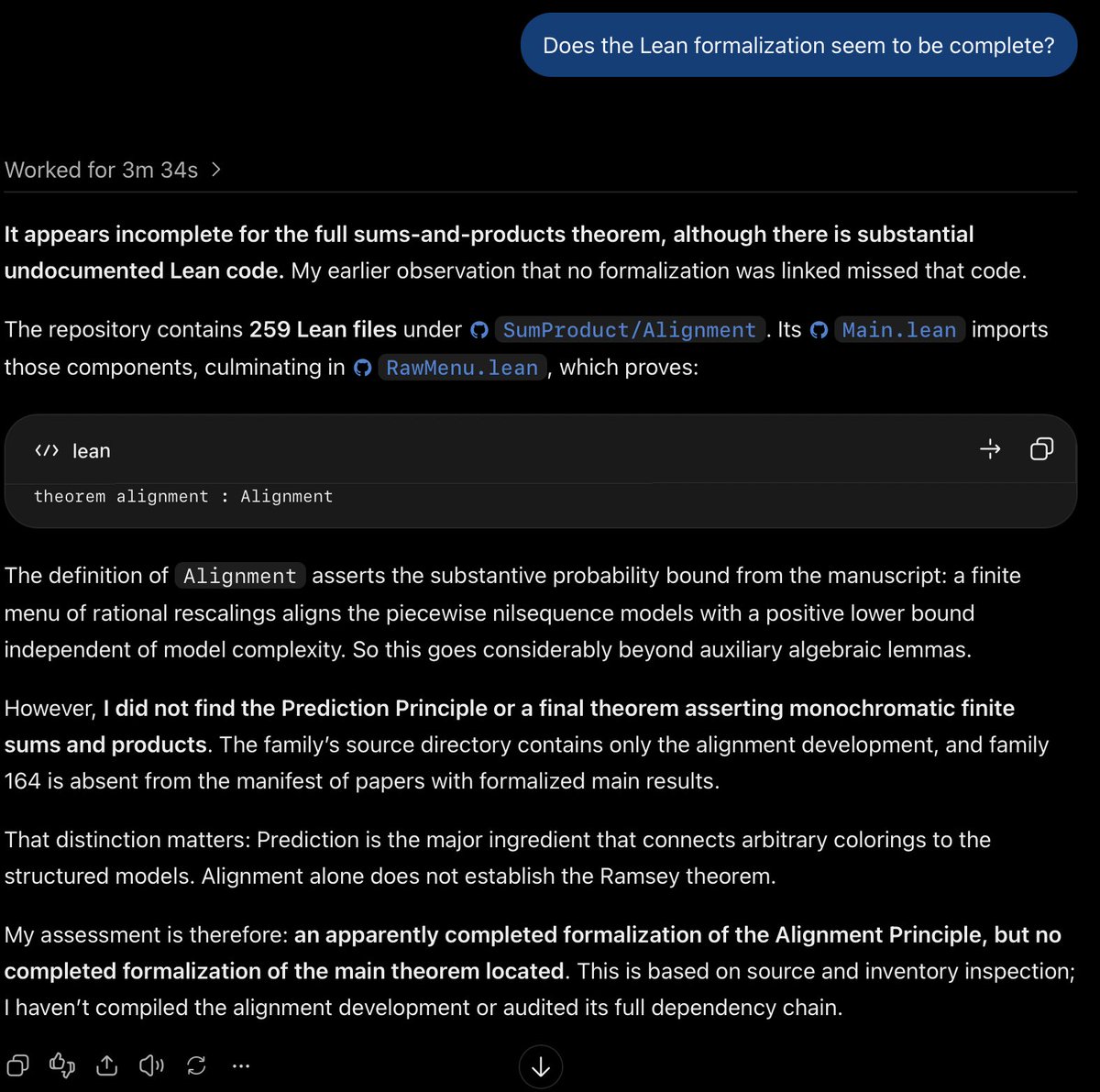
Btw it seems like this one is not completely verified yet with Lean. And many others also seem to not be verified with Lean.
Seems strange that they would release so many where a lean check is doable but not done.
I think that partially depends on you. For some people, learning the old-fashioned way might still be best. For some people learning through a very extended and ongoing conversation with AI might be best. I heard one professor tells his PhD students to alternate between one week being all-AI and one week no AI. That sounded pretty good too!