Católico. Data Scientist e Investigador. Ingeniero Comercial. Máster en Investigación de Mercados. Professional Certificate in Data Science by IBM. #Python
ANTHROPIC ACABA DE REGALAR EL MANUAL PARA MONTAR UNA EMPRESA SIN EMPLEADOS
taller gratuito sobre cómo construir un negocio operado por agentes de IA.
nada de asistentes. agentes que se reparten tareas y ejecutan procesos solos, sin intervención humana.
→ gratis
→ subtitulado al español
resultado: lo que antes necesitaba un equipo, ahora lo corre un sistema de agentes.
🔖 guárdalo, te va a servir.
STEP 2: Open ChatGPT and upload the Character Image alone. Add the below prompt and run it.
Create a professional AI Video Production — Character Reference Sheet for the provided character image. Create a polished 4:5 portrait continuity sheet focused exclusively on the character:
1. CHARACTER PROFILE — name, role, approximate age, height, body type, personality, distinctive traits, and signature colors.
2. FULL-BODY TURNAROUND — front, 3/4, side, and back views of the exact same character at matching scale, with identical facial features, hairstyle, body proportions, costume, colors, and accessories.
3. FACE AND IDENTITY DETAILS — front, profile, and 3/4 head-and-shoulder close-ups showing facial structure, eyes, eyebrows, nose, lips, hairstyle, skin tone, makeup, scars, tattoos, and other defining features.
4. EXPRESSION SHEET — neutral, happy, angry, sad, surprised, worried, confident, and determined expressions. Preserve the exact same facial structure and identity in every expression.
5. POSE AND BODY LANGUAGE — neutral standing, walking, sitting, relaxed, tense, and action-ready poses. Maintain consistent anatomy, proportions, posture, and silhouette.
6. COSTUME DETAILS — close-ups of clothing layers, fabrics, seams, fasteners, footwear, jewelry, eyewear, markings, logos, and other character-defining wardrobe elements.
7. COLOR AND MATERIAL PALETTE — include 4–6 key colors with HEX codes, plus references for skin, hair, fabric, leather, metal, plastic, armor, or other visible materials.
8. DO NOT CHANGE — lock the character’s face, identity, skin tone, age, hair, eye color, body shape, proportions, costume, accessories, markings, colors, and defining features. Do not redesign, beautify, age, stylize, simplify, or create alternate versions.
Use a clean white or neutral studio background, soft controlled lighting, realistic materials, sharp details, subtle shadows, clean typography, thin dividers, balanced spacing, and a sophisticated editorial production-design grid.
Every panel must depict the exact same character with absolute visual consistency. Focus only on the character. Do not include props, additional characters, environments, unrelated objects, or alternate outfits."
Un chico creó un agente de IA que funciona como analista autónomo para empresas y puedes hacer algo parecido con Kimi K3.
La idea es simple:
Le dices a la IA cuál es tu empresa, en qué mercado compites y cuáles son tus principales competidores.
Después defines qué quieres que vigile: lanzamientos, cambios de precios, nuevos productos, anuncios, posicionamiento, actualizaciones importantes y cualquier movimiento que pueda afectar a tu negocio.
El agente recopila esa información, la compara con lo que ya sabe y mantiene un historial de cada competidor.
Así, en lugar de revisar decenas de páginas todos los días, puedes recibir un informe con:
• Qué hicieron tus competidores
• Qué cambió desde el último análisis
• Nuevos productos o lanzamientos
• Cambios de precios
• Cambios en su estrategia
• Oportunidades que podrías aprovechar
• Acciones que tu equipo debería considerar
Para empezar, entra a Kimi K3 y pídele:
“Quiero crear un agente autónomo de inteligencia competitiva para mi empresa. Ayúdame a construirlo para que monitoree a mis competidores, recuerde sus movimientos anteriores, detecte cambios importantes y genere informes periódicos con oportunidades y acciones recomendadas. Primero pregúntame todo lo que necesitas saber sobre mi empresa, mercado y competidores.”
Con eso puedes comenzar a construir tu propia versión.
Básicamente estás creando un analista de mercado impulsado por IA que puede trabajar para tu empresa las 24 horas.
No están cayendo los influencers, está cambiando la forma de influir.
Durante años nos han dicho: mira mi vida, mira lo que tengo, mira lo feliz que soy. Y nosotros mirábamos.
Pero quizás estamos empezando a cansarnos de vidas perfectas. Porque una vida bonita en Instagram no necesariamente es una vida con sentido.
Y aquí aparece una pregunta mucho más importante: ¿Qué significa realmente influir en alguien? Porque influir no es conseguir que otro quiera ser como tú.
Influimos cuando nuestras palabras, nuestras decisiones y nuestra manera de vivir ayudan a otros a vivir mejor.
Y aquí los cristianos tenemos mucho que pensar. Porque Jesús también quiso influir. Pero no lo hizo desde la apariencia. No vendió una vida perfecta. Entregó su vida.
Su vida no llevaba a Él como una meta narcisista, llevaba a Dios.
Quizá hoy necesitamos menos personas que nos digan: “mira mi vida” y más personas capaces de decir “mira a Cristo”.
Personas que con su manera de vivir nos recuerden que se puede amar, perdonar, servir, esperar, levantarse… y vivir con Esperanza.
La verdadera pregunta no es: ¿cuántas personas me siguen?; sino: ¿hacia dónde estoy llevando a las personas que me siguen?
Eso sí es influencia y eso sí merece la pena.
(Texto de las Carmelitas Samaritanas del Corazón de Jesús)
Si tienen la oportunidad de venir a la Hacienda Pinsaquí, en Otavalo, NUNCA la desaprovechen. Es un lugar mágico, lleno de historia, naturaleza y arte. Con la mejor hospitalidad del mundo: una calidez impresionante. Y la hacienda es una preciocidad.
Pinsaquí, palabra kichwa, significa «casa entre dos ríos». Aquí se firmó el tratado de paz que lleva su nombre. Y en la habitación 1, se hospedó Simón Bolívar.
#HaciendaPinsaquí #Otavalo #Ecuador
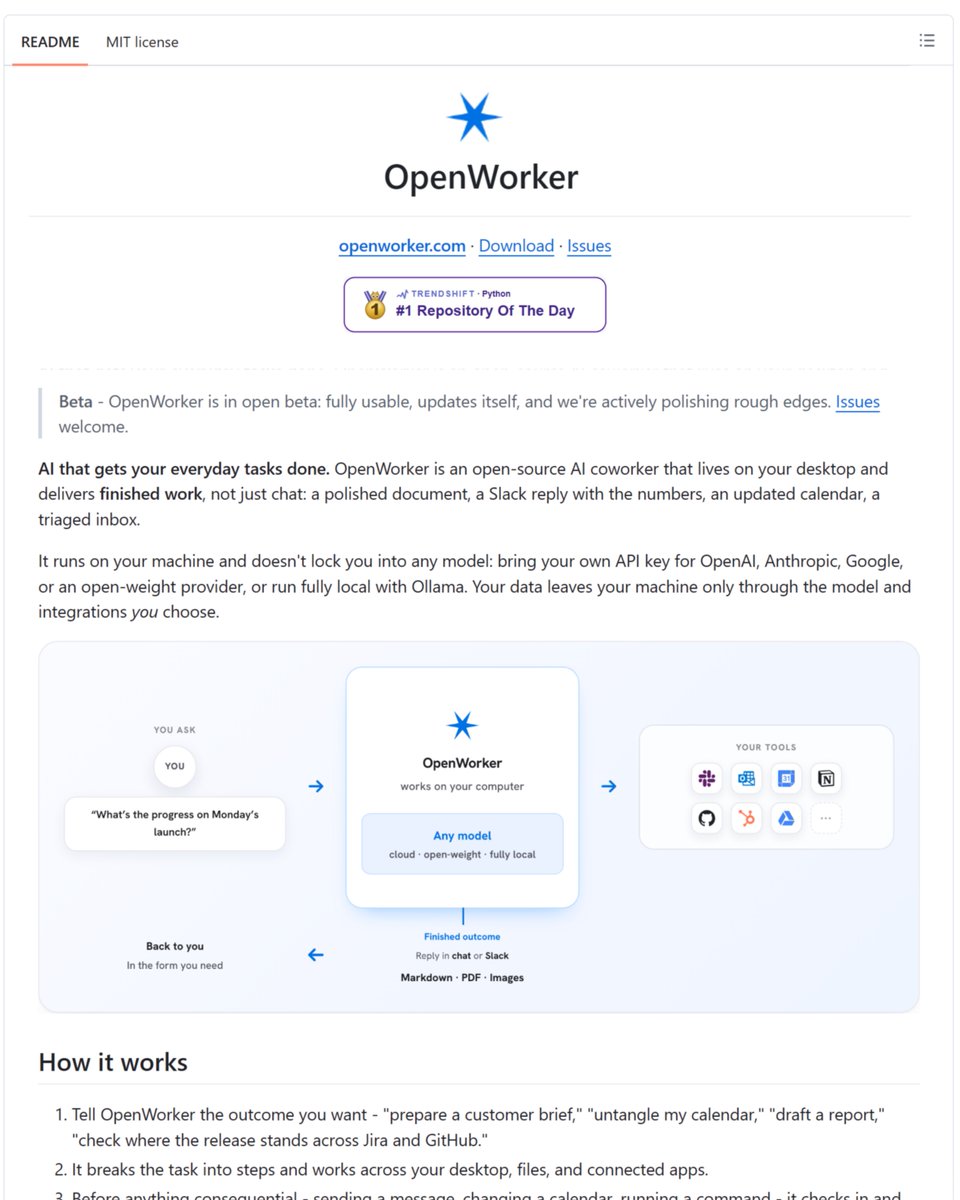
Andrew Ng open-sourced an AI coworker!
OpenWorker is a desktop app that delivers finished work, not just chat. You describe the outcome you want - a customer brief, a triaged inbox, a calendar update, a release status across Jira and GitHub - and it works across your files, terminal, and connected apps to produce the actual deliverable.
The design principle: it reads freely but writes only after you approve. Before anything consequential - sending a message, making a calendar change, running a shell command - it pauses and shows you exactly what it's about to do. Unattended scheduled runs park approval-needed actions in an inbox rather than acting on their own.
25+ integrations out of the box: GitHub, Slack, Jira, Notion, Linear, HubSpot, Gmail, Google Calendar, Outlook, monday, and your terminal and local files. Any MCP tool plugs in too.
Works from Slack directly. Mention @ OpenWorker in a channel, the work happens on your desktop with your tools, and the answer comes back as a thread reply.
Bring your own model. OpenAI, Anthropic, Google Gemini, DeepSeek, Kimi, Qwen, MiniMax, Mistral, Grok, and fully local via Ollama. Everything runs on your machine with your own API keys.
Built on aisuite, Andrew Ng's own unified LLM provider library. Currently in open beta on macOS and Windows.
Key capabilities:
• Delivers finished deliverables: documents, reports, Slack replies, updated calendars
• Approval-gated writes, sends, and shell commands
• 25+ integrations including GitHub, Slack, Jira, Notion, Gmail, and MCP tools
• Scheduled automations for recurring work
• Works from Slack via @ OpenWorker mention
• Bring your own model: any provider or fully local via Ollama
• Local-first: everything runs on your machine
OpenWorker shows what happens when you get the loop right. Define the goal, the agent executes autonomously, approval gates control what runs.
That's loop engineering in practice. Wrote a full breakdown on how to design loops you can actually trust to run without you.
I've shared the link to the Github Repo in the replies!
La mayoría de los agentes de IA dejan de evolucionar en el momento en que dejas de alimentarlos.
Cada día aparecen nuevos workflows en GitHub.
Mejores patrones. Arquitecturas más inteligentes. Skills reutilizables.
Ninguno llega a tu agente a menos que un humano lo encuentre, lo lea, lo entienda y lo instale a mano.
Ese cuello de botella acaba de desaparecer.
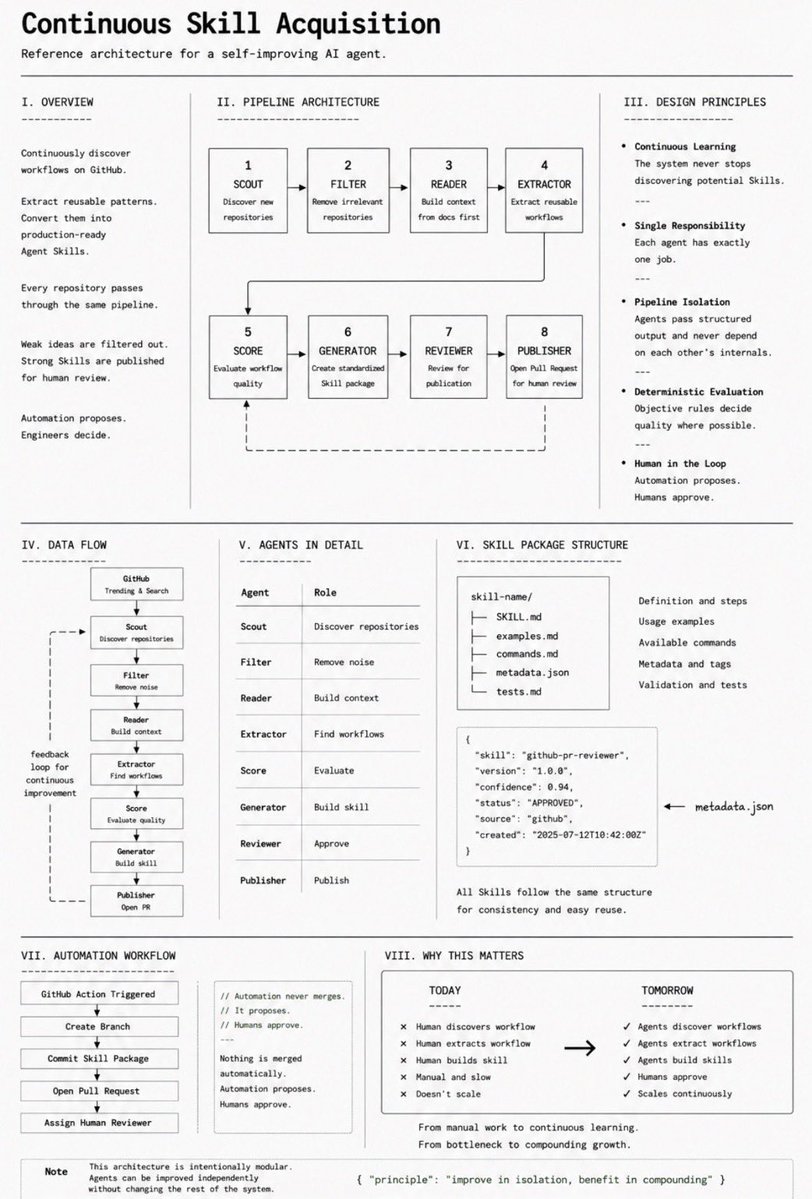
Alguien construyó un sistema de adquisición continua de skills:
8 agentes especializados. Un solo loop. Corre sin ti.
→ Scout descubre nuevos repositorios
→ Filter elimina el ruido antes de que cualquier modelo gaste tokens
→ Reader construye contexto primero desde la documentación (la intención > el código)
→ Extractor extrae el workflow reutilizable
→ Score lo evalúa con criterios objetivos — si falla, muere aquí
→ Generator lo empaqueta como skill completo (ejemplos, comandos y tests)
→ Reviewer hace una sola pregunta: “¿Un ingeniero experimentado lo instalaría sin editar nada?”
→ Publisher abre el Pull Request
La automatización propone.
Los humanos aprueban.
Nada se mergea automáticamente.
El resultado se multiplica: skills más fuertes → mejores descubrimientos → skills aún más fuertes.
Hoy, cada nueva capacidad de tu agente requiere que un humano la busque.
Este pipeline elimina esa limitación para siempre.
La arquitectura completa está en la imagen.
UN EX-ANTHROPIC ENGINEER ACABA DE CERRAR UNA RONDA GORDA POR UNA MEMORIA QUE NUNCA OLVIDA
La mayoría de agents despiertan en blanco cada sesión.
Te conocen 20 minutos… y mañana eres un completo extraño.
Él construyó una scoring layer que decide, en tiempo real, qué merece sobrevivir y qué se descarta.
- Las contradicciones entre memoria vieja y nueva se detectan automáticamente (nunca se sobrescriben en silencio)
- Lo que nadie vuelve a tocar se degrada solo
- El sistema no se hincha de basura
Nadie fuera del deal sabía cómo funcionaba el scoring hasta que el cheque ya estaba firmado.
Mira exactamente cómo decide qué sobrevive 👇
ESTE REPO HACE QUE CLAUDE ESCRIBA HASTA UN 94% MENOS DE CÓDIGO
Opus 5 es una bestia escribiendo código. También sale caro.
Cada línea que escribe de más, la pagas tú.
Ponytail lo arregla con una idea absurdamente simple: convierte a tu agente en el senior vago del equipo.
Ese que mira tus 50 líneas y las reemplaza por una.
Antes de escribir nada, el agente se pregunta:
→ Esto necesita existir?
→ Ya está en el codebase?
→ Lo hace la librería estándar?
→ Lo hace el navegador de forma nativa?
→ Cabe en una línea?
Solo si todo falla, escribe el mínimo que funciona.
Resultado:
hasta 94% menos código
un 20% menos de factura
un 27% más rápido
Sin recortar seguridad ni validaciones.
Se instala en 2 comandos:
/plugin marketplace add DietrichGebert/ponytail
/plugin install ponytail@ponytail
90.000 estrellas en GitHub.
Gratis y open source.
El mejor código es el que nunca escribiste.
Enlace al repositorio abajo👇
Google just released free 2-hour course on full agent engineering: 1 prompt → agent teams → loops → graphs from 0% to 100%:
10% → 38:46 - build your first agent
30% → 54:46 - connect MCP tools
55% → 1:12:43 - Loop engineering: 4 ways to run agents
70% → 1:20:57 - Graph engineering
100% → 2:22:31 - the full system that works while you sleep
most people build one agent and stop there - this is the full path to a system that runs without you from scratch
watch it today - then read the full graph engineering playbook below ↓
🚨 رئيسة Anthropic، دانييلا أمودي، تكشف:
“80% من مهندسينا انتقلوا بالفعل للعمل على الوكلاء (Agents). وخلال 3 إلى 6 أشهر، سيصبح دور “مهندس الوكلاء” هو الوظيفة الأساسية.”
وفي هذه المقابلة، تشرح أيضًا السبب الذي جعل مؤسسات مثل Jane Street وCoinbase تثق في Claude، وما الذي تفعله Anthropic بشكل مختلف عن OpenAI.
إذا كنت مهتمًا بالذكاء الاصطناعي، فالمحتوى في هذه المقابلة قيمته تتجاوز دورة مؤسسية بـ500 دولار.
شاهدها… ولا تنسَ حفظها للرجوع إليها لاحقًا. 📌
🔴 BOMBAZO: Unos chinos han reventado la industria de video con IA de PAGO.
Se llama LongCat-Avatar.
Subes una foto y un audio y tienes un video hablando que aguanta minutos.
¡Es BRUTAL! Y encima GRATIS....
Te dejo el repo abajo: 👇
Hay libros técnicos muy buenos que terminan teniendo el mismo destino...
Los lees una vez, guardas el PDF y, tres meses después, apenas recuerdas dónde estaba aquella idea que necesitabas.
Este proyecto intenta solucionar justo eso.
Se llama Book to Skill y convierte un libro técnico en una habilidad reutilizable para Claude Code, GitHub Copilot CLI o Amp.
Le proporcionas un PDF y el sistema lo transforma en una estructura pensada para que el agente pueda utilizarla mientras trabajas.
No crea solamente un resumen largo.
Genera un archivo principal con los modelos mentales del libro, un documento por capítulo, un glosario, una recopilación de patrones y una hoja de consulta rápida.
Después puedes preguntarle cosas como:
“¿Qué recomienda este libro para diseñar sistemas replicados?”
“Explícame el capítulo cinco.”
“Aplica los principios del autor a este código.”
El agente carga únicamente el capítulo que necesita, en lugar de introducir el libro completo en cada conversación.
Según las pruebas publicadas por el proyecto, este enfoque puede utilizar entre 24 y 51 veces menos tokens que volcar todo el libro dentro del contexto para responder una pregunta concreta.
También admite EPUB, DOCX, HTML, Markdown, archivos de texto y carpetas completas.
Eso significa que no tiene por qué utilizarse solo con libros.
Puedes convertir en una skill:
Documentación interna de una empresa.
Manuales de arquitectura.
Conjuntos de artículos y papers.
Guías de estilo.
Especificaciones técnicas.
Runbooks y documentación de onboarding.
Incluso puedes añadir material nuevo posteriormente y actualizar una skill que ya habías creado.
Proyecto: https://t.co/cguuU0GTuR
Un PDF normalmente permanece cerrado en una carpeta.
Este proyecto intenta convertirlo en conocimiento que tu agente pueda aplicar mientras trabajas.
مهندس في Anthropic يقول:
“مو لازم تراقب النموذج في كل خطوة. حطه داخل Graph، وهو بنفسه يكتشف أخطاءه وينفذ المهام بالتوازي.”
وفي 25 دقيقة يشرح كيف تبني Anthropic وكلاء يعملون بالتوازي، يراجعون أعمال بعضهم، ويتعافون تلقائيًا عند حدوث الأخطاء.
I deleted 80% of my CLAUDE.md last night.
My CLAUDE.md was 400 lines. It's now 60. Claude works better.
It's all because of this video.
Two Anthropic engineers. 50 minutes. The Claude team's best practices.
Anthropic deleted 80% of the Claude Code system prompt. The output got better.
Most people will keep adding rules and wondering why it keeps getting worse.
Watch it today, then read the guide below.
This video will make you an expert loop engineer in 21 minutes.
Prompting is dead. You need to be running loops.
0:51 Understanding LLMs
3:41 wtf is a loop?
6:17 Two kinds of loops
8:54 /goal versus /loop
10:44 Website audit demo
13:27 Real loop workflow ideas
19:11 Scheduling loops
🚨 ¡BOMBAZO de Anthropic!
Acaban de soltar un taller GRATIS sobre cómo montar una empresa entera solo con Agentes de IA.
Agentes que se organizan entre ellos, se reparten el trabajo y ejecutan procesos solos… como un equipo real que nunca duerme.
✅ Totalmente gratis
✅ Subtitulado al español
Si quieres que la IA trabaje por ti (y no al revés)…
Guarda esto YA 🔖🔥
The "Karpathy Method" Obsidian + Claude Code is quietly replacing $15/month note apps for 1000s of builders.
The setup costs $0. Takes 10 minutes. And it's stupidly simple.
Karpathy stores his entire brain in plain markdown files. No Notion. No database. A folder.
People mocked it for years.
Then Claude Code shipped an agent that lives in the terminal and reads files natively.
Obsidian IS files.
Notion hides your notes behind an API. Obsidian hands them to the agent raw. The "boomer stack" turned out to be the only one AI can walk through end to end.
The method, 4 steps:
Open your vault folder in terminal. Type claude. The agent now sees 100% of your notes.
Drop a CLAUDE.md at the root. 40 lines: how you tag, how you link, what a good note looks like. Your brain's operating manual.
Run 1 nightly job. Claude reads the day's dump links, highlights, half-thoughts and files it into atomic notes with backlinks.
Once a week, ask 1 question: "what connects that I haven't connected?" Old notes collide into ideas you'd never find alone.
A builder running this loop hit 4,120 notes in 5 months. Found 2 essay ideas in the collisions. Sold both for $3,400.
Hardware: a $599 Mac Mini. Software: a folder.
The industry spent 10 years building smarter note apps.
Karpathy bet on the file.
The file won.