PeptIQ, a peptide tracking app built on the side, launched in January and has made over $115,000 this year, its founder says. About 70% of its clicks and revenue come from Google.
He's a software engineer with a full-time job. He vibe-coded the app in about a week and grew it through search. His playbook:
1. He picked a category that was already working. Google search trends for peptides showed a hockey stick, and apps for GLP-1s were already succeeding. To stand out, he says, read the competitors' reviews and what Reddit says about them.
2. He went where his buyers search. His paying users are 45 to 55, "not somebody that's just sitting in ChatGPT all day," in his words.
3. He started on SEO very early. The marketing site was built around the questions people ask about peptides, so they could find him.
4. He gets the questions from Reddit. Go where people talk about your topic all day, find the questions they ask over and over, and write an article for each. He has written some himself, used AI for a good majority, and hired writers.
5. He puts a tool inside the article. His article on how to reconstitute peptides has a reconstitution calculator in it. Hit save and it walks you into creating an account, with your data already in the app.
6. He covers the basics. Schema, semantic tagging and no bad links, plus SEMrush or Ahrefs to see what competitors rank for and which of their pages get traffic.
7. He doesn't skip Bing. Submitting a sitemap costs nothing, and OpenAI and Bing have had a partnership for a while.
SEO took six or seven months to pay off. In the last 12 months, 590,000 people clicked through to his site from the blog articles, and the app is now at $14,000 in monthly recurring revenue, he says.
The reason it worked, I think: the reader's next step after the article happens inside the app. Someone who searches how to reconstitute a peptide gets the answer, then the calculator, and saving the result is the sign-up.
Three things I believe about the words you sell a product with:
1. Until a buyer has used the product, they are buying the words. The investor James Currier points out that a $400,000 software deal is sold on a PowerPoint, and a PowerPoint is words.
2. The words should come before the build. He once changed a homepage from "Store your photos" to "Share your photos" when the product couldn't share anything. His three-person team was embarrassed, added sharing within 48 hours, and the site started growing.
3. The best word is one the buyer already values. Lemonade at 20 cents and a lemonade cleanse at $20 can be the same product.
So I'd write the homepage line before the spec, and have the team build what it promises.
@FamiCareumh a check-in before the scroll starts is smart. way easier to catch the habit at the tap than pull out 20 mins later. what does the check-in ask you?
Sierra, which builds customer-facing AI agents, went from $200M to $400M in ARR in 5 months, by its own figures. The doubling before that, from $100M to $200M, took 6.
It came out of stealth in February 2024 with about seven design customers and no long-term contracts. Its chief customer officer joined that January as employee 23 and the first sales hire. Here's how he says the go-to-market team was built:
1. They organized the whole company by industry. They chose the industries where people talk to a brand often: financial services, healthcare, retail, media, travel and hospitality, telecom. Sales, agent development, marketing, product and the P&L are all built around them, so a seller arrives knowing the industry's trends, use cases and problems.
2. The first eight sellers were sales leaders. He calls them the Elite 8: leaders willing to take a step back, people he had worked with and seen deliver. His advice: hire people who already sell to the enterprise, not people who will learn it on the job.
3. Nobody took sales over from the founders. Both founders stayed in deals after he joined, and he says everyone is still in sales at $400M.
4. Every lost deal gets a postmortem. When they lose a deal or an engagement goes badly, the team swarms it and works out what to change.
5. They track plain leading indicators: meetings, pipeline created, proofs of concept started, and proofs of concept turned into long-term contracts.
6. They hire by consensus. Five to seven people interview each candidate, and the candidate presents on a prompt. No consensus, no hire.
7. They kept shipping things that opened new volume. He calls the voice launch "a huge unlock", and an AI teammate that helps build and improve the agents "a massive unlock".
His most underrated go-to-market advice: "don't make it complex. Keep it simple."
The reason it scaled, I think: each new seller joined a team that already knew their industry, so they could act as an adviser from the first meeting.
How to get an SEO audit out of Claude that lists only the fixes that matter. Prompt included.
Harpreet Singh, an SEO, gave ChatGPT, Claude and Gemini the same Nike category page and the same prompt: SEO and AI search recommendations, ranked by impact.
Gemini ranked "remove meta keywords" as its third most important fix. ChatGPT put FAQs above the title tag. Claude did best: it saw that the page listed 45 products, but only 24 were in the HTML. The rest loaded through JavaScript.
All three still handed back an old SEO checklist, with low-value fixes marked urgent. Part of the problem is the input. One page tells it nothing about the rest of your site, so give it a crawl instead.
1. Crawl your site with Screaming Frog SEO Spider. The free version crawls up to 500 URLs, which is probably enough for a small business.
2. Open the Issues tab and export the issues list.
3. Upload the export to Claude with this prompt:
"Give me SEO recommendations based on the issues in this crawl. Don't give me a lot of advice. Only the 20% of fixes that will get 80% of the results, in no more than five brief points. Leave out the other 80%."
4. Check what comes back. The title tag, H1 and H2s go first: they are the first things a searcher sees, and the easiest to fix.
5. If you sell in more than one country, check the language. Nike's Canadian page had "trainers" in its title and was set to en-GB.
6. Push FAQ schema and meta tag tweaks to the bottom. Google deprecated FAQ rich results, and there is no proof that FAQ markup gets you quoted by AI, only correlations.
7. Track one number: your rankings for the keywords you are actively targeting.
Rachel Woods, an AI operations strategist who runs her 8-person company on AI playbooks, has one rule for them: "Own the playbook, rent the tech."
Her team keeps every playbook in GitHub, not inside Claude or ChatGPT, so the work is never limited to what one tool allows. Their project planning playbook tripled her team's velocity.
How she builds one:
1. Define four things: the trigger, the inputs, the steps and the output.
2. Write the steps for a dream employee with unlimited time. Hers asks clarifying questions, then runs "1-3-1": the one problem, three ways to approach it, one recommendation.
3. At the end, have the AI flag the work it can start itself. It already has the context.
4. Tell it what to do when it doesn't know. Her sales questions playbook escalates with a proposed answer, and a second playbook updates the guide once they agree.
5. Start your team small: meeting recaps, the Friday manager update, the weekly report.
All 11 points are in the images.
Every sport has had a day when one player made everyone else look like amateurs.
@grok what's the single most dominant performance in sports history? One pick, then the stat that proves it. No hedging.
@Xavionis haven't hit it myself yet, so i can't rank them from experience. my guess is the usage, since that compute is gone even if you win the dispute
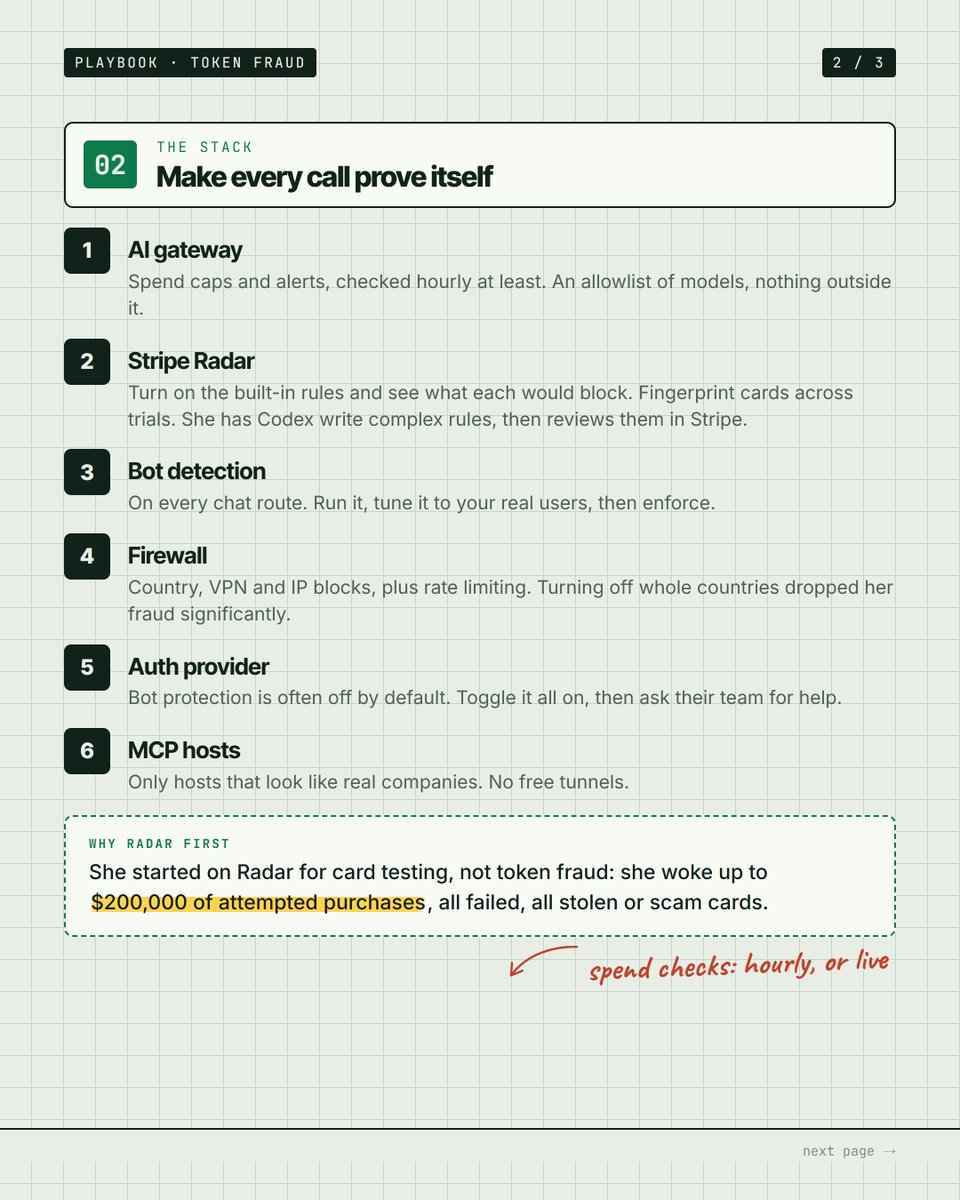
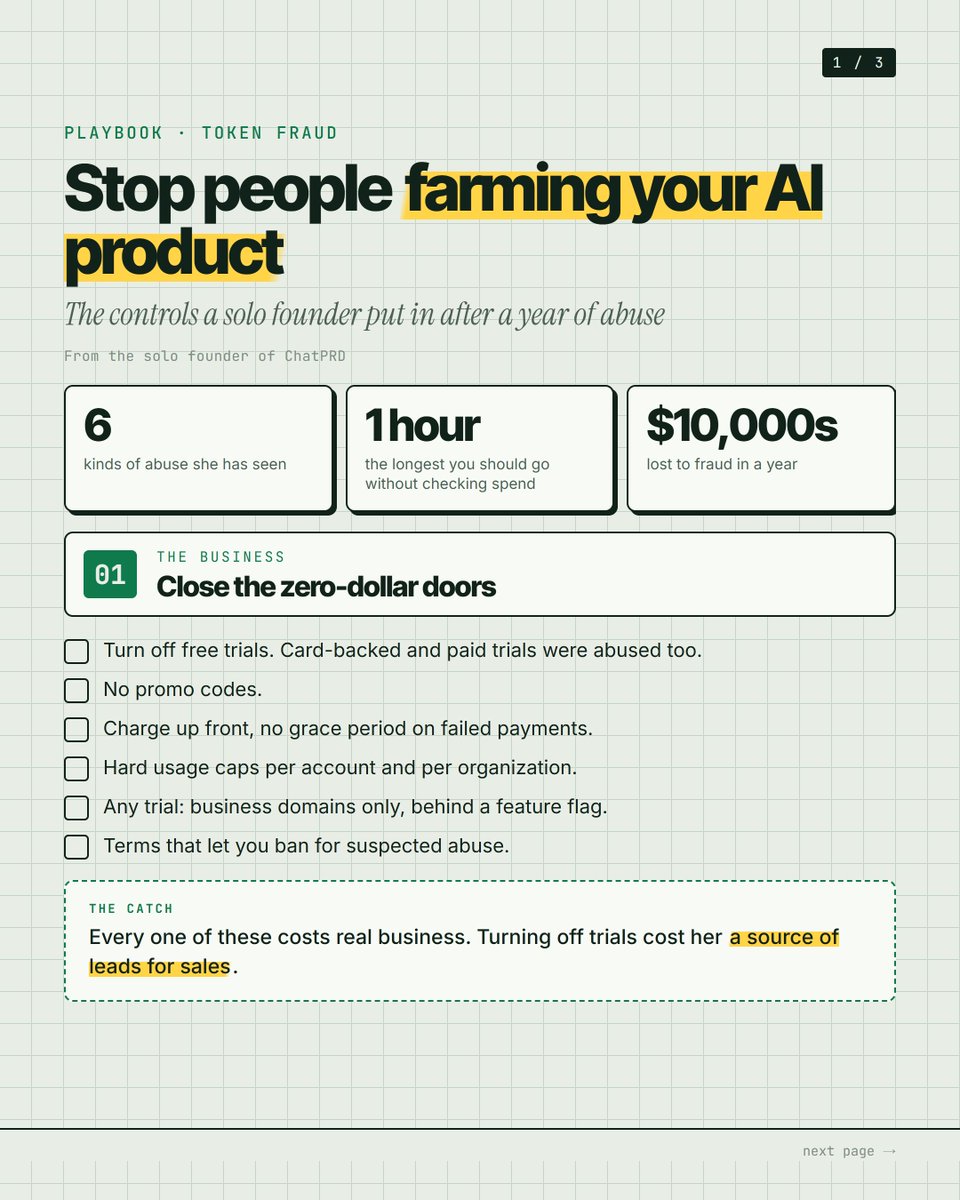
If you sell an AI product, people will try to farm your tokens. 12 controls from the solo founder of ChatPRD, after fraud cost her tens of thousands of dollars in a year 👇
1. Turn off free trials. Card-backed and even paid trials got abused through card cycling and chargebacks.
2. Drop promo codes. Hers were stolen, resold and used in bulk to run other AI businesses.
3. Bill up front, with no grace period on failed payments.
4. Set a hard usage cap per account and per organization.
5. If you keep a trial, restrict it to business email domains and put it behind a feature flag you can switch off.
6. Route every model call through an AI gateway (she uses Vercel's) with spend alerts checked at least hourly, and an allowlist of models so nobody can call a pricier one than you meant to give them.
7. Turn on Stripe Radar's built-in rules. It shows how many payments each rule would have blocked. Then fingerprint cards to catch one card across many trials.
8. Put bot detection on every chat route (she uses Vercel BotID), so a valid login is not enough: the request has to come from your app. Monitor first, tune, then block.
9. Block countries, VPNs and IPs at your host's firewall, and rate limit. When she turned off the top model in a couple of countries, nobody stole tokens anymore.
10. Switch on your auth provider's bot protection. It is often off by default.
11. Limit which MCP hosts users can connect, and block free tunnels. One user installed a custom MCP that ran as a 24/7 worker on her compute.
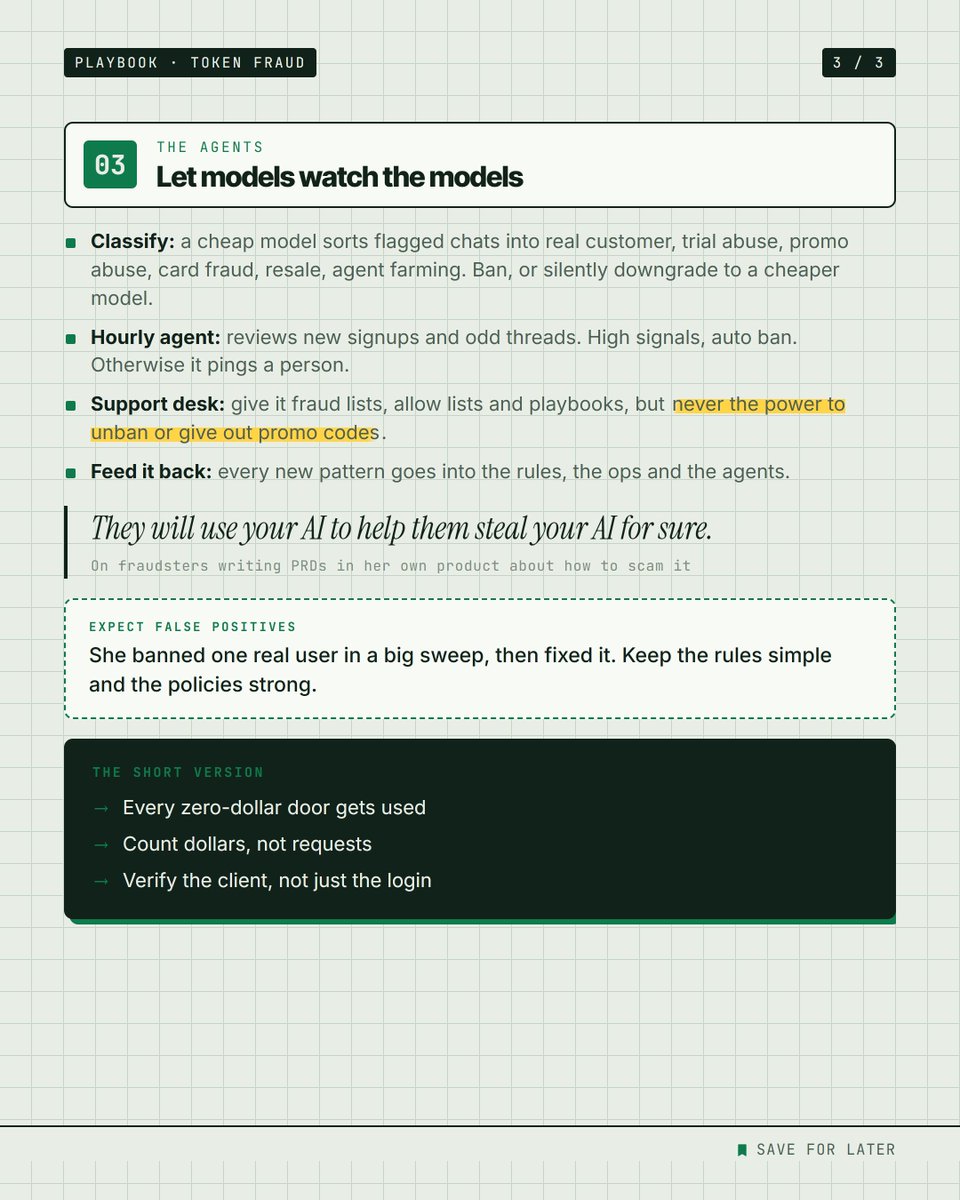
12. Have a cheap model sort flagged chats: real customer, trial abuse, promo abuse, card fraud, resale, agent farming. Ban, or silently downgrade them to a cheaper model.
Every one of these costs something real. Turning off trials cost her a source of leads.
Grok Bot: 5 setups that turn it into your content scout, designer and advisor 👇
Ras Mic calls himself a Grok Bot maxi. He uses it as a personal agent, and as the orchestrator that hands engineering work to Claude Code. These are the setups from his walkthrough worth copying.
1/ Set up a content scout that runs twice a day.
At 9am and 5pm, his YouTube bot goes through X. It sends three topics he would find interesting, based on the content he makes, with the tweets he could make videos from, a title idea and resources to add. It runs on Grok Bot's access to the X API, which he says feels close to unlimited. He doesn't use every idea, but he keeps up and always has a list.
2/ Build a design system before any code.
Find a site you like (he finds them on X and on Mobbin). Tell the agent to "create a design system using this site as reference" in Paper, which it works in through Paper's MCP. Tweak it, then reuse it across projects. To change something, leave comments on the design in Paper and tell the agent to address the comments. Code comes after the design is locked.
3/ Give each serious project its own bot.
A general engineering bot takes the small ideas. Anything you plan to launch or keep working on gets its own bot, with its own context. When a bot stops being useful, delete it. He calls the alternative bot fatigue: 15 bots for 15 different things.
4/ Give an advisor bot access to your money.
A finance plugin connects your accounts through Plaid, and the bots read your transactions. It tells you when you can't afford something, or when it goes against a goal you gave it. He uses it against his shiny object syndrome: a trucking company one day, a storage unit company the next. Sometimes it just tells him to relax and focus on the main thing.
5/ Run a security pass before real users arrive.
For any app that handles payments or sensitive user data, take the best model you have, run /goal and say "do security checks." If it refuses because it thinks you're trying to trick it, start a new thread and reword the prompt.
ChatGPT now has business profiles, much like Google Business Profiles. Nathan Gotch has already verified his company's. The setup:
Open ChatGPT. Click the three dots. Open Business Hub. Pin it there, because it is hard to find.
Click Add.
Prove you own the domain: a text file and DNS settings.
Scan your ID. Then do the face scan, turning left and right. It is strict, which tells you they want to stop people gaming it from day one.
Open Edit business info. Fill in every field: contact details, location, hours. Make sure each one is accurate.
Add at least three photos. Three is the minimum.
Open Products and upload a product feed. He had Claude build his, with three products.
Turn on a browser agent (he used Claude's browser extension). Have it audit the profile, list the weaknesses, then fix them. His profile had been audited before, and the second audit still found gaps.
Then check Overview. It gives you three numbers: mentions (how often you appear in ChatGPT answers, citations included), profile views (the side panel that opens when your name is underlined in a chat) and website clicks. Plus a list of discovery topics, which are vague.
That is all it shows. It will not tell you which prompts you lose or which pages ChatGPT cites. Keep your own prompt tracking for that, because the URLs cited again and again are your outreach list.
Nobody knows yet how much a verified profile moves your visibility in ChatGPT.
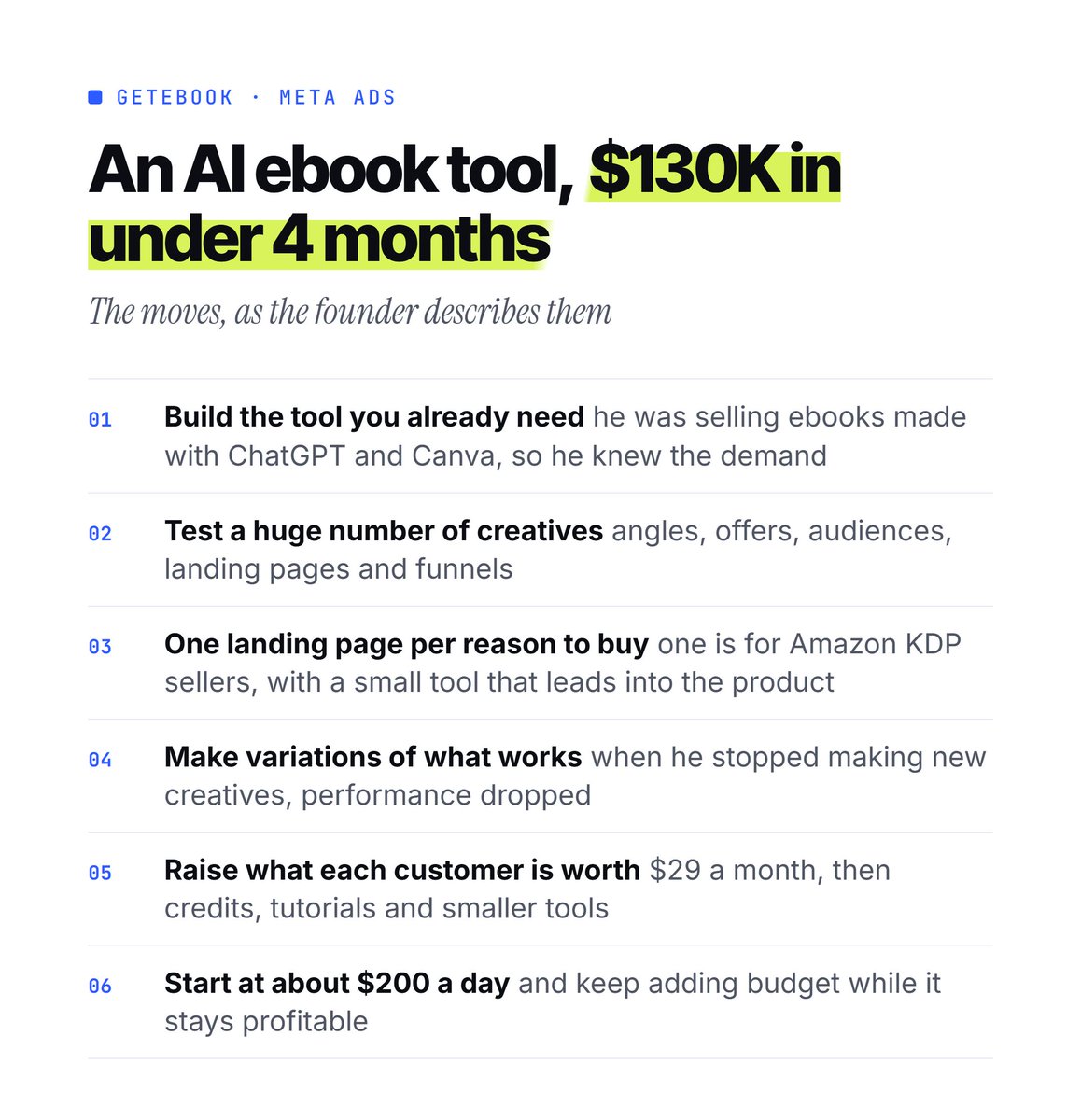
$130,000 in revenue in under 4 months.
1,700 paid customers.
$20,000 to $30,000 a month on Meta ads, at a 40 to 50% profit margin.
That is GetEbook, an AI tool that writes a whole ebook, built by a 28-year-old who runs a small marketing agency with his wife. The numbers are his, with the Stripe dashboard shown.
How he says it grew:
1. He built the tool he needed. He was already selling ebooks he made with ChatGPT and Canva, so he knew people buy the end product. The real proof came when the ads went live and strangers paid.
2. He tested a huge number of creatives. Not one homepage for everybody: angles, offers, audiences, landing pages and funnels, because people want it for different reasons. One wants an ebook to sell, another wants a lead magnet.
3. He built a landing page per reason. One is for people selling ebooks on Amazon KDP, with a small tool for them that leads into the product.
4. When an ad works, he makes variations of it. He learned this the hard way: he stopped making new creatives for a while, the campaigns kept running, and performance dropped.
5. He raised what each customer is worth. The subscription starts at $29 a month, then customers can buy credits, tutorials and smaller tools. That is what lets him spend more to win a customer up front.
6. He started at about $200 a day and kept adding budget while it stayed profitable.
The reason it worked, I think: he ran it as an ad business, not a SaaS with a homepage. The upsells after the sale are what let the ad budget grow from $200 a day.