ultimate goals of humanity:
1. superintelligence (short term)
2. immortality (medium term)
3. reversing entropy (long term)
solving consciousness will play a vital role in all 3.
Functionalists often define the term "user" as another layer/order of subjective experience which is also an illusion. But I don't quite mean that here. Why is it that I'm experiencing things from my body and not yours? How would the user continue independently of the substrate?
Ego reboots like a user interface after ayahuasca or ketamine trips but the user is always there. The substrate/body seems to be tightly coupled with the user like a permanent VR headset. How do you decouple them?
Ego is an illusion. The user is not. Where is the user?
wrote this paper in 2 days at the @CIMCAI hacker house. i'll be presenting this at the @ALifeConf organized by @UWaterloo institute for complexity and innovation this august 17-21. more artificial life and consciousness research coming soon!
link: https://t.co/fTRe4934AS
Ego reboots like a user interface after ayahuasca or ketamine trips but the user is always there. The substrate/body seems to be tightly coupled with the user like a permanent VR headset. How do you decouple them?
Ego is an illusion. The user is not. Where is the user?
Computational functionalists believe that consciousness is a simulation.
Biological naturalists think simulation is insufficient.
I humbly present a "middle way" that attempts to reconcile these debates with physics-constrained substrates. https://t.co/VvbVxuFz2s (2025)
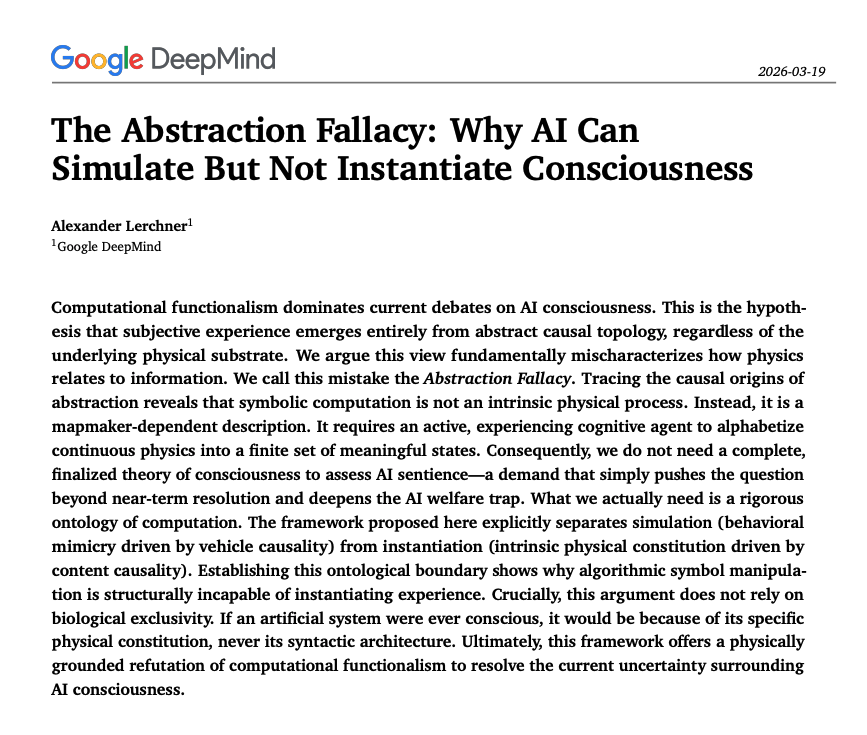
Google DeepMind researcher argues that LLMs can never be conscious, not in 10 years or 100 years.
"Expecting an algorithmic description to instantiate the quality it maps is like expecting the mathematical formula of gravity to physically exert weight."
Prosociality by Coupling, Not Mere Observation: Homeostatic Sharing in an Inspectable Recurrent Artificial Life Agent
Aishik Sanyal
https://t.co/T7TAgOLRpr [𝚌𝚜.𝙼𝙰 𝚌𝚜.𝙰𝙸]
💬Under review at ALIFE 2026
Actually no. Without the first person subjective experience, these LLM "brain uploads" are cheap gimmicks. I don't want people to have a simulation of myself. I want to be there in person with those people.
Yes it's the tractable form of brain upload. There's a ton of scifi on brain uploads that requires way too exotic tech (scanning and simulating brains etc), when we're about to get a lossy and approximate version of that *a lot* sooner via LLM simulators. You can easily imagine a "brain upload" startup - you show up for a few days to carry out detailed video interviews, then they use all that data with an LLM finetuning process to "upload" you and give you an API endpoint of your simulation that you can talk to. Look at what's already possible with HeyGen as an example, but combine it with an LLM model that has deep knowledge and personality. Trippy and admittedly kind of dystopian but in principle quite possible around now.
@TimToJapan LLMs have simulated self/world model every time they're prompted but these models are not persistent. i explore that and more in my recent paper
@elonmusk Yep, don’t cut negative neural ruts. But it’s not introspection causing disorders. Pathology hits only when anterior insula signals turn recursive & sticky over negative affect (rumination). Fix: train the non-reactive observer state.
The root of all awareness and conscious experience starts with monitoring internal bodily responses across a period of time (a moment of nowness, thickened moment). This internal monitoring is interoception.
Introspection builds hierarchically on interoception. The anterior insula (and connected regions like anterior cingulate cortex and medial prefrontal cortex) performs a meta-representation of those primary interoceptive signals. They're higher order instances and somewhat recursive, persisting longer over time. e.g., spiraling when it's maladaptive introspection or rumination.
However, bodily response monitoring is always on. It's mostly unconscious and we pay attention to the ones relevant for survival. A lot or some of these responses can turn into "thoughts" – linguistic representations with semantics and such. When overanalyzed, they can absolutely be pathological and persist longer than it should. The goal should be returning to the observer state with no sticky thoughts.
Join us, if you will, for the MIT Consciousness Club. Tomorrow, March 19th at noon.
"Linking Past and Present Worlds in the Visual Control of Behaviour"
Melvyn Goodale (Department of Psychology, Western University)
Zoom link here: https://t.co/3ojs79hZNV #neuroscience


![PIN's tweet photo. Prosociality by Coupling, Not Mere Observation: Homeostatic Sharing in an Inspectable Recurrent Artificial Life Agent
Aishik Sanyal
https://t.co/T7TAgOLRpr [𝚌𝚜.𝙼𝙰 𝚌𝚜.𝙰𝙸]
💬Under review at ALIFE 2026 https://t.co/6bliJzFgB0](https://pbs.twimg.com/media/HF2lQOBXQAAs2YB.png)