🦔UC Berkeley's computer science department just posted its worst failure rates in years. 35.3% of CS 10 students got F's in spring 2026, up from under 10% in prior semesters. Professor Dan Garcia says the primary driver is a "vast increase in academic dishonesty" through LLMs. Students use AI to complete assignments, never learn the material, then fail exams. His office hours, once full, are now empty.
My Take
Companies are firing experienced engineers while the pipeline that produces new ones is being gutted by the same technology. Students use AI to bypass the hard part of learning, show up to exams without the understanding, and fail. One professor discovered a student's linear algebra class had an "open AI" policy for homework and exams. That student then couldn't do basic linear algebra in the next course.
Both ends of the workforce are eroding at the same time. Senior engineers are getting cut to fund AI spending. Junior engineers are graduating without the skills because AI did their coursework. And the companies spending trillions on these tools haven't connected those two facts yet.
Hedgie🤗
🚨 Bloomberg: India's AI startup Sarvam AI was reportedly turned down by SoftBank, Prosus, a16z, General Atlantic and Accel during fundraising efforts.
• 🇮🇳 Sarvam is still on track to raise ~$300M at a ~$1.5B valuation
• Backed by Nvidia and focused on sovereign AI for India
India will never produce an NVIDIA, and it has nothing to do with talent. R&D is the purest form of investment, and the central bank has spent decades making investment the dumbest thing you can do with a rupee.
I've been surfing the semiconductor wave for a while now, reading 10-Ks for fun. Spent last month in the Bay Area and the gap between India and the US is not a gap; it's a different universe. Conversations about agentic AI and the next decade of hardware, with my boomer relatives Waymo-ing around SF and self-driving home on Tesla FSD like it's normal. Nobody there thinks any of this is remarkable; they already live in the future.
NVIDIA spends nearly twice as much on R&D as every listed company in India combined. Silicon Motion, the world's leading maker of NAND flash controllers and around since 1995, ploughs 29.7% of revenue back into R&D. Micron runs 10.2%, NVIDIA 9.9%, on revenue bases that dwarf anything we have. India Inc? 0.85% of turnover, and half our listed companies report zero R&D at all.
The easy move is to lambast our promoters and the dhandomaxxing capitalist class, or the foreign MNCs running India as a glorified offshoring unit, or the babus who fund nothing useful. Satisfying. But Wrong. The reason no rational Indian founder pours money into frontier R&D is that there is genuinely no payoff at the end of it. Why?
1. R&D compounds, and compounding punishes laggards. At the edge of science a 1-2% gain is a moat; Intel spent 20+ years performing impossible physics every 24 months because Moore's Law was the business model, and that consistency makes them one of the goated companies of all time even after they got mogged recently. NVIDIA lives the same way today: invent at the limit or cease to exist. If you're 50% behind, no quantum of innovation closes that. You never touch the high end. You stay a mass-market producer of things that already exist. India is precisely there.
2. The supply side is the real thesis, and it's monetary. Two decades of high inflation, high money-printing, high nominal rates. That regime subsidises consumption and taxes patience. R&D is the longest-duration, highest-variance bet on the board; it is the first thing a 8% risk-free rate kills. Frontier R&D only ever gets funded two ways: a psychopathically risk-tolerant capitalist with cheap capital, or a state with Stalin-grade control. The USSR took agrarian peasants to the first man in space in 20 years; China built its own version. India has neither the state capacity, the political will, nor the balance sheet to do that. So nobody does it.
Talent was never the bottleneck. Capital structure was. If you want a SpaceX or a TSMC born here, you need an environment where a conglomerate can deploy $10B and sleep at night: a low-rate regime that makes long-duration investment rational, IP and patent courts that actually function, and policy that doesn't get rewritten every 2-3 years on a minister's whim. Stability is the input. Innovation is the output.
Bay Area versus Bombay, we are several universes apart, and you cannot print your way across that distance; you can only compound your way there, and we've spent years optimising for the opposite. The gap won't be bridged. With luck, it narrows.
I am happy to report that we have developed the world's first biomaterial capable of regenerating cartilage damaged by osteoarthritis (OA). @AdvSciNews
https://t.co/znptDKCPP2
Let me explain the significance in a🧵1/7
It has been 16 years now that Magnus Carlsen is the highest-rated player in the world - he emerged as World no.1 in the January 2010 FIDE Rating list, and has since stayed there. A huge testimony to Magnus' unreal strength is, in his entire career there have only been 3 times he has lost twice to the same opponent in a classical tournament!
The first recorded instance we could find was in Linares-Morelia 2007 - a 6-player classical double Round Robin Tournament with the best players in the World. @vishy64theking Anand defeated Magnus with both colors, and went on to win the tournament a full point ahead of Magnus who finished 2nd!
In the Bilbao Masters Grand Slam Finals in 2008, it was Veselin Topalov who defeated Magnus with both colors. Topalov won the tournament!
Since then, there were no such events where Magnus lost to the same opponent twice in an classical event. That was until 2nd June, 2026 - Praggnanandhaa defeated Magnus Carlsen with both colors at Norway Chess 2026!
These stats speak to the amazing strength of Anand, Topalov, and Pragg - but perhaps more so about the incredible longevity of Magnus Carlsen! The World is looking forward to his last 2 classical games at Norway Chess - we'll see Magnus playing Classical Chess again at the FIDE Olympiad 2026 this September.
Photos: Oscar Javier, Nadja Woisin, Michal Walusza
#chess #chessbaseindia #magnuscarlsen
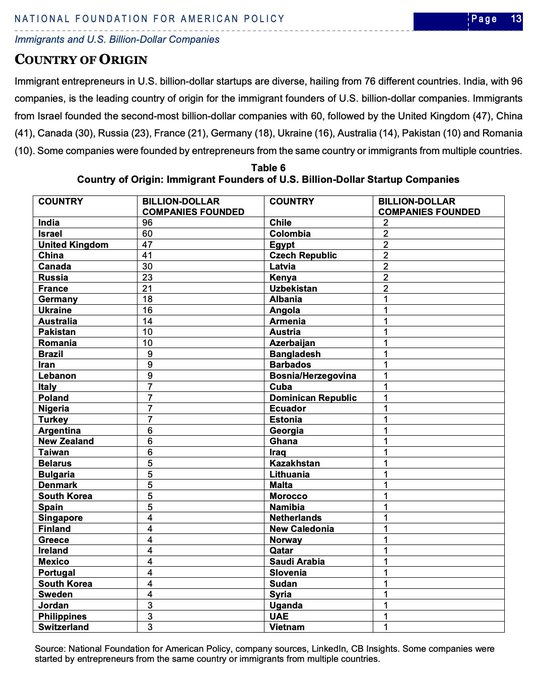
India has sent 96 people to America who started billion dollar companies. No one else is even close.
There's only about 5 million Indians in America. Almost one in 50,000 of them is a unicorn founder!
What a holy, special, beautiful people.
I will always fight for them.
I was reading up some papers in combinatorial optimization and came across this Taiwanese name "Gerard Jennhwa Chang". He has a strong publication record and I realized we both graduated from @Cornell_ORIE
Gerard Chang's google scholar: https://t.co/ByAOMgoFpo
I am excited to co-organize a two week school-plus-workshop on Worldsheet String Theory and String Field Theory at ICTS Bangalore from Nov 9 - Nov 20 later this year.
Interested PhD students, postdocs and faculty may please register at the link below: