"The winner will be the platform that feels the least like crypto."
This quote captures where fintech is heading. The companies innovating aren't adding features, they're removing complexity.
After researching how $CRCL, $FIS, and $SHOP are operating, I found some interesting data.
Market Insights:
🔹$81B in daily stablecoin transactions
🔹$400B+ projected stablecoin market cap by year-end
🔹800M+ weekly ChatGPT users creating shopping moments
🔹60-80% cost reduction through abstraction platforms
As AI agents execute more transactions, they need unified APIs, not fragmented systems requiring human judgment. Platforms that remove complexity will capture AI-driven commerce.
The deeper insight? Transaction data is key. Payment processing is a loss leader, but it unlocks vertical integrations into higher-margin financial services.
Full report with data, strategic frameworks, and forward indicators in the comments 👇
Sounds like there should be a platform that:
1) allows job seekers to upload their application and create a profile.
2) AI matches the application/profile with relevant employers
3) the hr team could evaluate the matches and reach out or the job seeker could be connected with the company recruiter
A system like this would reverse the current process for finding a job.
Instead of applying to 50 different companies and hr teams skimming through 100s of applications, someone could upload their app once.
Then AI would deliver the needle in the haystack to employers.
@itsolelehmann This is actually spot on. Writing is subjective and requires taste, judgement, and trust. Trying to automate this is very difficult.
Having llms edits rough drafts is fine, but I’d even say try to avoid this too. Llms can flatten voice and dilute ideas quick
@lennysan Mixed Signals: How Incentives Really Work by Uri Gneezy or a book on incentives in general would fit well in part 2.
It could fall under strategy, management, or leadership.
Understanding incentives is one of the most valuable topics to learn in life.
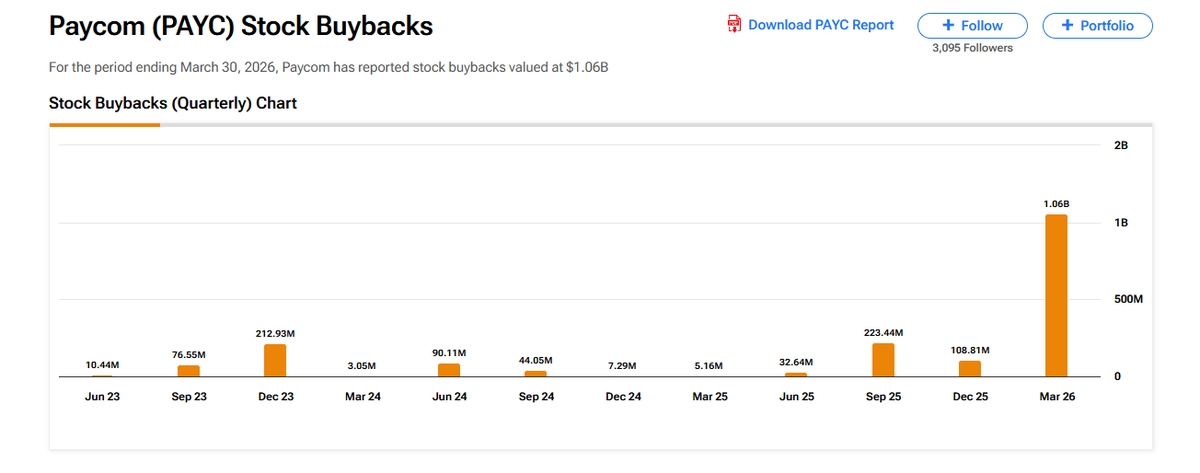
Just saw $PAYC repurchased roughly $1.06B of stock in Q1 2026. The company also approved a new $2B buyback plan in May 2026.
Paycom is a hr/payroll SaaS provider.
A public opinion on AI is that everyone will lose their jobs and enterprise software will be vibecoded.
If that's the case, why is a company that's in the business of serving employees this bullish?
On the recent earnings call, $JKHY said 88% of surveyed bank and credit union CEOs expect to increase technology budgets over the next two years.
Jack Henry & Associates is down 23.18% YTD.
This is a sticky, financial infrastructure provider. There is no way AI disrupts this platform in the near term.
Most community and regional banks do not want to build their own AI infra from scratch either.
JHA is in a position to be a trusted distribution layer for AI so the saas selloff doesn't explain the stock price.
What is the bear case for it?
I don’t know if this is technically possible but create a composite key by adding an immutable hash value to each uploaded video then connect it with a primary key associated with the creator’s account.
When someone downloads a video from X, the composite key is in the metadata.
If someone uploads the video to X, the algorithm could scan for the composite key.
If there is a match, it automatically tags the original creator.
If there is no match, a composite key gets created for the video.
In other words, give every uploaded video a social security number.
It's interesting to see blockchain usage in reality.
On May 5, 2026, $CPAY announced a partnership with JP Morgan and BVNK that connects $JPM 's blockchain, Kinexys, with Corpay's proprietary iACH network.
BVNK will provide the stablecoin infrastructure.
Customers will have the option now to transfer international payments with stablecoins alongside bank wires, SWIFT, etc.
Stablecoins are a major risk for companies that monetize international transfers, but integrating it into existing rails will help with reducing churn.
$CBOE 's top ten customers accounted for ~57% of revenue in 2025.
These are large market makers, liquidity providers, and proprietary trading firms but what's going to happen when equity tokenization, atomic settlement/self-clearing, and 24-hour trading begins?
Cboe could see an increase in revenue from SPX and VIX contracts due to an increase in trading activity, but if the top customers start routing orders to other exchanges, this would reduce liquidity resulting in a loss in revenue.
It's a tough position to be in cause it's a textbook case of innovators dilemma. It's either build the infrastructure for equity tokenization and reduce revenue from fees or make no changes and risk losing liquidity.
This is spot on advice. Having a back up plan ready at any moment is so important.
Living on one source of income from an employer is the absolutely riskiest and dangerous position to be in.
Financial freedom is thought of as having x amount of $ in the bank but it also means having options available, being able to take risks, and being able to say no to things.
Job security is an illusion. Building assets that compound and align with creating financial freedom is the top priority
My best guess would be, “if it ain’t broke, don’t fix it.”
You would know better than me but ai is great with greenfield projects. Pain in the neck with legacy codebases though.
Rewriting production code for the sake of using ai seems unnecessary if the code already works fine.
One could argue this would add costs, dependencies, and risk of critical errors.
Hey man, always looking forward to the Pitcherlist drops on Tuesdays. The notes really help with streaming sps in fantasy.
I recently build an mlb analytics tool that you might find useful for your research process.
It focuses on momentum data and tracks how well teams and players are performing over the past month.
For example, for individual players, it shows how well pitchers have performed over the past 2,3,4 starts. Chase Burns has a .72 ERA over the past 4.
You can access it anytime for free at
https://t.co/iVCgBmOel9
It's a daily newsletter but the app is at the bottom of each edition. Let me know if this helps any and if you have any features you'd like to see added. I'm always open to hearing feedback and suggestions on it.
One of the biggest changes I’ve made recently is I’ve stopped asking ai to proofread my writing.
There’s nothing wrong with that but the main goal of ai is to solve problems.
If I ask it for help with my writing, it assumes I think something is wrong so it provides recommendations.
This insight hit me when I noticed it never says “yeah this is fine” on first submission.
With proofreading, llms are great with making points sharper and fixing grammar mistakes but it takes away my voice and pulls the draft closer to average.
I firmly believe publishing raw, error-riddled drafts with color, character, and authenticity will only increase in social value as Ai usage with writing increases
@sama Wow, congrats @sama. This is a brilliant move for equity. A+ on strategy.
It’ll be fascinating to see what gets built.
Not only is this a win for OpenAI, but it’s also a unique way for the market to see what can actually be done with toxenmaxxing
You’re not alone. I retain maybe 10% with text. Even worse with audiobooks too.
This is great advice though, especially for measurable, objective-based learning.
For learning topics that are subjective or broad, say economics or technology as an example, I like to build my own table of contents.
Instead of reading cover to cover, I’ll just skim through all the chapters and index what I find noteworthy.
Then I’ll add this index into obsidian with relevant tags so it’s easy to access later.
This way, whenever I need to understand a specific topic better, I already have a list of handpicked resources readily available so I’m not starting from scratch.
It’s just a hacky way to build my own book for any topic of interest
Hey man, big fan of the podcast. Been a listener for years now. I built an mlb analytics tool that you, @CBSScottWhite, and @CPTowers might find helpful when doing research for your shows.
It's a daily newsletter that has:
- recaps for every game, every day
- momentum based individual player database that shows stats for each team from the past 7, 10, 21 days
- rolling stat tables for team based averages for bullpen, SP, and batting
and more. It's completely free to,
https://t.co/iVCgBmOel9
If you find this useful, feel free to share any feedback on it. I just created it and have a ton of features in line already but always open to feature recommendations
@suchenzang “A jack of all trades is a master of none, but more often than not, better than a master of one.”
This is the perfect framing for the current environment.
With all the doomerism on social media lately, this take is a breathe of fresh air.
Couldn’t agree more
@lulumeservey It really is wild. It’s mostly just text copied and pasted directly from a chat bot.
LinkedIn is even worse to. It’s as sloppy as slop gets over there.
Social media will be like a sea of bots in 3-5 years if it continues, but I’d bet it’ll reverse course soon. Kinda has to
Wouldn’t it be more practical for students/junior employees to learn new skills that are in demand own their own though?
College is great for credentialism, networking, and placing students at the center of a bell curve with fundamentals.
Degrees open doors but having agency and the ability to sell is just as important, if not more important, than technical capabilities.
It’s definitely a subjective topic. This isn’t an exhaustive list but the first areas that come to mind are entrepreneurship, healthcare, and education.
For the sake of brevity, I would just answer that by saying I believe every industry will benefit in some way from Ai, and this value add will trickle down to the consumer.
I don’t know how statistically true this is, but as tech advances, quality of life increases with it.
For white collar job loss, that’s a valid concern. I would argue will likely see job demand increase over the next 5 years though. Jevons Paradox is real.
The jobs offers will look different but I can’t imagine a world where people are living on ubi and agentic ai runs society. Especially with how constrained compute, power grids, and data center development is today