It’s the right time to re-read « Code as Design: Three Essays by Jack W. Reeves »
> …programming is fundamentally a design activity and that the only final and true representation of "the design" is the source code itself.
https://t.co/cUS3ZuPuMQ
A few random notes from claude coding quite a bit last few weeks.
Coding workflow. Given the latest lift in LLM coding capability, like many others I rapidly went from about 80% manual+autocomplete coding and 20% agents in November to 80% agent coding and 20% edits+touchups in December. i.e. I really am mostly programming in English now, a bit sheepishly telling the LLM what code to write... in words. It hurts the ego a bit but the power to operate over software in large "code actions" is just too net useful, especially once you adapt to it, configure it, learn to use it, and wrap your head around what it can and cannot do. This is easily the biggest change to my basic coding workflow in ~2 decades of programming and it happened over the course of a few weeks. I'd expect something similar to be happening to well into double digit percent of engineers out there, while the awareness of it in the general population feels well into low single digit percent.
IDEs/agent swarms/fallability. Both the "no need for IDE anymore" hype and the "agent swarm" hype is imo too much for right now. The models definitely still make mistakes and if you have any code you actually care about I would watch them like a hawk, in a nice large IDE on the side. The mistakes have changed a lot - they are not simple syntax errors anymore, they are subtle conceptual errors that a slightly sloppy, hasty junior dev might do. The most common category is that the models make wrong assumptions on your behalf and just run along with them without checking. They also don't manage their confusion, they don't seek clarifications, they don't surface inconsistencies, they don't present tradeoffs, they don't push back when they should, and they are still a little too sycophantic. Things get better in plan mode, but there is some need for a lightweight inline plan mode. They also really like to overcomplicate code and APIs, they bloat abstractions, they don't clean up dead code after themselves, etc. They will implement an inefficient, bloated, brittle construction over 1000 lines of code and it's up to you to be like "umm couldn't you just do this instead?" and they will be like "of course!" and immediately cut it down to 100 lines. They still sometimes change/remove comments and code they don't like or don't sufficiently understand as side effects, even if it is orthogonal to the task at hand. All of this happens despite a few simple attempts to fix it via instructions in CLAUDE . md. Despite all these issues, it is still a net huge improvement and it's very difficult to imagine going back to manual coding. TLDR everyone has their developing flow, my current is a small few CC sessions on the left in ghostty windows/tabs and an IDE on the right for viewing the code + manual edits.
Tenacity. It's so interesting to watch an agent relentlessly work at something. They never get tired, they never get demoralized, they just keep going and trying things where a person would have given up long ago to fight another day. It's a "feel the AGI" moment to watch it struggle with something for a long time just to come out victorious 30 minutes later. You realize that stamina is a core bottleneck to work and that with LLMs in hand it has been dramatically increased.
Speedups. It's not clear how to measure the "speedup" of LLM assistance. Certainly I feel net way faster at what I was going to do, but the main effect is that I do a lot more than I was going to do because 1) I can code up all kinds of things that just wouldn't have been worth coding before and 2) I can approach code that I couldn't work on before because of knowledge/skill issue. So certainly it's speedup, but it's possibly a lot more an expansion.
Leverage. LLMs are exceptionally good at looping until they meet specific goals and this is where most of the "feel the AGI" magic is to be found. Don't tell it what to do, give it success criteria and watch it go. Get it to write tests first and then pass them. Put it in the loop with a browser MCP. Write the naive algorithm that is very likely correct first, then ask it to optimize it while preserving correctness. Change your approach from imperative to declarative to get the agents looping longer and gain leverage.
Fun. I didn't anticipate that with agents programming feels *more* fun because a lot of the fill in the blanks drudgery is removed and what remains is the creative part. I also feel less blocked/stuck (which is not fun) and I experience a lot more courage because there's almost always a way to work hand in hand with it to make some positive progress. I have seen the opposite sentiment from other people too; LLM coding will split up engineers based on those who primarily liked coding and those who primarily liked building.
Atrophy. I've already noticed that I am slowly starting to atrophy my ability to write code manually. Generation (writing code) and discrimination (reading code) are different capabilities in the brain. Largely due to all the little mostly syntactic details involved in programming, you can review code just fine even if you struggle to write it.
Slopacolypse. I am bracing for 2026 as the year of the slopacolypse across all of github, substack, arxiv, X/instagram, and generally all digital media. We're also going to see a lot more AI hype productivity theater (is that even possible?), on the side of actual, real improvements.
Questions. A few of the questions on my mind:
- What happens to the "10X engineer" - the ratio of productivity between the mean and the max engineer? It's quite possible that this grows *a lot*.
- Armed with LLMs, do generalists increasingly outperform specialists? LLMs are a lot better at fill in the blanks (the micro) than grand strategy (the macro).
- What does LLM coding feel like in the future? Is it like playing StarCraft? Playing Factorio? Playing music?
- How much of society is bottlenecked by digital knowledge work?
TLDR Where does this leave us? LLM agent capabilities (Claude & Codex especially) have crossed some kind of threshold of coherence around December 2025 and caused a phase shift in software engineering and closely related. The intelligence part suddenly feels quite a bit ahead of all the rest of it - integrations (tools, knowledge), the necessity for new organizational workflows, processes, diffusion more generally. 2026 is going to be a high energy year as the industry metabolizes the new capability.
Few thoughts on retail investing since it’s popping up again on FinTwit:
- As I’ve said before, I think it’s probably the lowest ROI activity you can do if you’re trying to get rich. Focus on your career
- You should index 90% of your money
- You have zero edge day to day. Your advantages are that you have duration, no mandate, and nobody forcing you to sell
- It follows that the fewer trades you do, the better. The more trades you do, the worse you will do
- Process is the only thing that matters. How rigorous is your process? How do you reflect on what worked and what didn’t? Do you even know why it worked? Otherwise it’s just luck. For most people is still probably just luck.
- Your biggest enemy is yourself. You have no institutional guardrails to stop you from doing stupid things
- If you are thinking of it YTD you have already lost. That’s not your game, and is a recipe for failure. Trying to beat the market every single year will cause you to overtrade, where you have a structural and insurmountable disadvantage
- It’s OK to just do it for the love of the game. Because it’s the greatest game on earth!
Even stronger political signaling from Xi Jinping on the urgency of fixing China’s consumption + domestic demand shortfall problem. In a new Qiushi article published today titled “Expanding Domestic Demand Is a Strategic Choice,” Xi elevates weak domestic demand to a core issue of economic stability and security, making clear that the pivot toward domestic demand is no longer optional. The piece is very direct in identifying insufficient domestic demand as the most pressing problem facing the economy and calls for moving faster to close the consumption gap so domestic demand can become the main engine and anchor of growth:
扩大内需既关系经济稳定,也关系经济安全,不是权宜之计,而是战略之举...
要加快补上内需特别是消费短板,使内需成为拉动经济增长的主动力和稳定锚...
Xi then argues that the real advantage of a big economy like China lies in its ability in domestic circulation, stressing that stronger domestic demand does not contradict opening up but instead strengthens China’s position in global competition:
大国经济的优势就是内部可循环...
要牢牢把握扩大内需这一战略基点... 更多依托国内市场实现良性循环
扩大内需和扩大开放并不矛盾... 国内循环越顺畅,越能形成对全球资源要素的引力场,越有利于构建新发展格局,越有利于形成参与国际竞争和合作新优势
The article then puts particular weight on consumption, emphasizing that boosting demand ultimately depends on: employment, social security, and redistribution, especially expanding the middle-income group so households both can spend and feel secure enough to do so:
扩大消费最根本的是促进就业,完善社保,优化收入分配结构,扩大中等收入群体,扎实推进共同富裕。
要建立和完善扩大居民消费的长效机制,使居民有稳定收入能消费、没有后顾之忧敢消费、消费环境优获得感强愿消费
Then Xi calls for more disciplined investment, prioritizing new infrastructure, high-tech manufacturing, strategic emerging industries, reviving private investment, etc.
要完善扩大投资机制,拓展有效投资空间,适度超前部署新型基础设施建设,扩大高技术产业和战略性新兴产业投资,持续激发民间投资活力
One thing to note: the piece links domestic demand with supply-side reform, arguing that higher-quality, more self-reliant supply must not only meet existing demand but also actively create new demand, etc. So the near-term policy levers are still likely to be on the supply side.
ht @shuizaiping2
So after all these hours talking about AI, in these last five minutes I am going to talk about:
Horses.
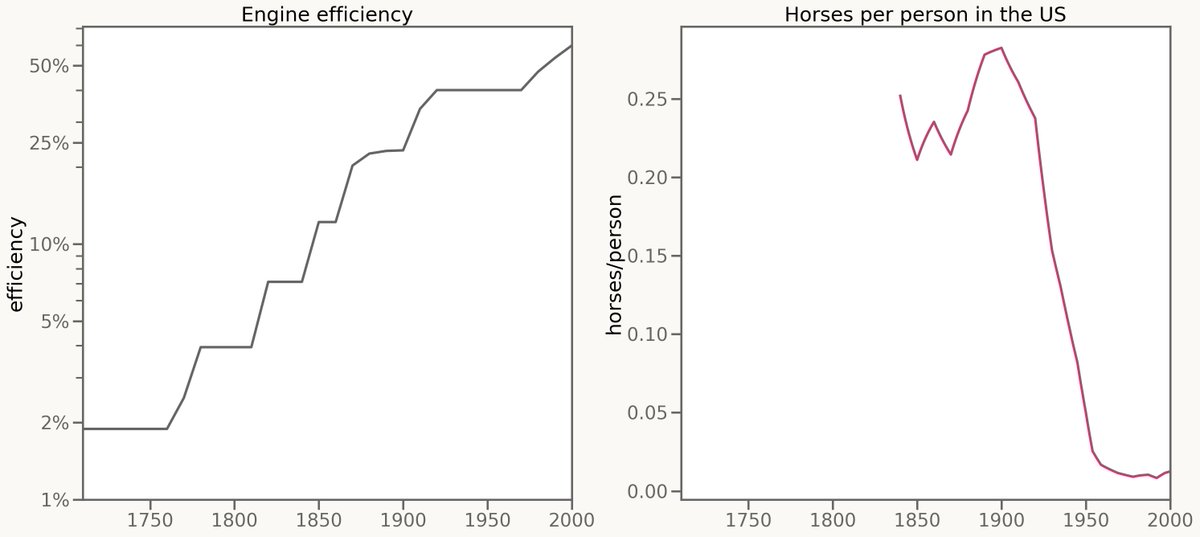
Engines, steam engines, were invented in 1700.
And what followed was 200 years of steady improvement, with engines getting 20% better a decade.
For the first 120 years of that steady improvement, horses didn't notice at all.
Then, between 1930 and 1950, 90% of the horses in the US disappeared.
Progress in engines was steady. Equivalence to horses was sudden.
a lot of books predicting the future have said the age of internet will make everyone smarter because of access to knowledge is everything ever written
but we're becoming retarded, chatgpt says we're always right as we consume another youtube short, predicting behavior is hard
So for 5 years, “offline” has been the #1 request.
Today, thanks to the perseverance of our engineering team, @NotionHQ finally works offline. Your ideas don’t need Wi‑Fi to exist!
For Notion community: thank you for your patience while we built this right.
This is a journey, I want to share what we had to invent to make this real... 1/n