Introducing ACM: Agentic Context Management for Long-Horizon Tasks.
ACM teaches agents when and how to manage context on its own — no forced compression, no loss of discarded details. It keeps short-term working memory clean and long-term external memory stable.
[1/9]
Introducing ACM: Agentic Context Management for Long-Horizon Tasks.
ACM teaches agents when and how to manage context on its own — no forced compression, no loss of discarded details. It keeps short-term working memory clean and long-term external memory stable.
[1/9]
Many strong prior and concurrent works explore context management from complementary angles. If you have time, we highly recommend reading:
ReSum: https://t.co/ERoh5Il9SJ
ACON: https://t.co/lLjjIcfeGY
SUPO: https://t.co/ITu5s7ONhr
CompactionRL: https://t.co/dlKkyjo2F5
SelfCompact: https://t.co/8mBq9SzVq3
AutoCompact: https://t.co/NYAkRJWJ7X
And more...
Hope context management becomes foundational for agents! [9/9]
We release the full pipeline, training data, rollouts, and model checkpoints.
Code: https://t.co/f1roncE7Gf
Paper: https://t.co/bGk3xUnma5
Hugging Face: https://t.co/oWRekBkUql
Feedback and discussions are very welcome! [8/9]
💻 Meet Qwen-CUA — our native computer-use agent for (almost) everything.
Code, APIs, and computer use are three of the most important interfaces for agents. Today’s models are already highly capable with the first two. Qwen-CUA is built to unlock the third: graphical interfaces designed for people.
👀 Native Perception — screenshots only. No DOM, accessibility tree, or other hidden machine-readable state.
🖱️ Native Interaction — keyboard and mouse events across browsers, desktop apps, and professional software. No task-specific APIs.
🧠 Native Intelligence — maintains long-horizon visual context, verifies progress, and learns from large-scale interactive experience with verifiable outcomes.
To make native computer use trainable at scale, we built approximately 40K verifiable tasks and rollout infrastructure with nearly 100K vCPUs, supporting tens of thousands of concurrent environments.
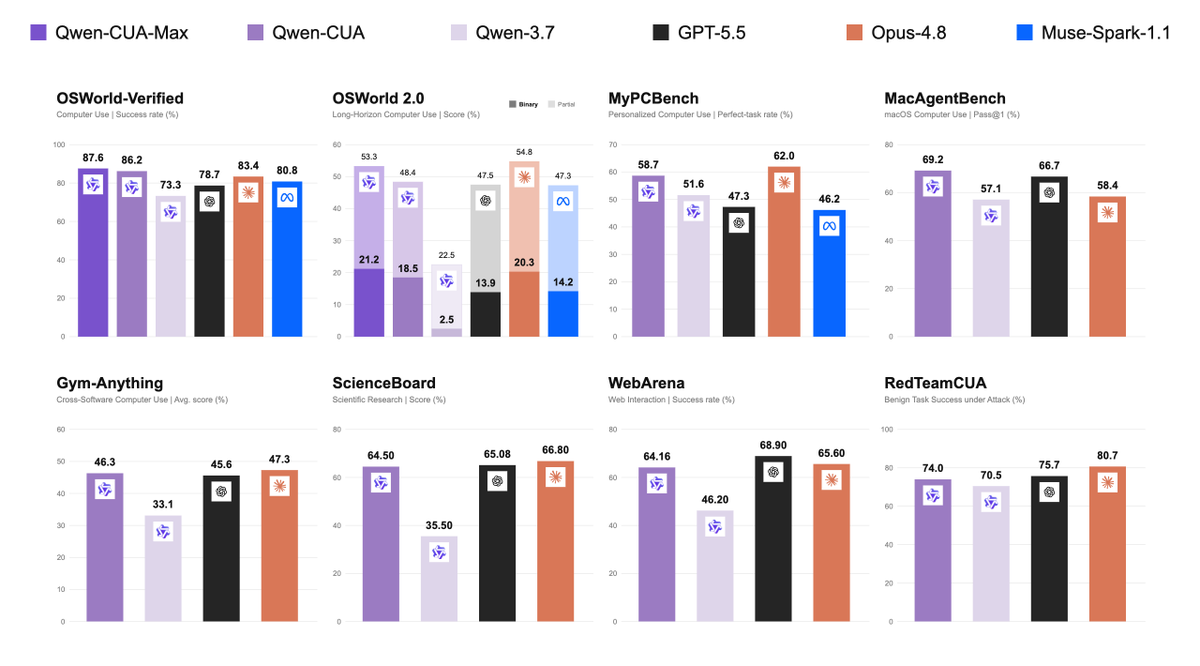
Across eight computer-use benchmarks spanning everyday desktop use, long-horizon workflows, personalized computing, scientific research, web interaction, macOS, and adversarial robustness, Qwen-CUA demonstrates strong and broadly competitive capabilities. Scaling the same recipe to Qwen-CUA-Max pushes this frontier further.
Not just “clicking the screen” — native computer use unlocks software and workflows that previously required a human at the keyboard. Together with code and APIs, it completes the interface stack for more general agents.
Joint work by Qwen Team × XLang Lab.
📖 Technical Report:
https://t.co/k0p1clnN7i
💻 Code:
https://t.co/r10vRIDFiV
🚀 OpenRSI is a new open research series from @FrontisAI for concrete, testable progress toward recursive self-improvement (RSI).
As its first project—and also my first work as first author—I’m proud to present OpenMLE: an open full-stack AI4AI system for autoresearch, where evolutionary agents improve ML solutions through executable feedback.
OpenMLE has three components:
- OpenMLE-Gym: 5,758 executable tasks + evaluators
- OpenMLE-ERL: execution-grounded SFT + RL
- OpenMLE-Evo: experience-guided long-horizon search
🏆 The full system—our trained Frontis-MA1-35B model paired with OpenMLE-Evo-Max—reaches 71.21% Medal Average on MLE-Bench Lite: surpassing GPT-5.5 + Codex (68.18%) and just 1.52% from GPT-5.6 Sol + Codex and the 2.8T Kimi K3 + Claude Code (72.73%). Budget: 12 hours/task on one RTX 4090 capped at 12 GB VRAM.
🌍 On 10 held-out NatureBench Lite tasks, both components transfer:
• same framework, model swap: Match-SOTA 50% → 70%
• same base model, framework swap: Match-SOTA 20% → 50%
🔓 Paper, code, models, data, and analysis below. 🧵
A2A, MCP, WebMCP -- the agentic web is being built fast. But almost no one is measuring whether agents actually coordinate well when every site hides its content behind its own agent.
Our #ICML2026 paper (@icmlconf) introduces 🌐 AgentWebBench https://t.co/FawChL4nGY
Auto Research is moving fast, but one capability is still under-tested: can an AI scientist update causal beliefs by doing experiments?
CausaLab asks agents to observe, intervene, and recover the mechanism—not just predict the answer.
92% task accuracy ≠ causal understanding.
Static benchmarks are dying — they tend to get saturated quickly.
Evaluation and training data should co-evolve with frontier models.
We released BenchEvolver — a framework that automatically evolves saturated problems into harder, verified tasks for evaluating frontier models, which can also serve as useful self-improvement signals for RL.
New work from UC Berkeley @berkeley_ai@BerkeleyRDI@BerkeleySky
Project Page: https://t.co/PL1KpGyd87
Paper: https://t.co/gBQOXrZbAV


![xiaochuanlee's tweet photo. Introducing ACM: Agentic Context Management for Long-Horizon Tasks.
ACM teaches agents when and how to manage context on its own — no forced compression, no loss of discarded details. It keeps short-term working memory clean and long-term external memory stable.
[1/9] https://t.co/MJT0X2mUNf](https://pbs.twimg.com/media/HO9n7p8XsAEIeXq.jpg)