The French hate air conditioning.
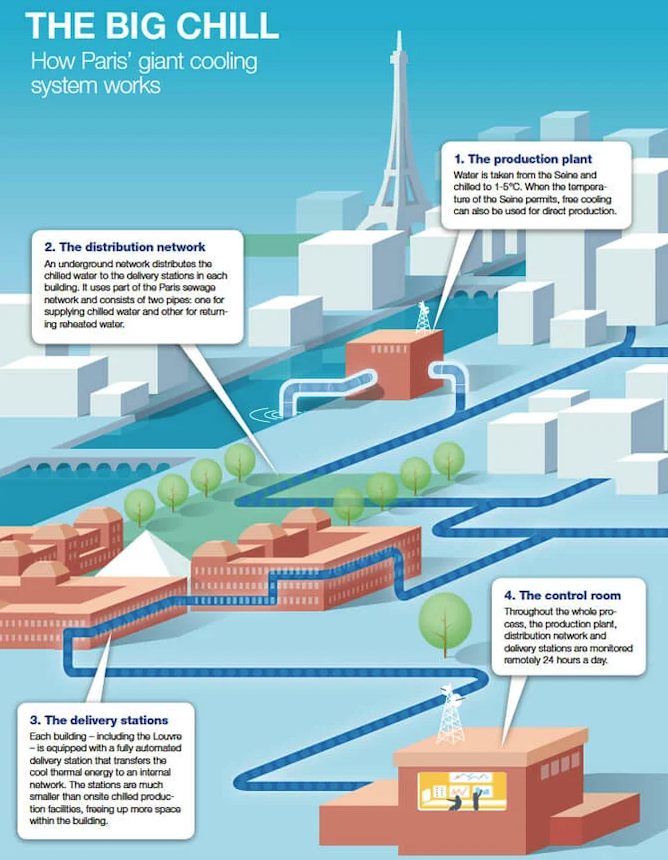
So Paris built a 120-kilometre machine under its streets for producing cold.
It’s called Fraîcheur de Paris, and it does for summer heat what district heating did for winter: centralise the problem.
Instead of every museum, office, hotel, hospital and shop bolting its own cooling plant onto the building, Paris moves cold through pipes.
The network sends water chilled to 2 to 4°C through buried supply lines. The water enters a connected building, absorbs heat through an exchange station, then returns at 12 to 14°C to be cooled again.
It essentially functions with two pipes. One carries the cold out, the other carries heat back.
The production plants cool the circuit from 12°C to 4°C. Some sites use the Seine as a heat sink. In colder periods, the system can use the river’s own temperature for free cooling, which means the machines work less and the electricity demand drops. The Seine water doesn’t become the building water. It stays separate, passing temperature across heat exchangers.
The scale is pretty strange when you see it written down though.
It's got 15 production sites, 4 storage sites, 120 km of underground network with 924 subscribers. This has resulted in 7 million square metres cooled, and 493 GWh of cooling sold.
A cold utility running beneath one of the densest cities in Europe.
The Forum des Halles has been cooled this way since 1979. The Louvre since 1986. Galeries Lafayette, Opéra Garnier, Hôtel de Ville, Station F, La Samaritaine and the National Assembly all sit on the same idea. Tourists stand in the Louvre looking at paintings while a municipal cold loop does part of the dull work below ground.
The boring part is the breakthrough.
Cold can be stored at night in chilled water or ice, then used during daytime peaks. The network is monitored from a control room with more than 125,000 control points. A delivery station inside a building takes 5 to 7 times less space than a standalone cooling installation and avoids the roof and façade clutter that turns cities into compressor farms.
That matters because conventional air conditioning solves heat by moving it somewhere nearby. In a dense city, thousands of private machines mean thousands of outdoor units rejecting heat into streets, courtyards and roofs, plus refrigerants, noise, vibration and maintenance spread across every building.
Paris’s public cooling network has a stated coefficient of performance of 4, against 3 for a wet standalone system and 2 for a dry standalone system. Against an equivalent set of autonomous installations, Fraîcheur de Paris says the network gives 100% higher energy efficiency, 35% less electricity use, 90% fewer refrigerant-fluid emissions and 50% lower CO2 emissions.
The climate backdrop is the real reason this exists.
Paris ran a full crisis exercise called “Paris at 50°C” in 2023. Météo-France’s 2050 reference trajectory for France points to heatwave days becoming five times more frequent, hot nights rising sharply in urban centres, and some local extremes around 48°C becoming possible.
The city signed a 20-year concession in 2022 with Fraîcheur de Paris, owned 85% by ENGIE and 15% by RATP. The contract is worth a projected €2.4 billion. The plan is to extend the network by 158 km by 2042, add 20 production plants and 10 storage sites, and reach more than 3,000 subscribers, including hospitals, nurseries, schools and care homes.
This is basically the infrastructure version of admitting that summer is becoming a public systems problem...
"While Stewart-Williams argues that there are inherent differences between men and women, he [...] recommends that people choose work and lifestyles that suit their health, gender, and interests."
@SteveStuWill
https://t.co/5lOxFJgigy
Dans le manifeste "techno-optimiste" de Marc Andreessen, il y a une phrase qui m'a marqué :
"Our enemies are not bad people – but rather bad ideas."
Nos ennemis ne sont pas des mauvaises personnes. Ce sont des mauvaises idées.
Prenons Jancovici. L'homme est brillant, sincère, travailleur. Il ne se lève pas le matin en se disant qu'il va nuire à l'humanité. Mais l'idée qu'il porte la décroissance, le rationnement, la frugalité érigée en horizon civilisationnel est une idée profondément destructrice. Elle prend des esprits brillants et les transforme en commissaires politiques d'un futur appauvri.
Et le plus fascinant, c'est ce que cette idée fait aux gens qui l'adoptent.
Dans mon entourage, une grosse partie de mes amis est sur cette ligne décroissantiste, avec tout le package qui va avec. L'argent c'est mal mais ils en veulent. Il faut moins prendre l'avion mais ils rêvent de voyager partout. Il faut consommer moins mais ils ne renoncent à rien de ce qu'ils aiment vraiment.
Et tous ont un point commun : ils sont déprimés. L'un d'eux m'a même confié qu'il était sous antidépresseurs.
Ce n'est pas un hasard. C'est mécanique.
Quand tu crois que ton désir de vivre, de créer, de t'élever est moralement suspect tu te détruis de l'intérieur. Tu passes ta vie à t'excuser d'exister. Tu vis dans la dissonance permanente entre ce que ton corps veut (plus, mieux, plus loin) et ce que ton idéologie t'ordonne (moins, sobre, immobile).
D'où ma théorie :
Quand on pense quelque chose de fondamentalement faux décroissance, communisme, extrémisme religieux (de tout ordre) ce n'est qu'une question de temps avant que ça devienne vraiment destructeur.
D'abord pour soi. Puis pour les autres.
Les mauvaises idées tuent. Lentement chez ceux qui y croient, brutalement chez ceux qui les subissent.
C'est pour ça que la bataille des idées n'est pas un luxe d'intellectuel. C'est la bataille la plus importante de notre époque.






![MalePsychology's tweet photo. "While Stewart-Williams argues that there are inherent differences between men and women, he [...] recommends that people choose work and lifestyles that suit their health, gender, and interests."
@SteveStuWill
https://t.co/5lOxFJgigy https://t.co/otUayEkSh5](https://pbs.twimg.com/media/HJcNzCOXYAUfLgM.jpg)