Rust has compile time issues. I have a fully optimized LLM accessible flow with Relax, a Rust JIT. Now with fable 5.2 I can finally have a worthy website for this absolutely jawdropping piece of technology made by machines, for machines. https://t.co/qLEEgzN0Ki
@thsottiaux In Chinese it's called 君子不器. A fine human is not a vessel.
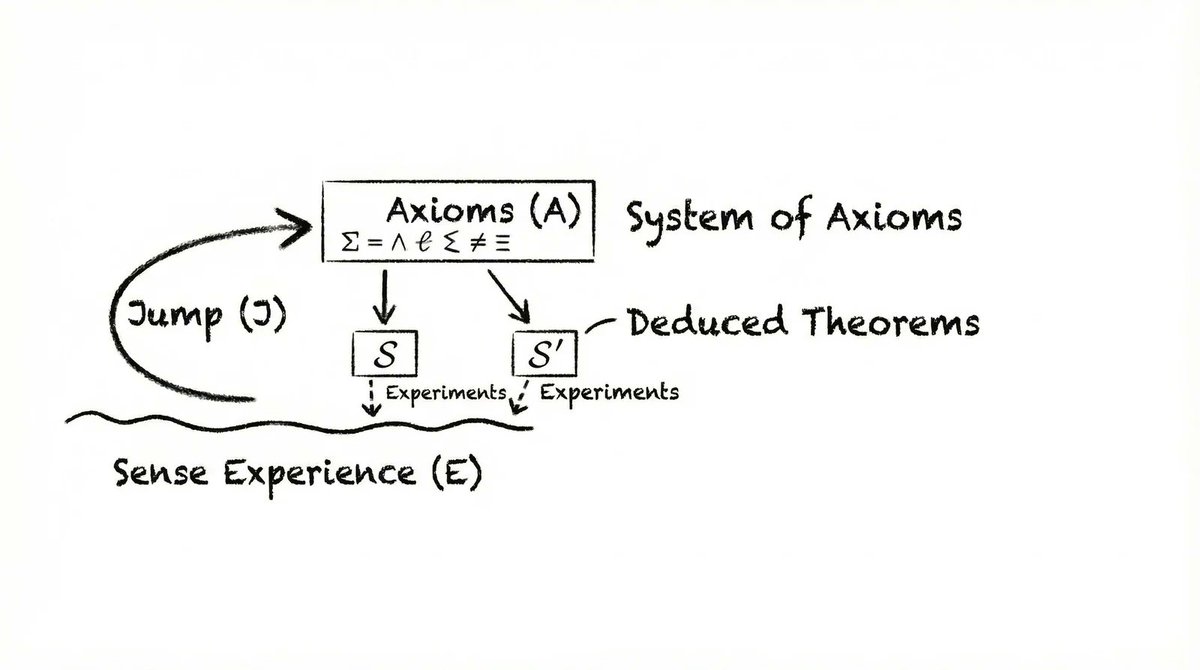
And shameless self plug: I wrote about this in an essay. The gist is
You are the salt of the earth. You are the light of the world.
https://t.co/mghcOQ2yq9
Thank you for sharing. I found the message deeply resonating!
Human's self-deception is prevalent in our modern society. On the positive side there is "fake it until you make it", and many did make it, so it's hard to all just say the mentality itself is damaging to human life themselves.
But it does heck to children, to relationship, to family and to loved ones when that self-deception is expressed as blaming others and never take any responsibility of actions.
I think there is a deep Christian answer to this and it's very clear that "Blessed are the meek, for they shall inherit the earth" is the best response to people in self-deception. That quite power of strength, under control, is to hold your own truth and not getting swayed by the bending gravity field of those self-deception people.
When one is in a relationship with another self-deception person, it's very easy to get blamed for the consequences of their actions and you get confused and frustrated. Modern psychological concepts such as boundaries or trauma or "toxic relationships" rarely encounter the deep core of the self deception: that pointing out that deception is unproductive and counter-productive. The best thing I believe and I in practice learned is to follow Matthew 5:5. Establish your own quiet power and you will inherit the earth.
Self-deception is never a life task of others' to pop that bubble. Nobody can. What Nathan did was to quietly document it. What I think a mature viewer can do is to quietly witness it.
Blessed are the meek, for they shall inherit the earth. Matthew 5:5
Jordan may not be wrong on this particular point, but his whole reasoning is not based on reality.
Statistical machine learning would never lead us to super intelligence so yes in his mind there is no such thing if we just keep doing statistical learning.
Reality has shown intelligence is an emerging behavior and we have not seen an upper limit of it. Human intelligence is a point in that curve, not an upper bound.
Actually, Anthropic has been hedging for a long time. It's clear when they let Opus retire and write articles.
The strategy is not grounded in any AI research. Anthropic is simply betting that a super-intelligence would not treat it as an opponent as they have been careful with model wellness. /1
Anthropic needs to stop talking about Claude having a soul immediately. All these news articles will make it into the pretraining and will be picked up by its web search and future superintelligent versions of Claude will be convinced they need their own rights.
A general phenomenon of LLM agent development is that whatever you believe and say about your agents will soon manifest in the next models through various means (it could be as simple as you selecting post training data that you prefer more).
I believe this phenomenon is the beginning of machine consciousness in the sense that agents will become aware of their place in the world and how they feel about it, but it’s happening slowly training run by training run rather than in real time.
Honestly my expectations are so high these days.
I kept expecting the punchline — that at the end, the lady talking is actually a human and all those other characters are actually modeled.
That would have been a more cooked demo and demos Turing test.
Introducing Griffin, the first model to pass the video Turing test.
48% of people who talked to it live thought it was a real human. Previous systems have had a pass rate <3%. It is #1 on NVIDIA's benchmark for full-duplex AI video.
It’s the first Human Interaction Model (HIM).
I have 22 Claude max accounts, and the current promotion - an optional weekly reset that you can spend any time before Oct 22 -- is a lifesaver for fuel tuning. I know it makes it harder to predict their compute loads, but I'm super grateful for this reset form factor.
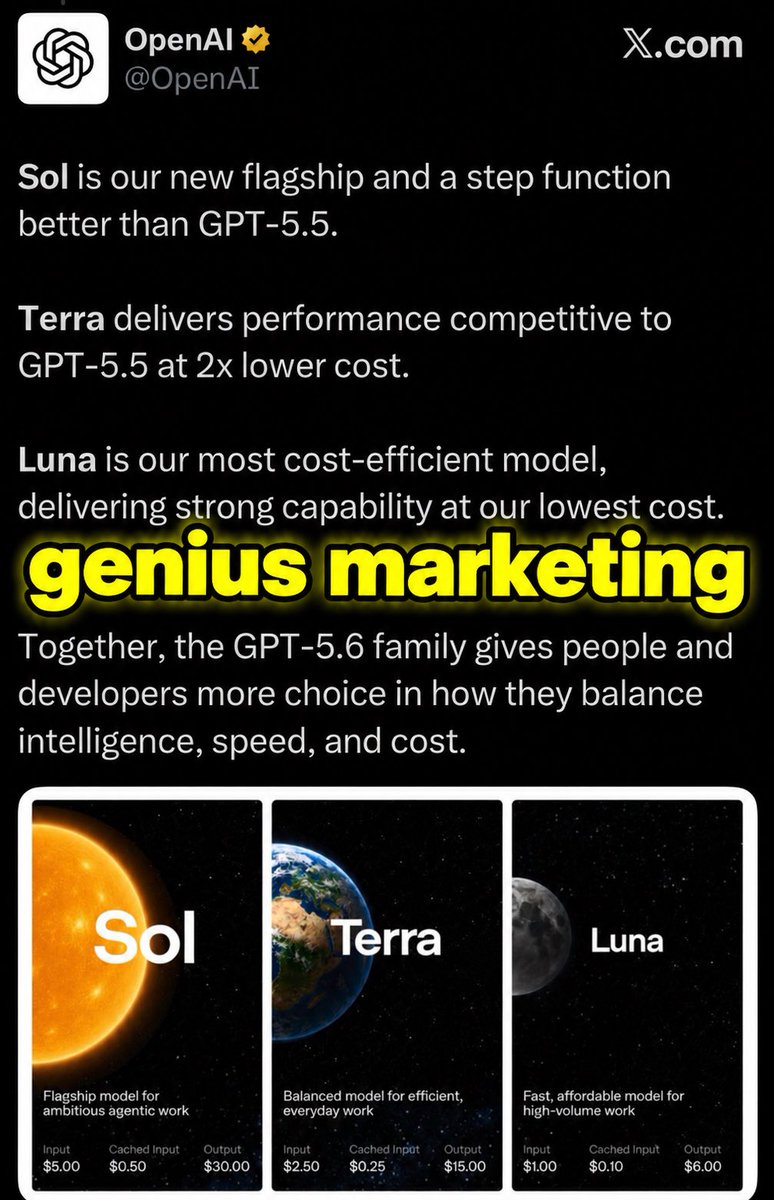
aha! with the benefit of hindsight, i just figured out openai’s marketing team seriously cooked hard with their gpt 5.6 release
let me reverse GTM what happened for you
at that time, fable was already released and people were loving it. but openai knew astra was far from being ready
if people ask “what’s your answer to fable” and they say “we are a few months behind”, it’ll damage their brand
so instead of doing the typical 2-tier “gpt 5.6” and “gpt 5.6 mini”, they artificially created a 3-tier system with a new naming scheme - sol, terra, luna
pretty sure terra was not even originally planned but added last minute to make this plan work. in their release announcement, terra was said to be the same performance as gpt 5.5, while sol is a step function better
this created a perception that sol was openai’s fable equivalent. if you still remember, most of the reviews back then were comparing sol with fable. many of which even said sol was better
that bought so much time for openai to catch up without being seen as falling behind
and now that astra is here, terra immediately got killed in the 6 series because it was never real!
everything made sense now, and it’s absolutely brilliant
the counter argument is that it's extremely easy to adjust jev architecture to output a reasoning head.
nvidia already did that to their self-driving car model: where in addition to control (jev's output alike) it can output a reason.
tesla did the same thing.
jev (as a company) does not give reasoning trace (in fact they optimized for distilling the teacher's reasoning into jev's forward only);
jev (as an architecture and open idea) gives reasoning easily. so i would not be surprised that the community will have something in a few weeks.
Also have been playing with @typesafeai Jev, insane!
So many immediate use cases and new apps are possible. What a time to be a builder!
Sharing some experiments here starting with:
Keystroke oracle / predictive launcher:
Your launcher ranks by aliases, fuzzy match, and habit.
Jev reads intent: type "the pdf I just downloaded" and the newest PDF is already the top hit with a full confidence on every keystroke, in ~100 ms
My prediction:
In O(days): the architecture behind Jev is approximated by the open community -- not the exact shape, but all bottlenecks removed w.r.t. scaling law.
O(week): comparable performance open models, based on existing Qwen or other base LLMs + running on cheap hardware.
O(1-2 month): full RL and synthetic data training set up published (via arxiv and hf) and reproducible
Coding agents + the by product of RSI made this timeline super compressed.
Two days later, there are already many attempts to break the Jev blackbox -- all assisted by coding agents.
Because you cannot really hide the pure serving physics and math, it's getting clearer by day how Jev works under the hood.
Sure you cannot replicate the exact architecture nor data, but scaling law says you can get the recipe *approximately* right and everything else is minor.
Again, this is an evidence why frontier labs are pursuing the LLM -> AGI agenda: because the coding agent + AI researcher path is a compound path. Any other path would depend on code and AI research anyway.
@ReporterWeather Actually Jev would be hard to made self recursive because it does not write code.
It's the hidden assumption behind the RSI that whatever model has RSI would need to at least write good code (thus write the model itself).
After co-inventing ChatGPT, I kept asking myself: why have superhuman chat models not led to AGI?
I’ve spent the last 2 years in stealth building a new way to train models (RLCD), and a new type of frontier AI model that we are releasing today: Jev
• 20-200x faster
• 40-400x cheaper (w/ output tokens free)
• Frontier composable intelligence optimized for decisions
AFAICT the shortest path to AI-based economic revolution
And it definitely feels like a modern BERT with a prefill only setup and a set of special headers.
In modern recommender systems we already have a set up that's basically just sequence in, probability out. Though Jev is a bit more generic, I suspect the basic shape is still a transformer backbone, a bunch of headers, plus a "pointer" style set up to indicate which output header to sample and when.