bill hwang was the egg man, leopold was not the egg man - looking at the archegos liquidation to understand how ken griffin executed the fake egg man trade
> bill hwang got liquidated in march 2021, he levered up to own 50%+ free float causing prices of those assets to skyrocket
> one of the companies, viacom cbs (now $PARA), noticing their stock has gone up a lot, issued a secondary stock offering. this dilutes the shares and led to the price to artiificially fall
> this caused bill hwang to get margin calls from the banks where he had split his viacom positions
> being levered to the tits on all his other positions, archegos (hwang's fund) couldn't meet those margin calls
> banks got together to discuss their archegos' obligations and they realized this guy has been longing the same stocks across all the banks
> the conference call ended with no resolution, but goldman sachs (and morgan stanley soon after) took the opportunity to dump/liquidate archegos' positions before everyone else could on friday into the weekend (margin call movie scene style)
> other banks (notably credit suisse) got stuck holding the bag of shit that was worth half of what it was worth a couple days ago (due to the GS/MS selling), with unrealized losses coming out of their own pocket
in the following weeks, people processed the news and realized there was no value in these stocks, other than the egg man bill hwang had been mindlessly buying them all up. the stocks never recovered
leopold's forced sale was different from bill hwang's blow up because
> according to the last 13F, SALT only owned around 2% of free float of $BE, $SEI and $HIVE. notably $SHAZ and $NBIS is at 20% and 5.6%
> archegos got fullly wound down URGENTLY by the banks, ken griffin is unlikely to wind down the entire position in the same fashion, the stocks are in smart hands
> SALT made popular bets. bill hwang was on a god given mission and bought huge % of companies that no one else was piling into. he was the egg man, leopold is a part of the egg fad and far from being the egg man
had leopold not been bailed out by ken, we could have seen a bill hwang style fire sale for $SHAZ and $NBIS, but because ken has stepped in, it is highly likely that many bystanders were shorting SALT stocks and covered as soon as they realized the fire sale isn't coming
masterclass by ken griffin and now this dip is likely to be an idiosyncratic side story in the unfolding AI bet concentration saga
🎙️ New @Edge_Pod
🔐 Ethereum Is A Vault, ETH Is The Lock: A Framework for ETH's Fair Value, Today and By 2030
0:00 - Intro
2:51 - Tom’s role investing at Varys
3:32 - DCF is the wrong way to value ETH
6:16 - Is Ethereum winning?
11:40 - Fees are friction, not how we value ETH
16:12 - Can Ethereum have its cake and eat it too?
19:45 - If Ethereum is the vault, ETH is the lock
23:58 - Why stablecoin numbers look bullish
27:04 - Ethereum must succeed, or crypto fails
28:59 - Comparison to Linux + DTCC is wrong
32:55 - Importance as trustware producing blocks
35:40 - Underestimating the L1 scaling
39:41 - Stablecoin issuers still rely on Ethereum
42:11 - The framework is for ETH, not DeFi tokens
45:15 - $20k - $50k price once liq hits $750B
47:33 - How Tom gets to a FMV today of $6.9k
52:59 - 2030 base case ($55k) vs bull case ($138K)
53:57 - Closing
🙏 Thanks to @VarysCapital Head of Venture, @dunleavy89, for joining us!
Verticals that most people agree "should" be big in crypto but mostly haven't taken off:
- Options
- Gaming
- Social
- DePIN
- Insurance
- Compute
- Identity
When do one of these pull an Augur--> Polymarket/Kalshi?
DeFi's loss-given-default problem is unlike anything in traditional finance.
When something goes wrong, it's immediate, total, and irreversible 😰
So why are depositors accepting 3%?
@dunleavy89 and @adcv_ debate it:
Timestamps:
🔥 01:14 How Tom and Adrian are rethinking yield rates after $606M worth of DeFi hacks in one month
📊 08:46 How TradFi prices risk, and why the same framework still applies to DeFi
⚠️ 13:54 The DeFi-specific risks TradFi can't model: hacks, oracles, governance, exotic collateral
🔢 18:20 Adrian on why loss-given-default in DeFi is 'almost total', and what that changes
🤝 23:52 Where Tom and Adrian actually disagree: resolution, not structure
📉 32:34 Luca Prosperi's additions: continuous collateral observation, liquidation timing, legal process
💬 41:49 Dan Robinson's pushback: if risk is mispriced, shouldn't demand fix it?
🏗️ 53:59 RWAs as collateral: why non-crypto-native assets may be the most dangerous mismatch
🔭 57:19 Which protocols actually reduce the risk premium, and how to think about the rest
After fielding a few hundred messages from teams, I wanted to give a few brief notes on best practices for engaging with VCs. These are my personal thoughts but I imagine most VCs would echo these. Mostly unfiltered thoughts below.
For Projects Pitching VCs:
1) Sell me your product in 1-2 lines MAX to start.
2) Following, tell me what your product actually does, why it's important, and ideally, why now is the right time for it. 1 paragraph.
3) Give me a handful of bullets on why I should REALLY be excited about you. Product features. User traction. Partnerships. Key Investors.
4) Always include your terms. Based on if you are raising a $3m or $30m round you will immediately exclude a certain set of investors.
5) ALWAYS include a deck or investment memo. If the above hooked me I am going to ask for it anyway.
6) Ideally, all of the above is in a TG blurb I can forward to my team or other interested investors.
7) Moving on to the deck. The deck should include at minimum: product overview, tech overview, business model, traction and GTM plan, team bios, competitive analysis, deal terms and investors, tokenomics (if applicable), runway and financial metrics.
8) Ideally, your deck is 15-20 pages. The rest of the details are for the data room.
9) Prob unpopular but the visual quality and attention to detail in your deck matter alot. I see 20+ decks a week. If it's obvious you made your deck in Claude vs have some clean awesome new presentation or visual I've never seen before, it is going to stand out regardless of the product. Not the end-all, be-all, but not worth ignoring.
10) DONT be pushy for a call immediately. Don't follow up after 24 hours. If a VC is interested they WILL follow up. If its been a week that's fair game to give a friendly nudge. Most VCs have dozens of deals in multiple stages of review.
11) Warm intros >>> everyone. Find someone who I know who can vouch for you.
12) Know the background and firm you are speaking with and what they are interested in. If they have never invested in your vertical and you saw they bashing it on a podcast prob not going to be the ideal investor for you.
13) I would probably love to meet you in person but only if we have already established interest on both sides. More likely we meet in person if there is a warm intro. More likely if we are both attending the same event already.
14) TG is generally the best place to get in touch with most investors. Emails are slow for discussion. Whats app/signal are mostly for your phone. Linkedin and X DMs are 99% spam and often unchecked.
15) Focus most of your initial efforts on your lead. 90% of investors won't commit until there is a lead or may be interested and back out if they dont like the lead or teams.
16) Unpopular one again but angel investor clout has basically lost all relevance unless the angel has some leverage they can provide your project. List less angels, less I think you are degen play screaming for CT clout.
The shift in the crypto fundraising landscape the past 6 months has been insane.
Crypto VCs used to have to constantly be networking/writing/podcasting/going on spaces/promoting your thesis/getting on 10 deal flow calls a week, to get into good deals...now it's literally enough to just have capital to write checks.
Deals are being pushed rather than dug out. Inbound if people know you have money is at an all-time high.
Most firms are either 1) Out of money 2) Moved to Series A and beyond or 3) Fundraising (with no success).
Deals that used to close in 2-3 weeks now close in 2-3 months.
Firms with questionable business models or copy pasta of the latest trend are getting zero primary or follow-on funding (Good news!).
There are now realistically <20 firms writing checks in pre-seed/seed.
VCs basically have the pick of any deal they want, with more time to do DD.
IMHO 25/26 are going to be historic vintages for those who stick around.
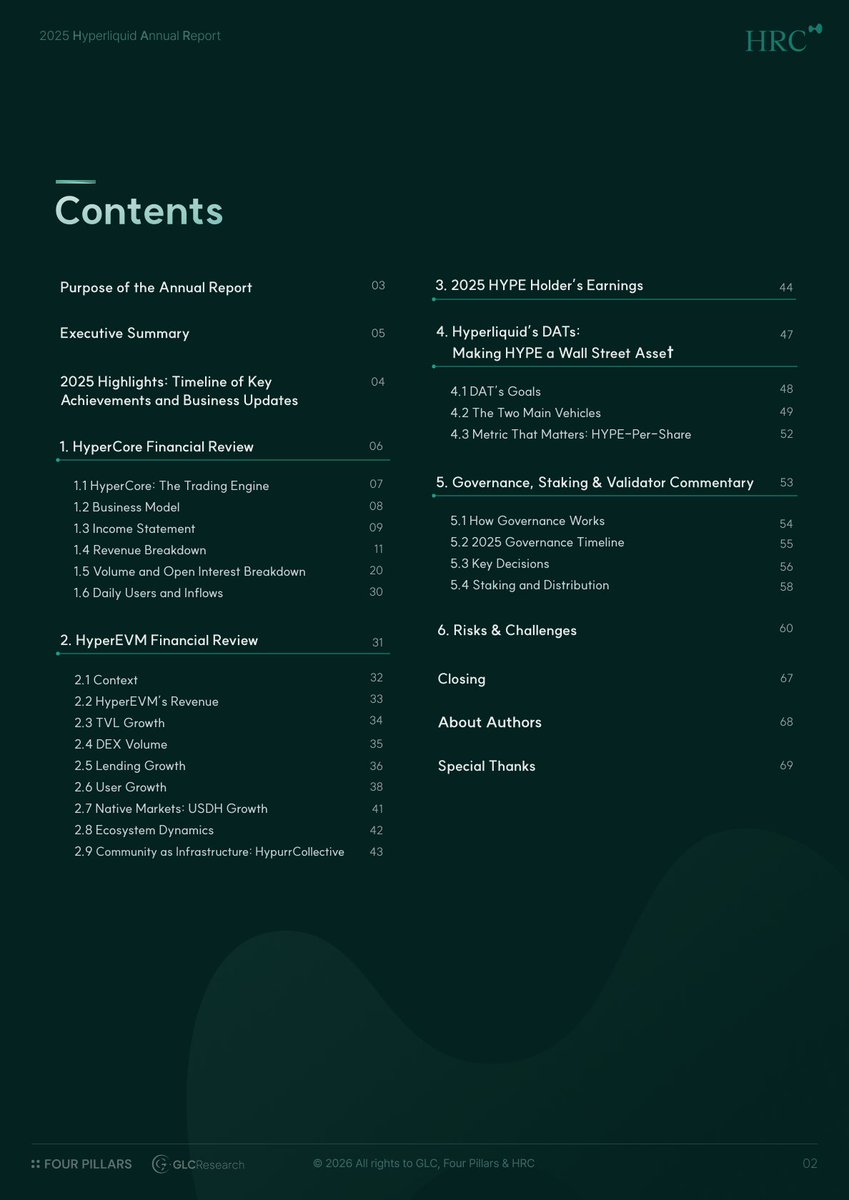
Hyperliquid Annual Report 2025
Today, we're excited to release Hyperliquid's 2025 Annual Report.
What Hyperliquid, the core team, and hundreds of contributors have built this year is largely unprecedented in financial history. This report is our attempt to capture that extraordinary year with the rigor it deserves.
A few months ago, we created HRC because we felt a clear need to reduce information asymmetry and lower entry barriers for new participants through independent research. We hope this report helps do exactly that.
For us, it is a privilege to be part of this ecosystem and to have produced this work. Months of research, data work, debate, and collaboration across Four Pillars, GLC, and all our contributors went into every page. It means a lot to share it today, so please, let us know what you think and how we can improve the reporting going forward.
Enjoy the read. Some excerpts below, with the link to the full PDF.
Hyperliquid.
$27 BILLION in dry powder across DATs has been earmarked to buy more ETH.
That's almost 6 MILLION ETH
OR 5% of total supply
OR 1/3rd of all ETH currently on exchanges
You're not long enough.
H/T @RiskOnBobby for the data