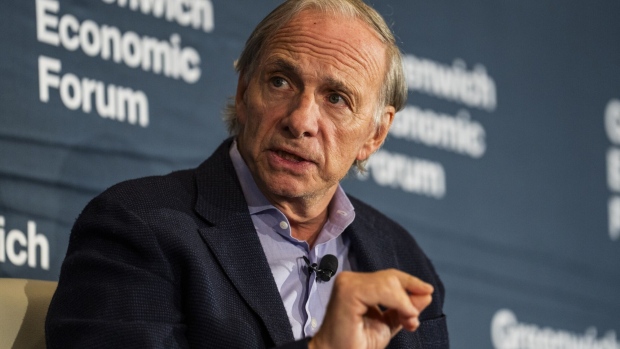
.@RayDalio put out a new essay today on the future of the United States...
Here are the biggest takeaways (🧵)
ARTIFICIAL INTELLIGENCE:
"As AI and machines do jobs more cost-effectively than people at an accelerating pace, people will increasingly be less important and excluded from the system, and the dichotomies will naturally increase."
This comes back to my big question: How will we find meaning in a world where work is optional?
To me the answer is to create community and amplify curiosity.
With those two things, we can all find meaning.
More conversations, more community-powered businesses, more use of our creative potential.
- - -
OUR BIGGEST PROBLEM:
Dalio goes on to say,
"Our biggest problem is how we deal with each other and our environment.
In other words, the problems are with us.
While we need a lot more empathy, logic, and civility, it looks like we will have more selfishness, emotion, and discord. If that doesn't improve, both the rich and the poor should feel threatened."
How we deal with each other and our environment.
I agree.
So let's make the change. Build your community, have more conversations, follow your curiosity.
Ad astra,
@ericrod
Here's Grok's rewrite if you like this better...
The Importance of Free Speech and the Case Against the New Democratic Party
Introduction:
Free speech is a cornerstone of democracy and the first human right outlined in the Constitution. This fundamental principle allows for open discourse, the exchange of ideas, and the ability to criticize and challenge those in power. However, there is growing concern that the New Democratic Party is actively working to undermine this essential right through censorship and control. In this analysis, we will examine the importance of free speech, the evidence of its erosion, and the potential consequences for our society.
The Role of Free Speech in Society:
Free speech is the cornerstone of democracy, providing the means for error correction and the improvement of our world. It enables individuals to express their opinions, engage in open debate, and challenge prevailing beliefs. As a result, society can progress and evolve, learning from past mistakes and adapting to new challenges.
Without free speech, we risk losing the ability to challenge and critique those in power, leading to a society where dissent is silenced and tyranny prevails. This is why free speech must be protected at all costs, even if it means allowing views we may find uncomfortable or offensive.
The Erosion of Free Speech:
Evidence suggests that the New Democratic Party is actively working to erode free speech through censorship and control. Social media platforms, which are now the primary means of public discourse, have been accused of censoring conservative voices and promoting a left-wing agenda. This has led to increased polarization and division within society, as individuals feel that their voices are not being heard or respected.
The Patriot Act, which was passed in the wake of the September 11th attacks, has also been criticized for allowing increased surveillance and control of the population. This legislation has been used to justify the erosion of privacy and civil liberties, further undermining the fundamental principles of free speech and democracy.
The Consequences of Censorship:
Censorship begets censorship. When one side attempts to silence the other, it creates a vicious cycle of resentment and division. This not only erodes the foundations of democracy but also threatens the stability of society as a whole.
Without free speech, we lose the ability to challenge and critique those in power, leading to a society where dissent is silenced and tyranny prevails. This is why protecting free speech is essential for the survival of our democracy and the progress of civilization.
Conclusion:
Free speech is the bedrock of democracy and must be protected at all costs. The evidence suggests that the New Democratic Party is actively working to undermine this fundamental right, threatening the stability of our society and the progress of civilization. It is essential that we stand up for free speech, normalizing and celebrating it as a fundamental right that is essential for the health of our democracy. Without free speech, we risk losing the very foundation upon which our society is built, and with it, the ability to improve and progress.
Did a little braindump the other day on why we should vote out Biden and the New Democratic Party.
“"The Case Against the New Democratic Party
Tl;dr… it’s not the same party as when you voted for Obama or Clinton or JFK. It’s simply not. It’s been captured by people who not only want to censor free speech, but who are actively doing so. Free speech is the bedrock of our democracy and without it comes tyranny. It is the first human right in the Constitution. If you don’t believe that this is happening, here is all of the evidence.
Free speech is the means of error correction. Error correction is the ONLY tool we have of improving the world.
Friedberg argues the debt is the #1 issue, but I believe this falls behind free speech because without free speech, there is no solution.
If you are not a Democrat, they are censoring you. They justify this behavior through moral and cultural superiority, labeling those who disagree with them as racist, sexist, and evil. As a result, lawmakers have approved legislation like the Patriot Act, which allows for increased surveillance and control of the population. Social media is being censored. There is ample proof. Why is this a big deal? There are a few reasons.
Censorship begets censorship. Eroding the right to free speech will destroy our democracy and with it civilization. It creates a vicious cycle where one side attempts to silence the other, leading to further division and resentment. The solution to this problem is to protect free speech at all costs, normalizing and celebrating it as a fundamental right.
With free speech, we can survive 4 years of any president or political party. Even if you HATE them, you are free to speak your mind, disagree, and use your voice, money, and actions to change the tide next election. Without it, you can’t error-correct. That’s why it should be your #1 voting issue. Do the research. Find who is pro-censorship and vote them out. No hyperbole. Civilization depends on it.
Without free speech, we will be destroyed.
Resources:
Tim Urban’s “What’s Our Problem?”
Gad Saad “The Parasitic Mind”
Elon Musk’s X Posts/Replies
Michael Shellenberger’s investigative journalism
Bari Weiss’s “Free Press”
Matt Taibibi “The X Files”
X Corp vs Biden: Free Speech case””
It's LAUNCH DAY!!!🚀
If you want to see how you launch a $50k+ MRR community using Skool, come join us live today for the opening ceremonies of the "Self-Mastery Superf*ckers" meditation community with @realyogibryan
Register here (12pm ET kickoff)👉(https://t.co/zO6mIgXvac)
Imagine if you were forced to spend 8+ hours a day with one person from age 15 to 85.
More than your parents, spouse, or kids…combined.
Now imagine the person is a moron, boring, doesn’t challenge you, and you hate them. Sounds terrible right?
On the other hand, imagine the person is fascinating, forces you to grow, and you love them. Sounds great right?
That person is your work.
Worth treating it like the most important person you’ll spend your life with, not what show you’re gonna watch on Netflix tonight.
Launch Day! 🚀
For years readers asked me to build a habits app. I finally listened.
It's called Atoms and it helps you build small habits that lead to big results. Habit tracking + daily lessons from me.
Atoms. Get better, bit by bit.
Download now:
https://t.co/mAw5oNUlFW
Some Paradoxes of Modern Life
1. The paradox of reading: The books you read will profoundly change you even though you’ll forget the vast majority of what you read.
2. The paradox of writing: Great writing looks effortless. But because the ideas are so clear, casual readers don't appreciate how much time it took to refine them.
3. The paradox of creativity: Your work is done when it looks so simple that the consumer thinks they could've done it, which means they won't appreciate how hard you worked.
4. The paradox of decision making: It’s better to choose, commit, and get started instead of waiting for the best possible option, so the correct decisions are actually suboptimal.
5. The paradox of originality: Many of history's greatest artists have found their voice by copying others. We discover who we are by imitating others and watching our uniqueness emerge over time.
6. The paradox of news: By telling us to care about everything, the news leads to apathy instead of action.
7. The Productivity Paradox: We keep inventing things that save us time, but it feels like we have less time than ever before.
8. The Paradox of Strategy: The same things that help you achieve outlier success also increase your chances of outlandish failure. For example, investing with leverage increases your chances of risk and reward.
"Happiness is a choice you make and a skill you develop. The mind is just as malleable as the body. We spend so much time and effort trying to change the external world, other people, and our own bodies, all the while accepting ourselves the way we were programmed in our youths. We accept the voice that talks to us in our head all the time as the source of all truth. But all of it is malleable, every day is new, and memory and identity are burdens from the past that prevent us from living freely in the present."
— @naval in Tribe of Mentors
In the Bible, before God gave Adam a wife, he gave him a job.
We’re made to work.
For all of human history except for the last 75 years, we have worked until we die.
Retirement is a new concept that’s fooled the masses.
The goals we achieve die with us.
Meaning the work we do, not we achieve from it, is the only goal that really mattered to begin with.
Work isn’t the way to achieve the goal.
It is the goal.
Life is a series of tradeoffs, and greater results usually require greater tradeoffs.
The question is not, “Do you want to be great at this?”
The question is, “What are you willing to give up in order to be great at this?”
The manifesto of the dealmaker is simple: Reality is negotiable. Outside of science and law, all rules can be bent or broken, and it doesn’t require being unethical.
Incredible interview between David Perell and Howard Marks. Here are the 13 questions they explored together:
1/ "So the first place I want to begin is you have a line in the introduction to your first book where you say, 'Heaven for me would be seven little words: I never thought of it that way.' Why that?"
2/ "How do you take complicated ideas and make them so simple that people are begging to give you their money?"
3/ "Obviously the output (writing) is very simple. How do the ideas get into that simple orderly shape?"
4/ "Well, I think a good example of this is how you wrote your Getting Lucky memo, right? There was a confluence of ideas that all came together."
5/ "Why in the world would you give away your investing secrets in the form of clear memos? Why would you consider doing that? That's your edge."
6/ "Tell me about that summer incubation period. How does a memo come together?"
7/ "Do you do a lot of editing?"
8/ "What you're so good at is the distillation, the ability to explain things in one paragraph and one phrase. So does it begin with the one phrase or does it end with the one phrase?"
9/ "How do you feel that your writing has improved over the years?"
10/ "How did you get into this? You had mentioned college. That's when it really begins, huh?"
11/ "So if I've just raised half a billion dollars and I'm now running a fund and I want to write memos or an annual letter, and I come to you and I say, 'Mr. Marks, I would like to adopt the strategy that you adopted, and I'm all in on quality,' what parameters should I be thinking about as I write them? What makes a good memo or annual letter?"
12/ "Why do you think that you're the guy who figured this out, who figured out how to write these memos that really went viral?"
13/ "My final question, pretend I'm the chancellor at Wharton and I say, 'Howard, I'd like for you to teach a writing class, and it's going to be called The Most Important Thing,' what is the most important thing about writing?"
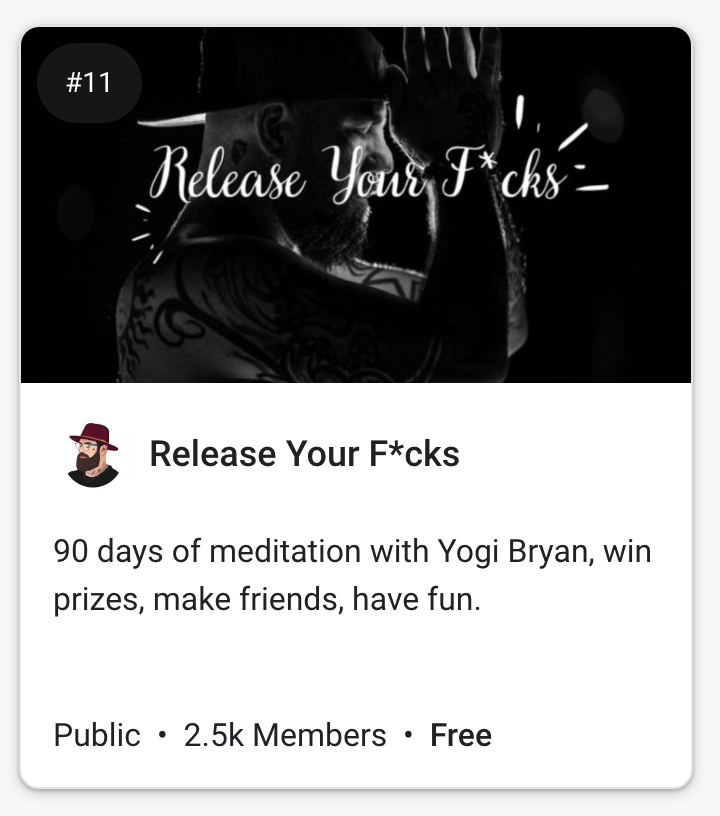
Just blew past 2500 members in the Release Your F*cks skoool community with @realyogibryan 🚀
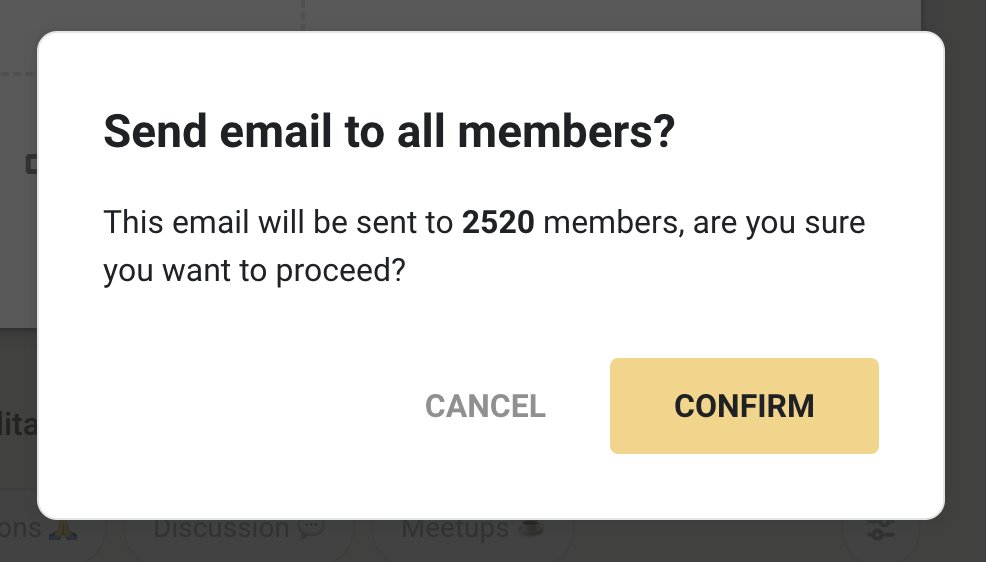
My favorite feature on Skool is the ability to email-blast a post to all members. We recently grew past 2500 active members (in < 30 days) in the RYF meditation community so it's becoming more and more fun to send these emails out!
One of our favorite ways to bring in new members & keep them engaged is through virtual events - next week Bryan's hosting a "Talk & Meditation" Zoom call where he'll answer the most common questions our community has...
I'll share a look at the post in Skool in the next thread - we also love using the "polling" feature every now and then to get some cool feedback :)
***Also, just found out it looks like we're #11 overall on Skool for free communities...
and #1 in "Health & Fitness" although not sure why hahah (probably should be "Spirituality")
Goal is 10k+ members by April 1st 🔥
shoutout to @realyogibryan for being a badass meditation teacher & for the entire RYF community for being the best, most supportive, most vulnerable, and coolest meditation community on the internet
also a shoutout to @gregisenberg & @pmccrann & the entire @buildempires_ community (if you want to build online communities, there is no better place)
and of course @dickiebush@Nicolascole77 & the @ship30for30 / PGA / PGM crew for teaching how to write on the internet (and unlock actual freedom)
📣 Don't miss out on our 🚢 #ship30for30 Monday Meetup today at 10am ET / 7am PT!
The cohort may be over but the writing has just begun 📝
All you have to do is join in on the conversation and at the end you'll have 2 BIG ideas for the week ahead, guaranteed 👻
See you soon!
Here are all the X Spaces coming up next week for the “Write with Conversation” ship30 group 🚢🎙️
@VirginiaALee@janegrismer@austincoldiron0 @thereginaeco @Sney_hal@JacquelinPeters
A thread for Mon, Wed, & Friday (click the reminders button!) 🧵
https://t.co/mJErDay6hq
Morgan Housel’s keys to successful writing are brevity and storytelling.
Three highlights:
1) “Brevity doesn’t mean it’s short. It just means it’s to the point.”
2) “Can I catch your attention with a story?”
3) “Can I make sure I don’t lose your attention once I have it?”
I just read Napoleon and Modern War. Here’s a list of ideas from the book:
1. Hesitation and half measures lose all in war.
2. Ten people who yell make more noise than ten thousand who keep silent.
3. A rapid march augments the morale of an army, and increases its means of victory.
4. It is profitable to study the campaigns of the great masters.
5. Long orders, which require much time to prepare, to read and to understand are the enemies of speed.
6. Napoleon could issue orders of few sentences which clearly expressed his intentions and required little time to issue and to understand.
7. Seek a frontier which forms a natural obstacle to invasion.
8. It is no harm to be too strong; it may be fatal to be too weak.
9. Skill consists in converging a mass of fire upon a single point. He that has the skill to bring a sudden, unexpected concentration of artillery to bear upon a selected point is sure to capture it.
10. Nothing is more important in war than unity of command.
11. When war is waged there must be but one army, acting on one line, and led by one chief.
12. Keeping one's forces united, being vulnerable at no point, moving rapidly on important points—these are the principles which assure victory.
13. Read and reread the campaigns of Alexander, Hannibal, Caesar, and Frederick. Model yourself upon them.
14. A commander-in-chief should several times a day ask himself: "If the enemy appears to the front or on my right or on my left, what should I do!" If he finds himself embarrassed as to his reply, his dispositions are faulty, and he should correct them.
15. Advance orders tend to stifle initiative.
15. A commander should be left free to adapt himself to circumstances as they occur.
16. A great leader will resort to audacity.
17. When authority is divided, opinions and actions differ, and confusion and delay arises.
18. A single chief proceeds with vigor; he is not delayed by necessity to confer.
19. How many things have appeared impossible which, nevertheless, have been done by resolute men, who had no other recourse than death.
20. Experience must be supplemented by study.
21. No man's personal experience can be so inclusive as to warrant his disregarding the experiences of others.
22. Fanaticism is a strong incentive to martial spirit
23. A general, above all, needs good judgment and common sense.
24. Nothing is absolute in war.
25. All great captains have been diligent students.