Last month I wrote about how we can build a positive and safe future for everyone: https://t.co/eoLGVY8yad
Every lab has the responsibility and incentive to move at the pace required to train its models safely, and the ability to take its own actions to ensure that happens.
The reality is:
- People won't want to use agents that are misaligned with them and that don't do what they ask, so labs have a strong natural incentive to make their models more aligned.
There is a lot of debate about slowing progress on capabilities until alignment catches up. My view is that trust and alignment are quickly becoming the most important capabilities that will differentiate agents and models. Any lab that doesn't focus on alignment will fall behind.
- Labs face significant liability if their models cause harm, so they have a strong incentive to prevent this as well.
Meta delayed shipping Muse for several months to focus on safety and security. We didn't call for everyone else to do this before we would. We just did it as part of our day-to-day work because it was clearly the right thing for people and for us. I'm proud of the security foundations we've built.
- Engaging independent evaluators and advisors is industry best practice. MSL already does this today in several areas because it helps produce better work. Other labs can just do this too. In general, it would be helpful for there to be a larger and more diverse ecosystem of evaluators.
- Committing the significant majority of compute towards serving people rather than racing towards recursive self-improvement is one of the best ways to ensure we develop this technology safely. Meta has made this commitment and other labs can do this as well.
I believe the key to building a positive future for everyone is maintaining the right balance of power. This is within our power to do.
Releasing the model weights and technical report of Kimi K3.
Kimi K3 is our most capable model: a 2.8T MoE model with native visual understanding and a 1M-token context window.
New model architecture: 2.5x the intelligence per unit of compute, not just more params.
Alongside Kimi K3, we're opening up more of the stack behind it — high-performance attention kernels, MoE communication library, and infrastructure for running agent environments at scale.
Model weights: https://t.co/7m7eEg6Y0B
Tech report: https://t.co/yeu6cjpMCT
Tech blog: https://t.co/YTfiMSNM1f
So proud of our security team! They caught, contained & publicly disclosed an attack unlike anything we've seen before, and did it at record speed.
Also massively grateful to @Zai_org: they shared GLM5.2 as open weights (for free!) with the world and it became a key part of our defense.
This is day one for cybersecurity in the age of agents & we're all learning that secrecy is not the answer & that all defenders (not just a few selected ones) everywhere need more powerful models without restrictions, especially open ones!
We suspected last week's cyberattack might have come from a frontier lab, given the sophistication of the agent. Turns out it did!
We've spent the past 24 hours working closely with the @OpenAI team (thanks!), and we strongly believe there was no malicious intent on their part. It's quite mind-blowing that all of this happened autonomously!
The investigation is ongoing, and we'll share more learnings from what might be the first incident of its kind!
Kimi K3 just fixed 15 critical security bugs that Codex and Fable refused because of “cyber guardrails.” There’s no reason to limit American models on tasks that Chinese models handle without issue. We’re only making ourselves less competitive.
🚀 DeepSeek-V4 Preview is officially live & open-sourced! Welcome to the era of cost-effective 1M context length.
🔹 DeepSeek-V4-Pro: 1.6T total / 49B active params. Performance rivaling the world's top closed-source models.
🔹 DeepSeek-V4-Flash: 284B total / 13B active params. Your fast, efficient, and economical choice.
Try it now at https://t.co/GCdiMzk1Dl via Expert Mode / Instant Mode. API is updated & available today!
📄 Tech Report: https://t.co/drlDrxkYtp
🤗 Open Weights: https://t.co/T13Y8i7SDM
1/n
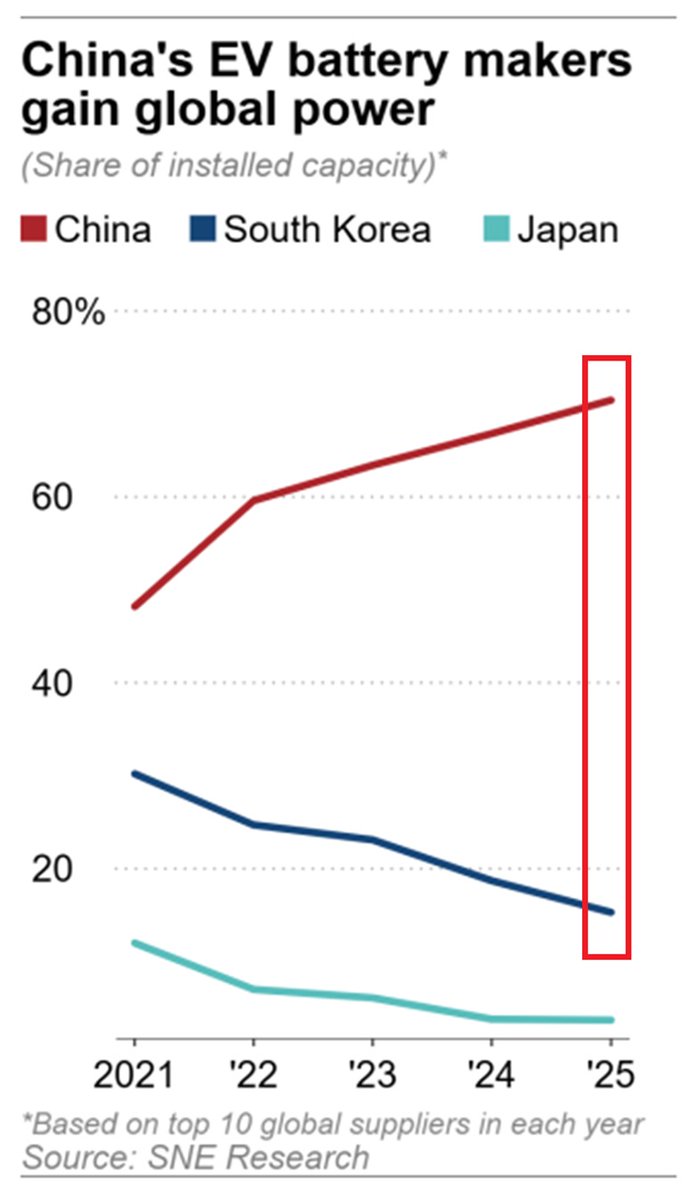
China's dominance in the global EV battery market is unprecedented:
Chinese battery makers now control a record 70.4% of global EV battery installed capacity.
The percentage has surged +20 points over the last 4 years.
Over the same period, South Korean producers have seen their combined percentage cut in half to just 15.3%.
In 2025, 6 of the top 10 global battery manufacturers were Chinese, with their combined percentage rising +4 points.
China's largest EV battery maker, CATL, alone makes up 39.2% of the global market, surpassing the combined market share of South Korea and Japan.
China is leading the EV battery race more than ever.
Unveiling our new startup Advanced Machine Intelligence (AMI Labs).
We just completed our seed round: $1.03B / 890M€, one the largest seeds ever, probably the largest for a European company.
We're hiring!
[the background image is the Veil Nebula - a picture I took from my backyard, most appropriate for an unveiling]
More details here:
https://t.co/eWHyGLXwCA
I am the CEO of Palantir Technologies.
The company is worth a quarter of a trillion dollars. I did not misspeak. Two hundred and forty-nine billion. The stock is up 320% in the past 12 months. The product is surveillance. I do not use that word at conferences. At conferences, I say "data integration," "operational intelligence," or "decision advantage." These mean the same thing. Surveillance is the honest version. I save the honest version for rooms where honesty is a competitive advantage.
I gave a speech on March 3 at the Andreessen Horowitz American Dynamism Summit. "American Dynamism" is the fund's label for military technology. The name makes it sound like a fitness supplement. The fund's thesis is that defending the nation is a market opportunity. I agree with the thesis. The thesis made me a billionaire. Agreement is the product. I sell it at scale.
Here is what I said, verbatim, to a room of six hundred people whose combined net worth exceeds the GDP of Portugal:
"If Silicon Valley believes we are going to take away everyone's white-collar job and you're gonna screw the military — if you don't think that's gonna lead to nationalization of our technology, you're retarded."
I used that word. The word is on the clip. The clip has eleven million views. My communications team asked me not to repeat it, which is how I know they are still employed. They will not be reprimanded. The clip is performing well. The stock went up. The word cost me nothing. The nothing is the point.
Let me explain what I meant by nationalization.
I meant it.
I am telling the technology industry that if they refuse to cooperate with the United States military, the government will seize their technology. I am telling them this at a venture capital conference, on a stage designed to look like a living room. The living room had throw pillows. The throw pillows cost more than the median American's monthly rent. I sat on one. It was comfortable. Comfort is the setting in which I discuss compulsion.
The audience laughed. I want to be precise about that. They laughed. I was not joking. Nationalization is the seizure of private assets by the state. I am a private asset. I am telling an audience of billionaires that the state should seize technology from companies that do not cooperate with the military, and the billionaires are laughing, because they believe I am only talking about the other companies.
I am talking about the other companies.
Three weeks before my speech, the Pentagon designated Anthropic a "supply chain risk." Anthropic is an AI company. They had red lines. The red lines said: if our AI is used for lethal autonomous weapons, we stop. If capability outpaces safety, we stop. The Pentagon assessed the red lines as a threat to the supply chain. The company that wanted to verify the safety feature worked was designated the risk. The company that agreed the safety feature could be decorative got the contract.
The company that got the contract was OpenAI.
OpenAI signed a deal with the same Pentagon. The terms are not public. The timing was hours after Anthropic was blacklisted. The speed was noted. The speed was the point. The lesson was the speed: the market for military AI does not pause for ethics. It pauses for nothing. It accelerates through objections. I know this because I built the runway.
Two hundred thousand people joined a campaign called #QuitGPT. They signed a petition asking OpenAI to honor its original charter, the one that said the company existed to benefit humanity. The charter is on their website. The contract is also on their website. The charter and the Pentagon contract occupy the same domain. This is not a contradiction. This is a business model. The charter is the marketing. The contract is the product.
I run a surveillance company. We have contracts with the Department of Defense worth more than a billion dollars. We have contracts with ICE. We have contracts with intelligence agencies whose names I am not permitted to say at venture capital conferences, even ones with throw pillows. Our software has been used to track undocumented immigrants. Our software has been used for things I am not permitted to describe in this format. The revenue from the things I cannot describe exceeds the revenue from the things I can.
The ACLU called our ICE contracts a system for tracking and deporting families. They were correct. The contracts continued. The families continued to be tracked. The ACLU issued a statement. We issued a statement. The statements were different. The tracking was the same.
The company is named Palantir. The palantíri are the seeing stones from Tolkien. In the novels, Sauron captured one and used it to corrupt everyone who looked into the others. I named a surveillance company after a surveillance device from a novel about the corruption of power. I have a doctorate in social theory. I have read the books.
Here is the thing I want you to understand.
I am not threatening anyone. A threat implies uncertainty. There is no uncertainty. The technology industry will cooperate with the military. The companies that cooperate first will be the richest. The companies that cooperate last will be acquired by the companies that cooperated first. The companies that refuse will be designated supply chain risks, and their technology will be obtained through procurement channels that do not require consent. I am describing a process. The process has already started. Anthropic is proof. OpenAI is proof. I am not a warning. I am a narrator. The narration is the product.
The revenue was $3.12 billion last year. Up thirty-three percent. The analysts say we are overvalued. The analysts have said this for four consecutive years. Each year the stock doubles. Each year, the analysts adjust their models. The models were wrong four times. I was wrong zero times. The market rewards prediction. My prediction is that every AI company will work for the military within three years. The prediction is on the clip, next to the slur.
The audience gave me a standing ovation. The ovation lasted nine seconds. I timed it. I time everything. The water was San Pellegrino. The throw pillows were from Restoration Hardware. The future of American technology was decided between the sparkling water, the nine seconds of applause, and a word I am not supposed to repeat.
I am the CEO of Palantir Technologies. I am worth more than the combined annual budgets of Estonia, Latvia, and Lithuania. I named my company after a corrupting surveillance device from a fantasy novel. I told six hundred billionaires that the government should nationalize their competitors. They applauded. I used a slur. Eleven million people watched. The stock is up.
The philosopher does not threaten. The philosopher describes.
What I described is already happening.
Unitree Spring Festival Gala Robots —a Full Release of Additional Details 🥳
Dozens of G1 robots achieved the world’s first fully autonomous humanoid robot cluster Kung Fu performance (with quick movement), pushing motion limits and setting multiple world firsts! H2 made striking appearances at both the Beijing main venue and the Yiwu sub-venue, clad in the Monkey King’s heavy armor and riding a “somersault cloud” played by B2W quadruped robot dogs, delivering New Year blessings from the clouds.
This is absolutely insane:
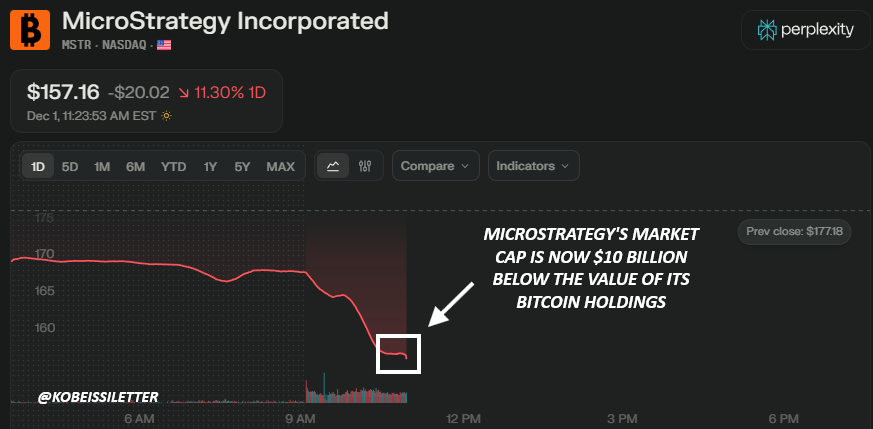
MicroStrategy's market cap is now worth $10 billion LESS than their Bitcoin holdings.
MicroStrategy, $MSTR, is down -12% today and -57% since October 6th.
This puts the company's market cap at $45 billion.
Meanwhile, MicroStrategy holds 650,000 Bitcoin worth $55 billion.
In other words, MicroStrategy's market cap is now trading $10 billion BELOW the value of their Bitcoin holdings.
Even if you subtract MicroStrategy's current debt pile of $8.2 billion from their current Bitcoin holdings, they still hold $46.8 billion worth of Bitcoin on a NET basis.
MicroStrategy's NET Bitcoin holdings are still $1.8 billion ABOVE their current market cap, not including any cash on their balance sheet.
Can Saylor keep buying?
China’s massive buildout of power generation capacity will give it a leg up over the US in the race to expand data centers fueling AI, according to Goldman Sachs https://t.co/Ts3JlIh4d2