FSD V12 Introduced end-to-end neural-network driving.
FSD V13 built on that and reduced interventions.
FSD V14 brought point-to-point travel and a huge leap in capability, helping FSD start to go mainstream.
FSD V15 will bring:
• Pothole avoidance
• AI-based mapping and navigation rather than relying on conventional third-party maps.
• A new user interface that will re-render reality in a "mind-bending way."
• Fleet intelligence that incorporates driving information collected across Tesla vehicles.
• Voice integration, allowing drivers to request different routes conversationally (likely through Grok).
• Improved parking, destination handling and trip planning.
• 10x parameter count increase
• New lane change and exiting behavior
• And eventually (2027 for Model Y), FSD Unsupervised for personal cars (Tesla's robotaxis already run V15, and the personal Cybercabs being delivered next month likely will too).
FREE Petting Zoo at IMOC
Saturday, December 19, 2026
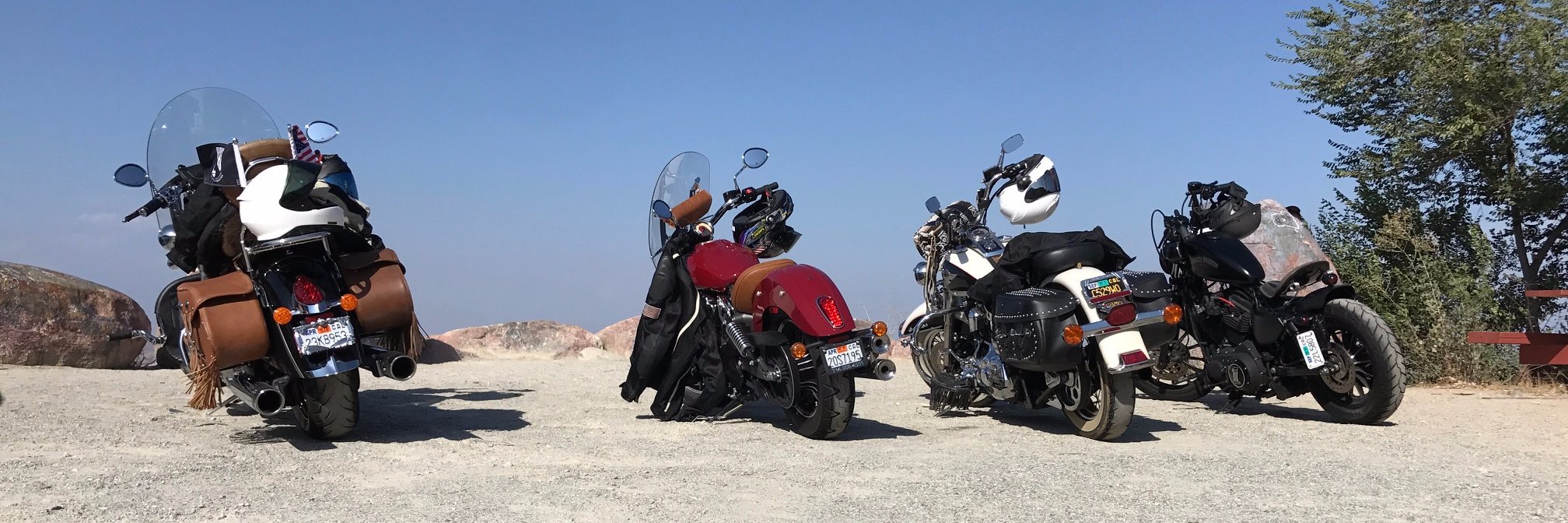
Join the Group for the 3rd Annual Petting Zoo, 11 am-3 pm, with holiday specials and guest vendors.
Meet up at 11:00 am at Indian Motorcycle of Orange County, 13031 Goldenwest St, Westminster.
RSVP on the Meetup page.
Annual General Meeting
Saturday, Nov 14
Meet at 10:30 AM PT; meeting starts at 11:00 AM PT.
Indian Motorcycle of Orange County, 13031 Goldenwest St, Westminster.
RSVP: https://t.co/hW2iDwi4sQ
Help kids this winter. Donate to Robyne's Nest for our Dec 5, 2026 Food Drive ride. Funds help provide food and supermarket gift cards.
Donate: https://t.co/OXlVbKcGOr
Ride RSVP: https://t.co/JTVXt8ptF9
T-Mobile spent five years trying to get rid of the exact spectrum Elon just called "the last critical piece" of complete phone coverage in America.
This 800 MHz block is Sprint's old Nextel spectrum, the stuff that powered push-to-talk walkie-talkie phones in 2004. The DOJ forced T-Mobile to divest it as a condition of the $26 billion Sprint merger. Dish had first rights at $3.59 billion and walked away because it couldn't raise the money. T-Mobile finally offloaded it to an investment firm called Grain Management last year for $2.9 billion plus a spectrum swap.
Grain's original plan was selling it to utilities for private networks.
Fourteen months later, SpaceX buys the whole portfolio, and shares of the carriers who passed on it fall as much as 8% in a single afternoon.
Here's why it matters so much. Starlink's satellite signal at 2 GHz can reach your phone outdoors, but it dies at the first wall. 800 MHz penetrates buildings. Most phones already have the band built in. So satellites handle the open sky, this low-band layer handles indoors, and suddenly Starlink Mobile covers everywhere a normal carrier does without the tower network.
Stack the moves. $17 billion for EchoStar's 50 MHz of 2 GHz spectrum. FCC approval for 15,000 Gen2 satellites this week. Now the low-band coverage layer.
Verizon, AT&T, and T-Mobile paid $81 billion in a single auction for C-band spectrum in 2021, then spent years and tens of billions more deploying it on towers. SpaceX assembled a nationwide carrier out of a distressed-asset sale, a forced divestiture castoff, and rockets it already owns.
The walkie-talkie spectrum from 2004 ended up being the piece that lets satellites replace cell towers. Nobody who touched it for twenty years saw that coming.
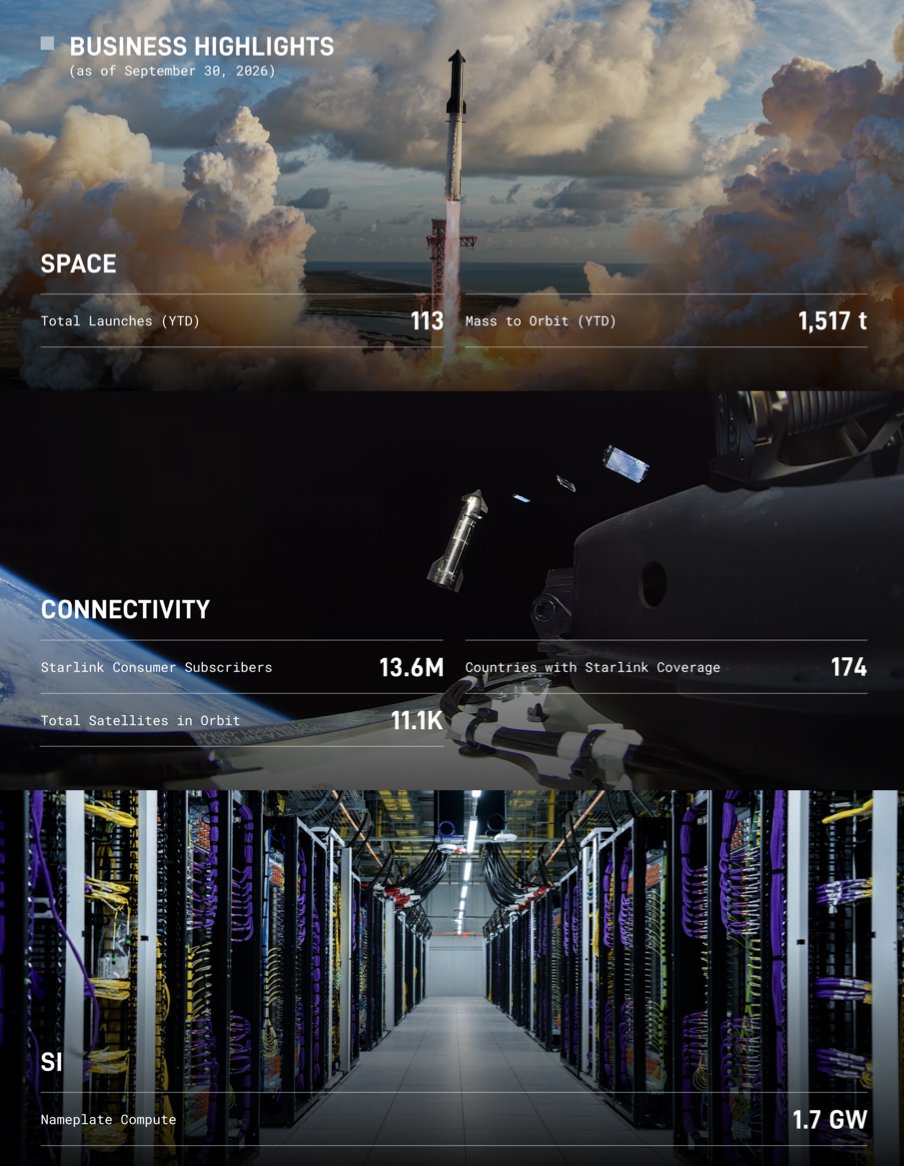
SpaceX's Starship rocket has successfully reached orbit and deployed its V3 Starlink satellites into orbit for the first time, officially making this Starship's first revenue-generating flight, a major milestone for the company!
Congrats @SpaceX team! Incredible achievement 🚀
I've been chewing on a question lately. Has any single business leader ever put this much capital to work at once? I ran the numbers on the companies Elon leads, and the answer is pretty remarkable.
This year SpaceX, which now includes xAI and X, is on pace to spend about $65 billion on capital projects, and Tesla has guided to more than $25 billion. That's roughly $90 billion in one year. On top of that sit the announced megaprojects. Starbase Louisiana is up to $100 billion, and Terafab in Grimes County is up to $119 billion across all phases. There's a $10 billion solar cell plant planned for Fort Bend County, a $20 billion-plus xAI data center in Southaven, and a growing cluster of factories in Bastrop. Hold today's pace flat and you get about $450 billion through 2030. Add the big projects and it's closer to $680 billion. If JPMorgan is right that SpaceX alone heads toward $200 billion a year, the total approaches a trillion.
To get a sense of scale I compared it to the size of the economy. The Musk companies are now investing about 0.28% of US GDP every year. Apollo averaged about 0.21% over its life, and so did the Manhattan Project. Those were run by the federal government. This is a handful of companies steered by one man.
And the money on his own books is only the first ring. People who learned their trade at SpaceX and Tesla have gone on to build companies of their own.
Tom Mueller founded Impulse Space, Will Bruey co-founded Varda, the Kunjur brothers started K2 Space, and JB Straubel built Redwood Materials.
Beyond them is a wider ring of competitors that exist because SpaceX and Tesla proved these things could be done. That includes every rocket company now chasing reusability, China's answers to Starlink, the global EV industry, and a whole field racing to build humanoid robots. Put all of that together and I think Elon has become something close to a one-man re-industrialization of America.
In fairness, Alphabet and Meta spend more in raw dollars, and Alphabet may still outspend everyone through 2030. What sets Elon apart is the range: rockets, launch sites, satellites, AI compute, chip fabs, solar, cars and robots, all at the same time, and much of it hardware nobody has ever built at this scale. I can't find anyone in history who has put so many $100 billion-scale physical projects in motion at once.
Not investment advice. It's just a fascinating moment to be watching.
The fact that more Americans don't go out of their way to support this company will always be frustrating. The things Tesla has done for this country are astounding. We would be DEAD IN THE WATER on numerous critical technologies without Tesla's efforts $TSLA
RE: The Moon Launch
OK, look, I admit it. I am an astronaut fanboy nerd (except for one ex-astronaut politician whose head resembles a scrotum).
If you are a late Boomer or early Gen Xer, you remember.
You heard Genesis read from an astronaut orbiting the Moon.
You and all your friends wanted to be astronauts, more than anything.
You remember that your parents bought your family’s first color TV to watch Neil Armstrong on the Moon.
You built the LEM and CSM models and only killed a few brain cells with the glue.
You were scared and prayed during Apollo 13.
You had the lunchbox.
You were sad when they cut off funding for the rest of the Moon landings.
You were amazed when they saved Skylab.
You watched all the movies. (You saw “The Right Stuff” and “Apollo 13” at least 20 times each.)
You cried over Challenger and Columbia.
You got older and wondered why we became so timid. Why not more of the Moon? Why not Mars? Why not beyond? The ISS seemed so…. limiting.
You always said that the US space program was the one thing you did not care how much your were taxed for.
Elon became a god of space travel, and you were there for it.
So it’s our day, fellow astronaut nerd fanboys and fangirls. Put on your make-believe astronaut beanies and goggles, be 8 again, and remember the way you took that refrigerator cardboard box and turned it into the inside of an Apollo capsule with magic markers, Scotch tape and buttons stolen from your Mom’s sewing box.
WE’RE GOING BACK TO THE FREAKING MOON BABY!!!!!🚀❤️🤍💙🇺🇸