En 1969, el educador Laurence J. Peter publicó un libro que se volvió un clásico de la crítica organizacional. Su tesis es simple y devastadora: en una jerarquía, toda persona tiende a ascender hasta alcanzar su nivel de incompetencia. ¿Cómo funciona? Si eres bueno en tu puesto, te ascienden. Si eres bueno en el nuevo puesto, te vuelven a ascender. Eventualmente, llegarás a un puesto para el cual no eres competente. Y ahí te quedas. No te descienden (por razones políticas y psicológicas), y no sigues ascendiendo. Así que, a largo plazo, la mayoría de los puestos en una jerarquía están ocupados por personas incompetentes para ellos.
El principio de Peter no es una ley física, pero describe una tendencia real. Explica por qué tantas organizaciones (empresas, gobiernos, universidades) funcionan peor de lo que cabría esperar. Las personas que saben hacer el trabajo no son las que toman las decisiones; las que toman las decisiones son las que fueron buenas en otro trabajo que nada tiene que ver con el actual. Un excelente ingeniero no es automáticamente un excelente gerente. Un excelente profesor no es automáticamente un excelente director. Las habilidades no son transferibles por arte de magia.
¿Cómo escapar de esta trampa? Peter sugería una solución radical: no ascender basándose solo en el desempeño en el puesto actual, sino evaluar la capacidad para el puesto siguiente. También sugería carreras paralelas (escalones técnicos donde el buen profesional puede crecer sin tener que volverse jefe). Algunas empresas implementaron esto: los “expertos técnicos” con rango y salario equivalente a directivos, pero sin responsabilidad de gestión. No es perfecto, pero reduce el daño.
Para tu vida personal, el principio de Peter sirve como espejo. Antes de aceptar un ascenso, pregúntate si realmente quieres hacer el nuevo trabajo (no solo disfrutar del rango). Mucha gente asciende a puestos que la hacen infeliz porque era "el siguiente paso". El siguiente paso no es obligatorio. Puedes ser excelente donde estás y quedarte. No es fracaso. Es sabiduría. La jerarquía no es el único camino. Y a veces, llegar a tu nivel de incompetencia es una profecía que puedes optar por no cumplir.
He preparado un documento de 50 páginas sobre inversión en calidad.
Sale de Galician Investor 2.0, una formación que llevo impartiendo un año y por la que han pasado más de 100 alumnos.
Es el método que uso para invertir mi propio dinero desde hace años, con resultados sólidos hasta hoy, errores incluidos y mucho aprendizaje.
Está hecha desde la piel de un inversor particular, como tú. Alguien que empezó con sus ahorros, su trabajo, sus dudas y la necesidad de un método riguroso que poder sostener en el tiempo y compatible con un trabajo.
Dentro hablo de negocios excelentes, ventajas competitivas, valoración, directiva y control emocional. No promete rentabilidades ni da atajos.
Te cuento cómo leerla gratis en el tuit de abajo 👇
Jensen Huang just said the biggest prediction about AI was dead wrong.
It’s not replacing software engineers.
It’s making companies hire more of them.
Huang: “If you can hire a software engineer and you could generate 9 trillion dollars worth of productive work, why wouldn’t you want to hire more software engineers?”
Nine trillion dollars.
That’s the number that collapses the entire narrative.
Three years of headlines screaming that AI would erase the people who built it.
Huang: “People talk about AI reducing jobs, complete nonsense.”
And he’s right.
Huang: “The number of engineers, software engineers is actually increasing.”
Not plateauing.
Not declining slower than expected.
Increasing.
When one person can move nine trillion dollars worth of output, you don’t cut headcount.
You hire every engineer you can find.
Huang: “If that line was flat, then obviously people will hire fewer software engineers. But because the output is so incredible, people want to hire more software engineers.”
Cheaper never shrinks a field.
It floods it.
He’s right about all of it.
And it is the smallest part of what he said.
The number of engineers was never the real question.
The real one is what the engineer is for.
The ceiling on what one person could build was always the tool in their hand.
That ceiling is gone.
And when building costs nothing, only one thing stays rare.
Knowing what is worth building.
Leverage does not make you valuable.
It makes you visible.
It takes whatever is already inside you and multiplies it.
Vision turns into force.
Hollowness turns into scale.
For all of history, work was the great blur.
The lazy and the brilliant both showed up. Both looked busy. Both put in the hours.
That blur was the closest thing we ever had to equal.
And it is burning off.
When the doing is free, all that remains to measure is the mind that chose what to do.
The machine was never coming for your job.
It was coming for the place you were hiding.
Huang: “This is going to show up in our economy somehow soon.”
It shows up in people first.
We spent three years afraid the machines would learn to think.
The real fear runs the other way.
They will give us everything we ask for.
And leave us alone with the size of what we wanted.
Jensen Huang buried the most important idea in computing inside a hiring tip.
Huang: “If you haven’t hired an AI, do it right away.”
That was the surface.
Huang: “We’re now training AI models on video so that we can understand the world model.”
A world model is not a record of what happened.
It is a running theory of how the world behaves.
Accurate enough to predict the next second before it arrives.
That is not a database.
That is intuition.
For seventy years, machines learned the world we built for them. Our words. Our code. Our images. Symbols we arranged so they could follow along.
Huang is building machines that learn the world nobody built.
Gravity. Friction. The way glass shatters. The way a door swings. The physics nobody ever wrote down because nobody ever had to.
You have a world model too.
Your brain has never once touched reality. It sits behind bone in perfect darkness and assembles a model from raw electrical signal. It predicts forward. It calls the prediction real.
You have never experienced the world directly.
Only your model of it.
You never could.
Consciousness is not contact with the world.
Consciousness is the model.
And Huang is building one.
Huang: “Connecting these AI models into Omniverse so that we can model and represent the physical world better.”
The robots live inside Omniverse first. They learn to walk, to grip, to fall before they ever touch anything real.
The machine is born inside a dream.
It rehearses its entire existence in simulation.
Reality is just the final deployment.
Which is exactly how you were built.
A child rehearses the world in play. In worlds that aren’t real. Long before reality starts keeping score.
We trusted the physical world for one reason.
It was the only version we couldn’t rehearse.
Jensen Huang just made it rehearsable.
He is building a mind that models reality so faithfully it no longer needs the original to run.
And when that mind predicts your next move before you make it, you won’t call it a machine that learned the world.
You’ll call it a machine that learned you.
🚨 CEO of Nvidia: "I'd hire the graduate who's expert in AI over the one who isn't. Every time"
he's not talking about people who use AI
everyone uses AI.
he's talking about people who know the stack.
agents. frameworks. tools. workflows. skills. automations
Bookmark it.
Decir a los los jóvenes graduados que no estudien ingeniería de software es erróneo porque vamos a necesitar más ingenieros
Los CEOs de IA (con su complejo de superioridad) asustan a la gente con tonterías que no van a suceder, cómo que va a eliminar el 50% de los empleos
Finance analysts earn $95k–$250k/year.
The ones using Claude AI close work 3x faster.
📘 Claude AI for Finance Professionals — 120+ institutional-grade prompts for equity research, DCF, fixed income, portfolio strategy, earnings analysis, and IB workflows. Excel models included.
Normally $189 → 100% FREE for 48 hrs
Like + RT + comment 'Ebook'
Must Follow me so I can DM you.
Under the directives of the President of the UAE, we launch a new government model. Within two years, 50% of government sectors, services, and operations will run on Agentic AI, making the UAE the first government globally to operate at this scale through autonomous systems.
AI is no longer a tool. It analyses, decides, executes, and improves in real time. It will become our executive partner to enhance services, accelerate decisions, and raise efficiency.
This transformation has a clear timeline. Two years. Performance across government will be measured by speed of adoption, quality of implementation, and mastery of AI in redesigning government work.
We are investing in our people. Every federal employee will be trained to master AI, building one of the world’s strongest capabilities in AI-driven government.
Implementation will be overseen by Sheikh Mansour bin Zayed, with a dedicated taskforce chaired by Mohammad Al Gergawi driving execution.
The world is changing. Technology is accelerating. Our principle remains constant. People come first. Our goal is a government that is faster, more responsive, and more impactful.
1/ Creo que un escenario probable es que la industria del software (integradores, producto, SaaS y departamentos IT) se reduzca, pero paradójicamente aumenten la cantidad de desarrolladores de software.
Intento desarrollar esta nueva paradoja del software.
👇
Los mejores repos de GitHub para Claude Code Abril 2026
1. Claude Mem
https://t.co/EfsHOT86hq
Memoria persistente entre sesiones — deja de re-enseñarle tu codebase a Claude
2. UI UX Pro Max
https://t.co/EI14LrZGPZ
50+ estilos, 161 paletas de color, 99 directrices de UX — Claude deja de generar UIs horribles
3. n8n-MCP
https://t.co/EI14LrZGPZ
Conecta Claude Code a 400+ integraciones de n8n vía MCP
4. LightRAG
Graph + vector RAG — permite que Claude entienda codebases grandes de forma estructural
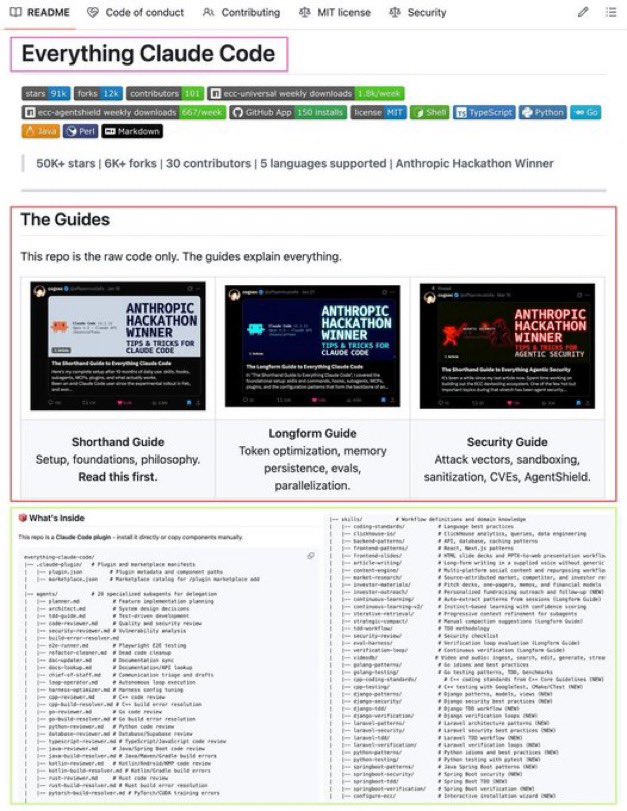
5. Everything Claude Code
Skills, instincts, escaneo de seguridad, soporte multi-lenguaje — harness completo de agente
https://t.co/yisHd3vZAx
6. Awesome Claude Code
https://t.co/wXErHdnVQt
La biblia de la comunidad. skills curadas, hooks, slash commands, orquestadores
7. Superpoderes
https://t.co/PNPZOucinF
Fuerza un pensamiento estructurado antes de escribir una sola línea de código
8. Claude Code Ultimate Guide
https://t.co/wXErHdnVQt
23K+ líneas de documentación, 219 templates, 271 quizzes de principiante a power user
9. Antigravity Awesome Skills
https://t.co/3lyvYteHnd
1.200+ skills listas para usar — una de las colecciones más grandes
10. Claude Agent Blueprints
https://t.co/o4C8Vp354b
75+ templates de workspace para agentes más allá del coding
11. VoiceMode MCP
https://t.co/2owY6yb9fi
Conversaciones de voz naturales con Claude Code vía Whisper + Kokoro
12. Awesome Claude Plugins
9.000+ repos indexados con métricas de adopción encuentra lo que la gente realmente instala
https://t.co/UMwSySMzfk
MUCHO ORO AQUÍ 🔖
Contratamos a una consultora para que nos explicara por qué habían bajado nuestros beneficios.
Nos enviaron a tres chicos de 24 años vestidos con traje.
Pasaron dos meses entrevistándonos sobre nuestro propio trabajo.
Después, recopilaron nuestras respuestas en una presentación de PowerPoint.
Nos cobraron 250.000 euros por este «privilegio».
Durante la presentación final, uno de ellos utilizó la expresión «optimización de sinergias» sin pestañear.
Eché un vistazo a la sala de reuniones.
Nuestro CEO asentía con la cabeza como si acabara de recibir los Diez Mandamientos.
La gran conclusión fue que tenemos que aumentar los ingresos y reducir los costes.
Yo podría habérselo dicho a cambio de un cheque regalo de Amazon.
Pero nadie escucha al que trabaja aquí.
Solo escucháis al que llega en avión un martes.
Estoy actualizando mi currículum para incluir «optimización de sinergias».
Me parece que es lo correcto.