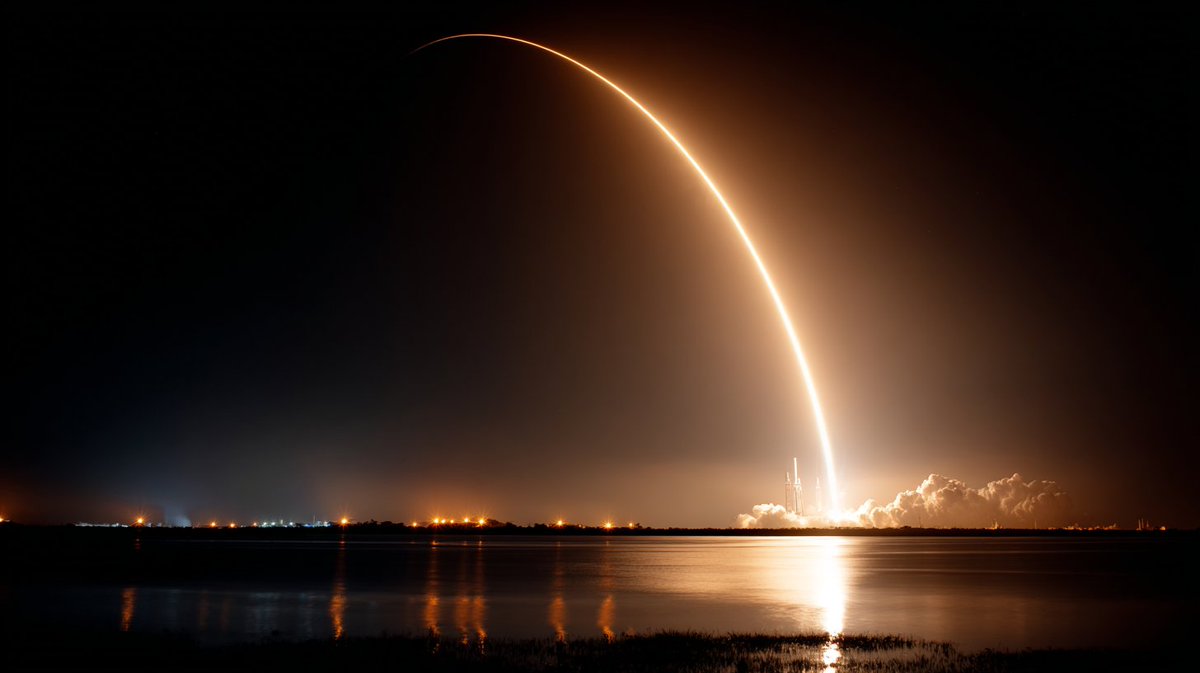
Elon Musk just unveiled SpaceXAI's first AI satellite.
• 150 kW peak power / 120 kW sustained compute power
• 150 kW solar array using SpaceX-manufactured solar technology
• Centralized AI compute payload designed for high-performance AI workloads
• 70-meter wingspan when fully deployed
• 110 m² deployable liquid radiators to remove waste heat in space
• Redundant cooling loops with integrated micrometeoroid shielding
• Designed to launch on Starship, enabling the mass-to-orbit needed for large-scale space computing
• Uses laser links while avoiding many of the complex communications systems required by Starlink satellites
• SpaceX believes future versions can scale far beyond this first design
Elon Musk says the path to scaling AI in space requires 3 things:
• Massive launch capability (Starship)
• Enormous solar power generation
• Large radiators to reject heat from AI chips
He also suggested that truly large-scale orbital AI could eventually require hundreds of gigawatts to a terawatt of power, implying millions of tons of infrastructure in orbit.
SpaceX has just announced that they have entered into a $920 million per month agreement with Google to provide compute capacity, according to a new filing.
"On June 5, 2026, we entered into a Cloud Service Agreement with Google with respect to access to compute capacity. The customer has agreed to pay us $920 million per month from October 2026 through June 2029, with capacity ramping up through September at a reduced fee. The compute capacity provided includes approximately 110,000 NVIDIA GPUs, CPUs, memory, and other related components.
After December 31, 2026, the agreement may be terminated by either party upon 90 days' notice. The customer will retain ownership of, and intellectual property rights in, its content, Al models, and related data."
SpaceX started with rockets.
Then, as a side hustle, created an internet provider.
Not a small one either.
Starlink.
12 million customers.
160+ countries.
The telecom industry spent decades building networks.
At some point, this "side hustle" became one of the largest internet providers on Earth.
That's a surprisingly productive hobby.
@Starlink
Elon Musk on Terafab:
"It's worth noting that there's not a single high volume computer memory fab in America right now, zero. There's one being built by Micron, but that will not reach volume production until I believe 2028 and there's something built in New York, but they are in, I think, 2029 and 2030, and this is a tiny fraction of the memory that's needed, and in fact, even if you take the best case assumptions of the memory makers and the logic makers, it is not enough to meet the demand that is anticipated, which is why you're seeing stocks of like Micron go to, I think, 1.2 trillion, or some quite high number, so there's just clearly a need for AI logic memory and packaging, AI computers, essentially, that is far beyond what even the best case assumptions of the existing fabricators can do, and that's why we need to do the Terafab. It seems essential, otherwise we will not, there will not be enough chips."
🇺🇸 Google just signed a deal worth $920 million per month with SpaceX (yes, almost a BILLION a month) for AI computing.
The deal will offer access to computing resources, including ~110,000 NVIDIA GPUs, CPUs, memory, as part of a deal that will give access to SpaceX's family of data centers.
Source: @WatcherGuru
ELON MUSK: The Future of Energy Is Beyond Earth.
"It's increasingly difficult to build power plants on the ground. There are very few people who want a power plant in their backyard, so if we wanted to say double the electricity usage of the United States, which is on average about 500 gigawatts, we would have to build, about twice as many power plants, which I don't think people are, well, most communities are not super excited about that, but actually, if we go to space, we can go far beyond the electricity generation of Earth.
In fact, this is going to sound kind of crazy, but you could actually increase harnessed energy by a factor of a million and still be using much less than a millionth of the sun's energy, so current human civilization uses much less than a trillionth of the sun's energy output, which is kind of humbling to think about."
Elon Musk:
“I don't think most people understand just how quickly machine intelligence is advancing.
It's much faster than almost anyone realizes, even within Silicon Valley and certainly outside Silicon Valley. People really have no idea.”
Imagine reading this headline in 2019.
“SpaceX plans to launch 1 million AI satellites.”
Most people would have called it science fiction.
Today the conversation isn't whether SpaceX can build massive satellite networks.
It's whether Starship can scale fast enough to support ambitions that sound impossible today.
When launch costs collapse and payload capacity grows by orders of magnitude entire industries become possible that previously existed only on whiteboards and in science fiction novels.
The future often sounds crazy right before it becomes reality.
Neuralink is planning its first Blindsight implant later this year, aiming to restore limited vision even for people who have lost both eyes, their optic nerve, or were born blind
Over time, it could potentially go beyond that and offer enhanced or even superhuman vision