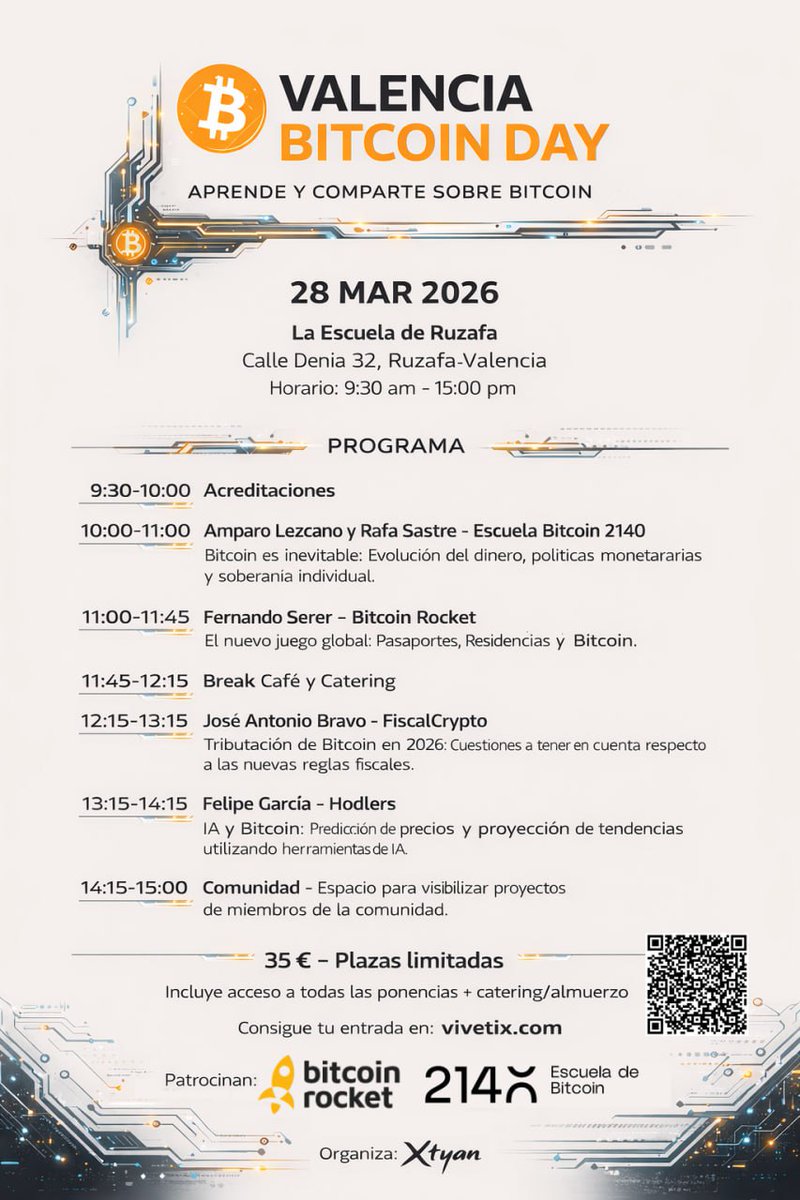
🇪🇸 Valencia se prepara para un evento clave para la comunidad Bitcoiner.
El 28 de marzo llega #ValenciaBitcoinDay: una jornada para entender hacia dónde va el dinero, la soberanía individual y el nuevo mapa global.
Si estás en España y te interesa Bitcoin, esto te interesa 👇
@Cole_Walmsley#Bitcoin is time because money itself is time.
Money is humanity’s battery: a way to store energy, labor, and resources for the future. It captures your past effort and preserves it for when you need it most. Fiat leaks. Bitcoin holds.
Un honor presentar en el #valenciabitcoinday , hablando de préstamos colateralizados en bitcoin y como @firefish_io es la mejor opción en el mercado.
Fue un placer conocer a la comunidad bitcoiner de València 🔥
¡No te puedes perder el Valencia Bitcoin Day 2025!
El próximo sábado 22 de marzo, un encuentro donde aprender y compartir sobre Bitcoin.
Incluye acceso a todas las ponencias, a un catering/almuerzo a mitad de mañana y además sorteamos 2 NerdMiners.
Empirical Evidence that Bitcoin is not "crypto".
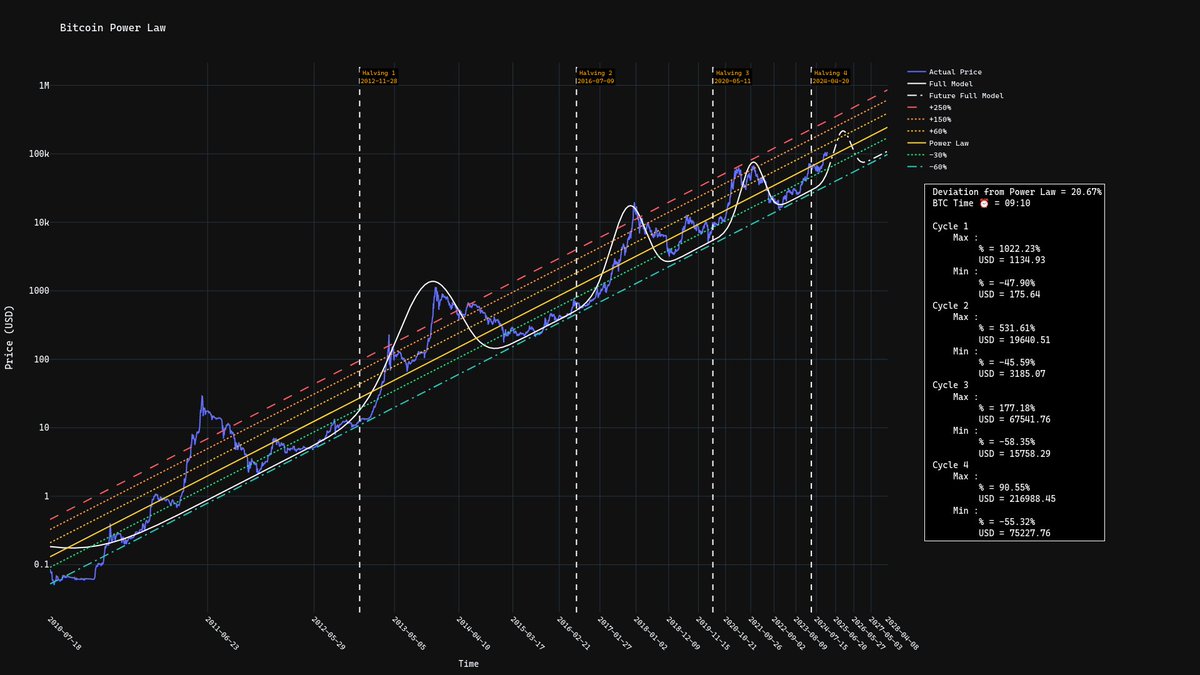
Bitcoin’s adherence to a power law over 8 orders of magnitude is a profound and unique empirical characteristic.
This orderly scaling behavior is not seen in any other cryptocurrency or traditional asset—and certainly not in pyramid schemes or scams. Let’s unpack why this is significant.
1. Power Law as Evidence of Underlying Order
A power law represents a predictable relationship between two quantities that holds consistently over vast scales. Bitcoin's price, adoption metrics, and other key parameters follow this law, indicating deep, intrinsic order in its behavior. This is not a coincidence—it reflects the robust design and natural scaling dynamics of Bitcoin’s decentralized protocol, fixed supply, and network effects.
2. Why Scams and Pyramid Schemes Fail the Test
Scams and pyramid schemes are inherently chaotic and unsustainable. They rely on short-term hype, manipulative marketing, and an ever-expanding base of new participants to maintain their structure. These schemes are characterized by unpredictable bursts of activity, rapid collapses, and no underlying value creation. Such systems do not exhibit the long-term, steady growth patterns that a power law describes.
In contrast, Bitcoin’s power law behavior emerges from its alignment with fundamental principles:
Conservation of Money principle due to its fixed supply of 21 million coins.
Decentralized consensus ensuring trust and resilience.
Adoption dynamics driven by utility, proof of work, social network effects and mutual consensus, not hype.
3. Crypto vs. Bitcoin: The Power Law Divide
No other cryptocurrency demonstrates the same adherence to a power law. Most "altcoins" and tokens are subject to speculative cycles, manipulation by founders or insiders, and lack intrinsic value or network effects that drive sustainable growth. They often exhibit price behavior that is highly erratic, uncorrelated, and unsustainable over time.
This absence of a power law scaling relationship reveals their fundamental weakness. It’s not just that they fail to deliver value—they lack the structural integrity required to create the orderly growth patterns seen in Bitcoin. They are, by nature, chaotic and opportunistic, designed more for enriching insiders than creating long-term value for society.
4. What This Reveals About Bitcoin
Bitcoin’s power law behavior demonstrates its alignment with natural systems of growth and scaling. It shows that Bitcoin operates not as a speculative gamble but as a resilient, self-organizing network with properties akin to other scale-invariant phenomena found in physics, biology, and social systems.
This characteristic suggests:
Robustness:
Bitcoin can endure shocks and adapt without breaking its overall pattern.
Predictability: The power law allows for a level of long-term forecasting, which is unheard of in most assets, let alone scams.
Trustworthiness:
It reinforces Bitcoin’s role as a unique and reliable store of value over time backed by the laws of physics.
5. Conclusion: Differentiating Bitcoin
The presence of a power law is a litmus test for legitimacy and sustainability. Bitcoin passes this test with flying colors, demonstrating qualities that no other "crypto" asset or traditional investment can claim. The lack of power law scaling in other assets underscores their speculative and unsustainable nature.
In short, Bitcoin’s adherence to a power law is not just a mathematical curiosity—it is a defining feature that separates it from scams, pyramid schemes, and even conventional financial assets. It is empirical proof of Bitcoin's unique position as the soundest money and the most resilient and transformative financial network in history.