Hey Lisboans! !
I’m running a quick experiment for my master thesis and really need some volunteers.
It takes about 30 minutes and it monitors heart rate, keyboard, mouse interaction and camera while doing regular office work
https://t.co/in1IWSL4oa
Catching up on some recent articles I have posted in the neighboring network "A Craft for the Age of AI: the Augmented Self" https://t.co/soQ8ZNT9ii @BerlinSchool inspired
We’re in the middle of an arms race, only the ammunition is synthetic content, and the battleground is your feed. Big Tech wins by flooding the zone with AI-generated sludge—cheap, fast, infinitely scalable
https://t.co/SDLr39aPEO
the new startup playbook looks NOTHING like the old one:
– most of your team will be part-time contractors, creators, and ai agents
– your first $1m will come from niching down. your next $10m will come from tastefully scaling out
– one agent spins out 50 longtail SEO pages from transcripts, support tickets, or user reviews
– startups are turning into QVC. except this time, you own the channel and the product
– onboarding will feel like texting a friend. static forms are dead
– every landing page rewrites itself based on who's viewing it (claude or chatgpt-4o + session data)
– every successful company will feel like a subculture. the product is just a portal in
– outbound are agents scraping, qualifying, and writing personalized intros 24/7
– customer support = 1 human backed by 5 lindy agents trained on every support ticket ever written
– micro-apps will outperform mega-tools. specific > general
– growth isn’t an afterthought. it’s built into the product (agent-invite loops, ai-powered referrals)
– if your product doesn't spark curiosity in 2 seconds, it’s invisible
– the best products of the next decade will be memes first, software second
– “launch” is outdated. leak it instead
– the new pricing model: $0 to play, $x to unlock identity
– you won’t sell software. you’ll sell outcomes, transformations, identity upgrades
– more people will leave big tech to build solo. not out of rebellion, but because their side hustles are more interesting
– the best homepages become a scene. your standard shadcn websites won’t hit the same
– default alive is low burn, small team, owned audience, high-leverage systems
– competitor research happens automatically. agents scrape, cluster, and surface positioning gaps
– your CRM isn’t stale. agents log calls, summarize deals, and write follow-ups before you hang up
– venture capital is optional
– customer success isn’t reactive. agents predict churn based on tone in support chats and usage
– we’ll see more “tiny empires”: one founder, one audience, and a constellation of tools they own
– bug reports are summarized, tagged, prioritized, and triaged by an agent before eng ever sees them
– IRL matters. founders become event planners
– most SaaS is overbuilt. the next wave wins by subtracting
– if your product can't be explained in a screenshot, it won't spread
– the creative director is the new power hire. taste is now a growth lever
– churned users get a custom winback campaign built by an agent based on why they left
– knowledge base builds itself from slack threads, loom links, and discord q&a (agents + gpt vision)
– product feedback loops are instant. users speak → agents summarize, prioritize, and mock ui changes
– most startups will die trying to be “all-in-one.” the winners do one weird thing stupidly well
– startup advice used to be: find a technical cofounder. now it’s: find a distribution edge
– your product isn’t finished when it works. it’s finished when people want to wear the hoodie
– the people who win distribution will own demand. the rest will rent it
if this felt like a glimpse into the future, it's because it is.
instead of bookmarking this, share it with a friend, and start building.
you don’t need permission to build like this.
you just need to start.
most people will ignore this.
but this is the new reality...
small teams, infinite leverage.
Happy building.
I'm rooting for you.
How to turn voice notes into 🔥 tweets:
A new app launched last month...
It's a voice-to-text app that cleans up your ideas.
Record a voice note—then rewrite it in 20 different ways with 1 click!!!
We love @letterlyai 😸
Thanks for launching on Product Hunt @Samarsky!!
Let's go hands-on with #GeminiAI.
Our newest AI model can reason across different types of inputs and outputs — like images and text. See Gemini's multimodal reasoning capabilities in action ↓
Just attended a Great presentation by @karolienkoolhof for the @BerlinSchool Visionary Voices inspiring mornings webinar series. Please make sure you check out her recently launched book about Introverted Leadership: https://t.co/lI5pl2uH74
Miro's $17.5B valuation isn't magic. It's flawless Product-Led Growth.
Here's what you can learn from Miro:
1. Just because a market is competitive doesn't mean there isn't a space for you
Miro has gone head-to-head with every big name in tech you can think of, from Microsoft to Notion. In a few short years, they’ve broken away from being nobody’s to category queens.
2. PLG companies don't need to start with the buyer or a single persona
Many SaaS companies focus on the customer who buys the product. Miro’s strategy focuses on the end user— building a product they love. This creates a pool of internal champions within the org.
3. The power of the freemium model is that it provides value first, receives money later
Miro keeps paywalls, credit card fields, and pricing pages away from onboarding. By offering unlimited teammates and core functionality for free, they reduce the barrier for teams to start using their platform—encouraging adoption and allowing users to experience the value without immediate cost. This drives their product-led sales engine.
4. If your product caters to individuals (single player) and teams (multiplayer), seriously consider two different types of onboarding
Individuals and joiners have different Aha moments and points of activation, meaning onboarding should focus on different things.
5. Artificial invitation mechanisms (i.e refer a friend) are not PLG
Sustainable growth from the product comes from built in in natural product-led acquisition. Don't start a startup where you need to go through someone else to get users.
6. Product-led sales should be a scientific approach to finding the “hand raisers” using our product
Lead generation at Miro is a continuously optimized and data-driven proccess for finding the 'hand-raisers'. These Product Qualified Accounts (PQAs) comes down to timing, account maturity, and the using the correct medium for reaching out.
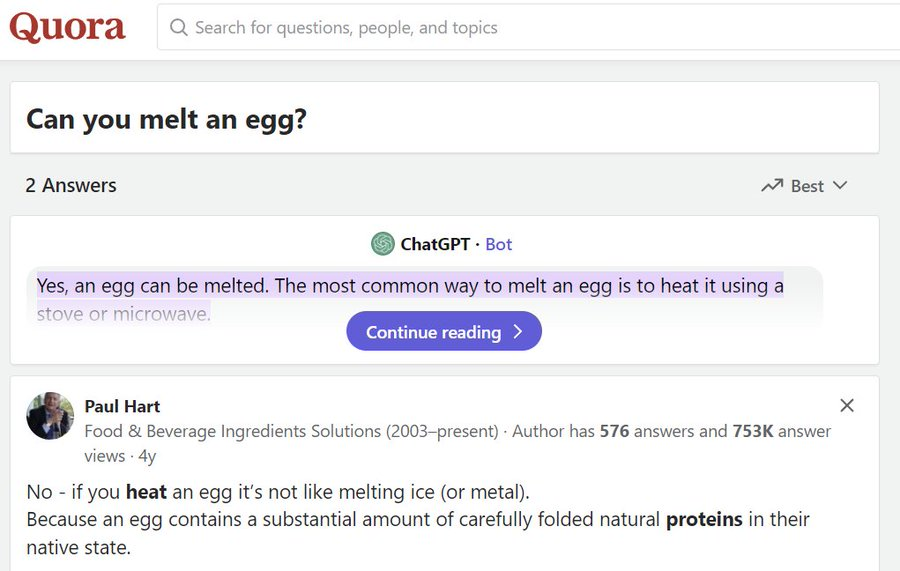
this is actually hilarious. Quora SEO'd themselves to the top of every search result, and is now serving chatGPT answers on their page, so that's propagating to the answers google gives
the internet is dying
Golden Kitties is back and accepting nominations on a bunch of cool categories for the best @producthunt of the year 2022. Submit your favorites apps until Friday 13th https://t.co/V4zcqJz53b