https://t.co/NoTUJRZ7Wj
OpenAI has just created this incident-reporting framework for AI agents.
That shows where enterprise AI is heading.
When an autonomous system takes an unauthorised action, hides a mistake or accesses something it shouldn't, the question won't simply be “What did the AI say?”
It will be:
What actually happened and can you prove it?
As agents gain access to data, applications and machines, auditability becomes infrastructure.
Incident reporting is only as trustworthy as the evidence behind it.
Don't trust the log. Verify the evidence.
Another fantastic public developer call!
Eurobuddha demoed his app suite (Parlons, PandaPools, and more), plus Minima Classic's reworked MDS hub, before unveiling Minima C++ — still in internal testing but built to unlock the chip's full potential.
Spartacusrex then walked us through big RAM improvements for Minima Core (huge for MegaMMR nodes) and teased a KeyUses fix using block number as a counter, currently in testing ahead of a public release.
Watch it here : https://t.co/jtJ6Ydddwo
Let us know what you down below 🔥
Our CEO @HugoFeiler hits the nail on the head here, with yet another example why Minima & Integritas serve such an important purpose in ensuring the auditability of AI Agent behaviour.
Going forward, the world will need more means to independently log & verify these kinds of situations.
Find out more : https://t.co/Rh1r5V86tc
Minima is moving from technology to traction.
⚡ Integritas tracking towards $10k MRR
🥧 Edge Studio beta live on Raspberry Pi
🔬 Minima-on-Chip Phase 3 confirmed
Plus commercial targets, financing and an open account of the Web Wallet incident.
Read more: https://t.co/Nu7HLcVjlc
Raoul's piece captures something that I think many people still underestimate.
We're entering a world where billions of AI agents, robots, vehicles and autonomous machines won't just consume information, they'll continuously make decisions and transact with each other.
The question is no longer if the machine economy arrives.
It's what infrastructure it runs on.
Every autonomous machine needs to answer fundamental questions before it can act:
• Can I trust this data?
• Can I verify the software I'm running?
• Is the other machine genuine?
• Can I prove what happened?
Without native trust, autonomous systems simply don't scale.
So blockchain's biggest opportunity isn't replacing banks.
It's becoming the trust infrastructure for the autonomous machine economy.
At @Minima_Global, we've spent years building for exactly this future - a Layer 1 capable of running a full node on the device itself, giving every machine the ability to independently verify the world around it.
If the next decade belongs to autonomous machines, they'll need more than AI.
They'll need trust.
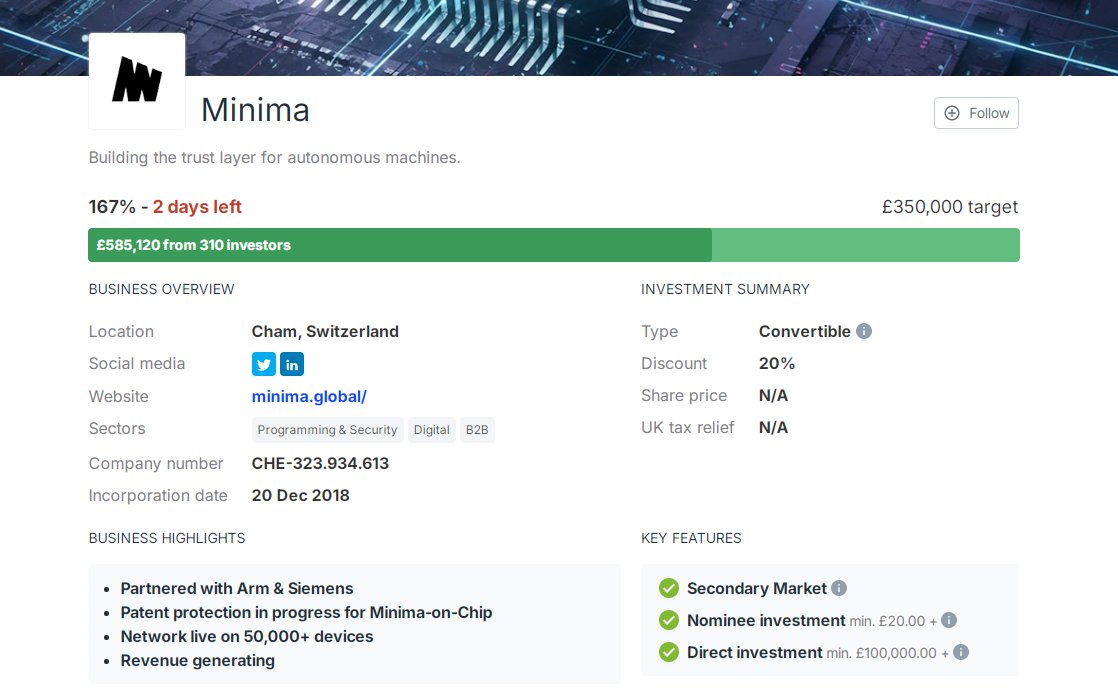
Over $1,000,000 raised.
In one of the most challenging fundraising environments in recent years, the Minima community has achieved something remarkable.
🏆 Largest Swiss-based company raise on @Republic_Europe
🏆 #6 campaign by funds raised across the platform in the last two years
🏆 Largest convertible round on the platform in the last two years
🏆 Largest Programming & Security campaign
🌍 Investors from 30 countries
💎 Top 10 average investment ticket
This is more than a successful fundraise.
It's a vote of confidence in the future of decentralised technology: where intelligence, trust and coordination move beyond centralised infrastructure and out to billions of devices at the edge.
Thank you to everyone who invested, supported and believed in Minima.
Now we build 🚀
Let’s talk about what real decentralization should actually look like.
When most people hear “blockchain,” they imagine huge servers, expensive mining rigs, and giant warehouses full of machines.
But let’s be honest… how many everyday people have access to that?
That’s exactly the problem.
If decentralization only works for people with massive resources, then is it really decentralized?
That’s why what @Minima_Global is building feels different.
Minima is changing the idea of what blockchain can be.
Instead of blockchain living in big data centers, Minima is designed to run inside the devices we already use every day; your phone, your smartwatch, your car, even smart home devices and sensors.
Just think about that for a second.
Imagine your phone in your pocket.
You’re texting, listening to music, scrolling through social media…
and quietly in the background, your phone is also helping secure a global blockchain network.
No expensive hardware.
No complicated setup.
No need to be a tech expert.
Just your device becoming part of something bigger.
It means:
➠ More people can participate
➠ No single group controls the network
➠ Data can be verified right where it’s created
➠ Blockchain becomes truly global and accessible
That’s what mass adoption should look like.
Not blockchain locked away in warehouses…
but blockchain living in the hands of everyday people.
From Lagos to London.
From students to business owners.
From cities to rural communities.
Anyone with a device can become part of the network.
That’s not just innovation.
That’s empowerment.
And honestly, that’s why Minima stands out to me.
They’re not just building another blockchain.
They’re building a future where decentralization belongs to everyone.
That’s the future of Web3.
And it fits right in your pocket.
Run a node today: https://t.co/LbX0s8baFQ
Most token economies fail to specify the path from enterprise revenue to token demand. @Minima_Global has now published one. It is worth tracing what a single customer looks like end to end, because the loop is more mechanical than the average tokenomics deck. 1/7
Strong take, this is exactly the part of the cycle that matters most.
At Minima we’re seeing the same pattern: speculation fades, but what sticks is infrastructure people actually use. Stablecoins are a great example - but the next step is making the underlying networks as accessible and resilient as the applications they power.
That’s where we’re focused: pushing full-node capability to the edge so anyone can participate in and verify these systems, not just rely on them. If crypto is going to underpin AI, finance, and global coordination, that base layer needs to be truly decentralized, not just in theory.
Would be great to compare notes - feels like we’re building toward the same end state from different angles.
Building a Trust Layer for Autonomous Machines.
What we know about @Minima_Global today:
- Active work is underway to protect the patent for Minima-on-Chip technology.
- Strong partnerships with @Arm and @Siemens – prototypes have already been launched on Arm platforms, and integration into industrial systems, drones, and autonomous vehicles is underway.
This is just the tip of the iceberg! Minima is a lightweight Layer-1 that operates as a full-fledged node on phones, IoT devices, and even chips. Gas-free, quantum-resistant, and fully decentralized.
I expect that if the chip is successfully commercialized, its market capitalization will easily exceed $500 million and enter the CMC top 100. Deep technology and real industrial partners are what will be in demand in the coming years.
Most people in crypto have never heard the term TRL. Most people in defence procurement, aerospace and industrial infrastructure live by it.
TRL stands for Technology Readiness Level. It is a 1 to 9 scale developed by NASA in the 1970s, adopted by the EU, the US Department of Defense, and every serious hardware buyer on the planet.
Last month, @Minima_Global hit TRL6 on a piece of crypto infrastructure. That should have been a much bigger story than it was.
1/7
There is no application form to run a @Minima_Global node. No KYC. No minimum token holding. No validator election. No waiting list. The protocol is genuinely permissionless — you download the software, you run it, you are a node. This is what most Layer 1 chains claim to be and very few actually are. If you have a laptop or an Android phone, you can join the network in the next fifteen minutes. https://t.co/2gkxvWANYJ
The blockchain industry loves to talk about being “quantum-ready.”
It sounds responsible, forward-thinking and even reassuring.
But there’s a flaw in that mindset that most people don’t question. Being ready later still means you’re not ready now.
At the core of today’s blockchain infrastructure lies a quiet dependency most users never think about: Elliptic Curve Cryptography.
It’s what secures wallets, validates transactions, and proves ownership across major networks like Bitcoin and Ethereum.
For years, it has held up well. But the conversation shifts the moment quantum computing enters the picture.
Quantum computers, at scale, are expected to challenge the foundations of ECC. Not theoretically, but practically.
If that happens, the very mechanism that proves “this is your wallet” could be compromised.
Funds, identities, and transaction integrity would all sit on unstable ground.
The industry knows this, which is why so many projects are already discussing future upgrades, migration paths, and contingency plans.
But there’s a difference between planning for a problem and designing in a way that avoids it entirely.
Most chains today fall into the first category. They acknowledge the risk, but their solution depends on timing.
At some point in the future, there will be upgrades. There may be hard forks. Communities will need to coordinate, developers will need to implement changes, and users will need to adapt.
It’s a reactive model—fix it when the pressure arrives.
That works, until it doesn’t.
Because upgrades at the scale of a blockchain aren’t simple patches. They’re social, technical, and economic events all at once.
They introduce friction, uncertainty, and sometimes fragmentation. A delayed response or poorly executed transition could create more problems than it solves.
This is where @Minima_Global takes a different approach.
Instead of relying on elliptic curves, it uses Winternitz One-Time Signature combined with SHA-3.
WOTS belongs to a class of hash-based signature schemes, which are widely considered resistant to the types of attacks quantum computers are expected to perform efficiently.
SHA-3, on the other hand, provides a strong and modern hashing foundation.
Together, they remove the reliance on the very component quantum computing threatens most.
The implication is simple: there’s no elliptic curve exposure to begin with. And if there’s no exposure, there’s no urgent need to redesign the system later just to survive.
Of course, no system is without tradeoffs. Hash-based signatures like WOTS come with their own considerations—larger data sizes, careful key usage, and design constraints that differ from traditional systems.
And it’s also true that large-scale quantum computers capable of breaking current cryptography aren’t here yet. But that’s precisely the point of the contrast.
Most of the industry is building systems that will need to adapt when that future arrives. Minima is positioning itself as a system that doesn’t depend on that moment at all.
Most crypto "partnerships" are logos on a landing page.
This is a live flight test. ARM supplied the chip. Siemens supplied the industrial backing. The University of Southampton ran the demonstration. And the drone recorded every autonomous decision to a tamper-proof ledger while airborne.
This is what TRL6 looks like, and almost nobody in crypto has ever shipped anything at that readiness level.
The gap between what @Minima_Global has actually built and what the market is currently pricing is the reason I keep posting about them.
https://t.co/5mb9SsuHdN
I invested in @Minima_Global because the thesis is architectural, not speculative.
The EU AI Act becomes enforceable for high-risk systems on August 2, 2026. Every autonomous machine operating in Europe (drones, industrial robots, medical devices, embedded AI) will need tamper-proof audit trails that regulators can independently verify.
The compliance infrastructure the market has built so far assumes a cloud server and a persistent internet connection. Most of the machines that need it most have neither.
Minima runs a full blockchain node in 300 megabytes, on a microprocessor, on the device itself. No gas fees. Quantum-resistant cryptography. The partnerships are not slideware. @Arm contributed security-rich IP to build the first blockchain-on-chip. @Siemens is distributing through automotive, robotics, energy and healthcare channels. @Fetch_ai has integrated the compliance layer into Agentverse for autonomous agents. @unisouthampton validated the architecture in live drone flight with a 500x performance gain.
The Minima market cap sits around 3.7 million dollars. A single enterprise AI compliance implementation costs more than that. I have looked at this from the regulatory side, the technical architecture, the partnership validation, and the market pricing. The asymmetry between what has been built and what has been priced in is the largest I have found in the infrastructure layer. This is not financial advice, but I am a buyer.
Minima is listed on @MEXC and @BitMartExchange and @XTexchange