@DonnyWals This source-breaking change is being deferred from Swift 6, and you will continue to be able to write ‘bare’ existentials (or explicit ‘any’) until some future language mode to be determined—unless you enable the future feature. https://t.co/gGzEJPPnvl
@TfL@Burberry Hey @TfL, remember when you yourselves did a station takeover of the @TTChelps (in Canada! why?) in the 2000s, complete with London transit maps? Tourists seriously confused—good times! (It really wasn’t.) Neat that you’re now doing the same thing to your own customers!
@MichaelRetchin It had to be discovered eventually, but (at least how I was taught) the notion that certain lineages of immune cells obligatorily break and edit their own DNA was more or less heretical at the time of Susumu Tonegawa’s work, and the Nobel was awarded to him alone
“some AIs were found to be picking up on the text font that certain hospitals used to label the scans. As a result, fonts from hospitals with more serious caseloads became predictors of covid risk” 😬 https://t.co/U68CRY4c90
@bjhomer It's been talked about before, certainly.
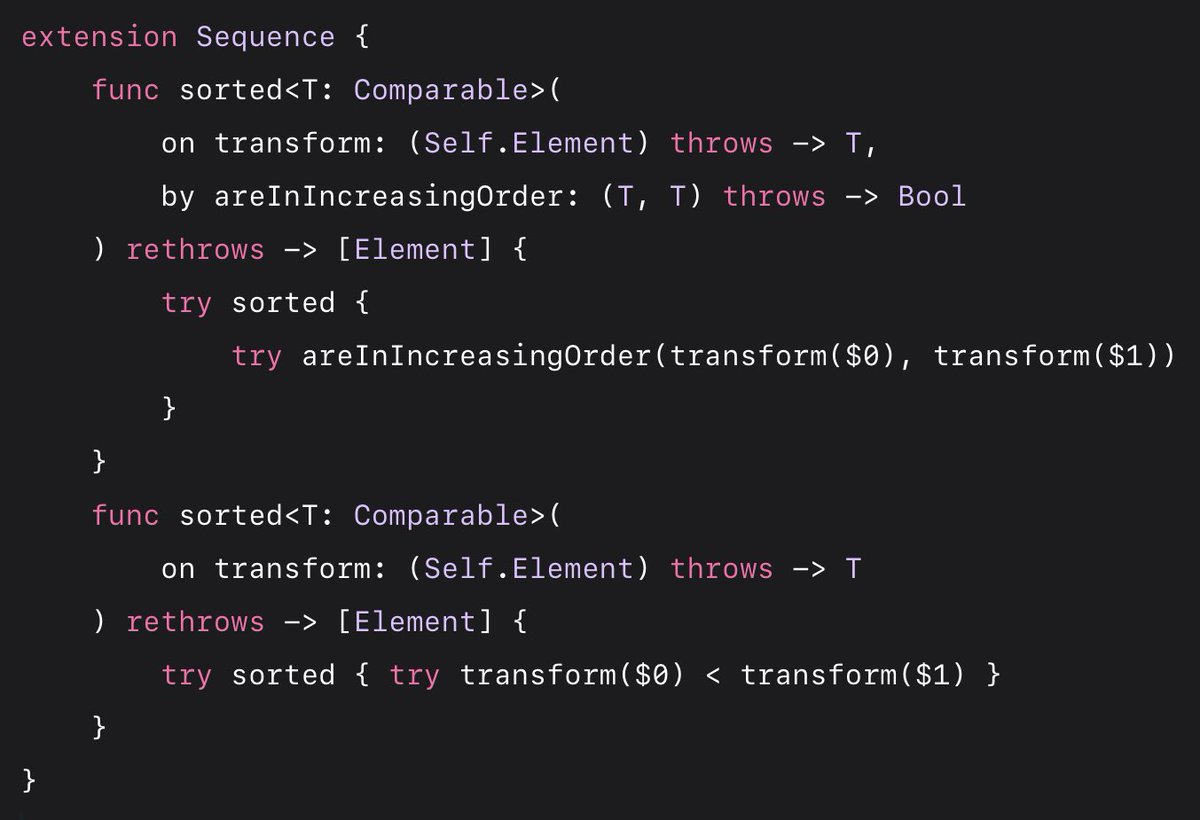
Since key path literals can be used where a function takes a closure as an argument, my preferred spelling is something like the following, which can be used as `people.sort(on: \.surname, by: >)`:
@doug_rand@InnovateEconomy@LettieriDC Curious if you have insight into why biological sciences are excluded from the definition of “STEM” in this bill. Seems like now’s particularly not the time for that.