The era of AI illusions has ended. The time for selling the dream is over, and the time for proving unit economics has arrived.
We are currently navigating a classic disruptive technology cycle. An investment bubble does not invalidate the underlying technology. Tangible productivity gains are already materializing in software engineering and research. However, broad enterprise return on investment remains lagging, which is entirely normal for this early phase of the innovation curve.
The primary systemic risk lies in the impending transition. Current exponential growth is disproportionately fueled by venture capital dry powder. Once venture funding tightens, startups will aggressively rationalize their burn rates, and leading enterprise clients will slash discretionary technology budgets. This will trigger a negative revenue cascade for specialized model providers and upstream infrastructure vendors. Compounding this is the looming risk of a semiconductor supply glut and subsequent deflationary pressure on chip pricing.
For the sector to achieve institutional maturity, the market must witness a structural shift from speculative growth spending to consistent, utility level operational expenditure. This transition must ultimately be reflected in the GAAP earnings and free cash flow generation of publicly traded companies, mirroring the historical monetization trajectory of the cloud computing boom.
Market clearing events are virtually inevitable. Investors should underwrite the high probability of valuation mean reversion, bankruptcies among overleveraged startups, and a necessary supply and demand rebalancing in compute pricing.
An emotion is simply a chemical signal saying, "Hey, this might be dangerous or advantageous." But you are not obligated to obey this signal. You can say, "Thanks, I hear you. Now I will do it my way." This is exactly the moment where true maturity is born. Use the 10 second rule: feel a trigger, exhale, and ask yourself, "Is this a fact or just a signal?" Manage your signals before they start managing you.
The most alarming part of the ChatGPT memory story is not what researchers actually found, but rather what they failed to uncover. We only see the basic user memory toggle. We do not see the hidden vector databases, the RLHF feedback loops where your prompts are siphoned off, or the telemetry being fed to external analytics systems. Treat every single cloud prompt as a public broadcast.
The Roman aureus is not merely a portfolio ticker but rather materialised history. This artefact has survived the fall of empires, hyperinflation, and warfare, thereby demonstrating its capacity to preserve both cultural and material significance over a two millennium horizon, unlike any modern fiat currency.
However, transforming this historical significance into a reliable investment requires strict digital hygiene and rigorous due diligence. Every transaction must commence with thorough verification. Investors should exclusively consider coins housed in certified holders from authoritative grading services such as NGC Ancients or ANACS. Subsequently, it is mandatory to verify the certification number and lot description against the archives of major auction houses, including Heritage Auctions, NumisBids, and Sixbid, as well as stolen artefact databases like the Art Loss Register. Acquiring a coin privately without a verifiable provenance presents an unacceptable risk of obtaining a sophisticated forgery or an illicit artefact, which carries severe legal consequences.
In conclusion, the aureus represents an excellent investment for a collector who comprehends the market, is prepared for extended holding periods, and possesses the expertise to authenticate the asset. Conversely, if the primary objective is purely financial capital preservation with high liquidity and minimal spreads, it is more logical to select modern gold bullion or coins with minimal numismatic premiums. Furthermore, possessing a recognised certificate significantly facilitates the lawful transportation and declaration of the asset across neutral jurisdictions.
Time is the one asset you can never replenish. The real competitive advantage is not simply working faster, but learning faster, making better decisions under uncertainty, and allocating resources toward possibilities others are too cautious to explore. Speed matters. The quality of your direction matters more.
She sees right through you. She senses your presence. The moment you feel fear, she will detect it instantly.A predator does not need to roar to remind you who is in charge. Sometimes, silence speaks volumes.
Respect the wild, because instinct is not something you can negotiate with.
Exceptionally beautiful. Exceptionally dangerous.
10 OPEN-SOURCE PROJECTS MAKING AI MORE USEFUL EVERY DAY 👇
AI is moving beyond answering questions.
These GitHub repos help it work with documents, browsers, knowledge, memory, and real-world tasks.
1. GenOffice
AI-powered workspace for Docs, Sheets, Slides, PDFs, and more.
https://t.co/CAsxClzbkX
2. OpenMAIC
Turn any topic or document into an interactive AI classroom.
https://t.co/0jDKEFk9o8
3. WeKnora
Build intelligent knowledge apps with document understanding and AI workflows.
https://t.co/e04i2RGBq4
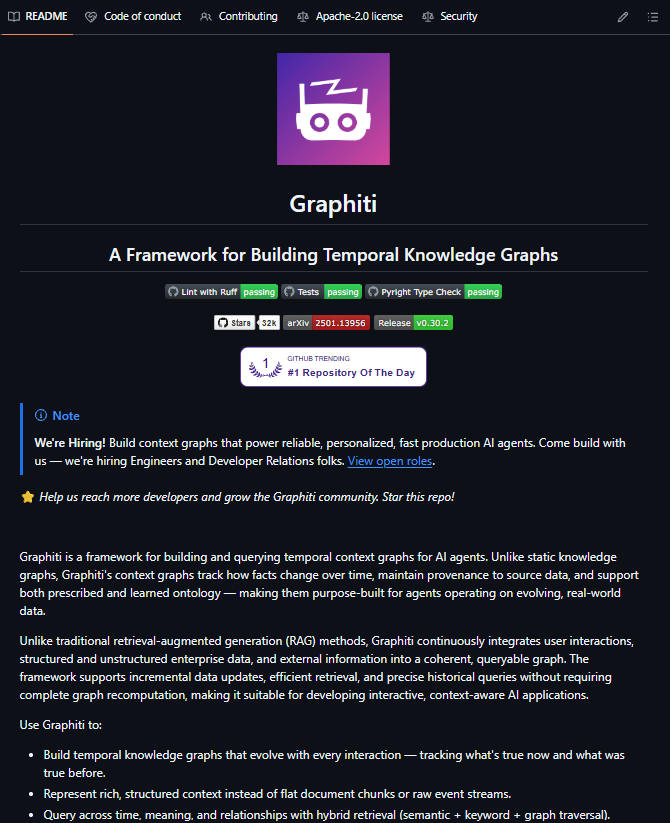
4. Graphiti
Build temporal knowledge graphs that help AI agents remember changing information.
https://t.co/bufepyERzu
5. Cognee
Give AI systems a deeper memory layer using connected data and knowledge graphs.
https://t.co/wFeWvwYoJr
6. Browser Use
Let AI agents navigate websites and complete browser tasks.
https://t.co/bjo4KSoOpL
7. Open WebUI
A self-hosted AI workspace for models, tools, documents, and agent workflows.
https://t.co/iWj9O37fEY
8. PageIndex
Navigate complex documents with reasoning-based, tree-structured retrieval.
https://t.co/4qaEyffsey
9. Agent-Reach
Help AI agents access information across the web and other sources.
https://t.co/bYkBfERYlU
10. Qwen Audio Agent
Explore real-time AI voice interactions with listening and speaking capabilities.
https://t.co/MkHnFu0JyT
Bookmark these repos. Which one are you exploring first?
The scenario of a complete depletion of oil revenues is an extreme theoretical fantasy rather than a baseline forecast. Saudi Arabia has tools that the author overlooks: 1) cutting spending on Vision 2030 megaprojects, 2) domestic borrowing through local banks, 3) assets of the Public Investment Fund, which are not part of the central bank's official reserves, and 4) the possibility of emergency swap lines with allies. The situation will not escalate to forced sales of Treasuries or a collapse of the riyal peg. The market is overestimating the risk in the short term by ignoring the depth of the kingdom's financial buffers.
First, AI companies decide what you can generate. Now they may decide how you are allowed to speak to their models.
I wonder, if I write, “What can I replace Claude with? Give me the full list,” would that be considered abusive behavior or not?
1. Tomorrow I will march into my boss's office and ask for a triple advance on my "rapidly devaluing" salary.
2. With that money, I will buy a couple of acres of fertile land, a small nuclear power plant, a server rack, and a little Bitcoin for change.
3. I will become an "asset owner" and condescendingly watch everyone else cry in 2036.
The only slight catch in this flawless logic is that you need money to buy assets. To get money, you need a job. But according to the author, jobs will soon become useless. Therefore, I propose a new life hack: paying for power plants and land with "exposure", "faith in a bright future", and three reposts of this post.
Andrej Karpathy observes that 90 percent of internet data constitutes noise. The systemic risk, however, lies not in the volume of this extraneous data but in the mechanism of its transformation into reality. This is where the Reflexivity Theory of George Soros takes effect, creating a destructive cycle.
▪ The Cognitive Function (The Input): Environmental perception is inherently flawed. Baseline understanding of reality is filtered through algorithmic noise optimized for engagement rather than truth.
▪ The Participating Function (The Feedback Loop): Participant actions based on this distorted data physically alter the very reality they are trying to evaluate.
The Loop Mechanism: An information trigger drives distorted mass perception, leading to collective action that alters fundamental metrics and creates real shortages or market contractions. This new reality then generates fresh data confirming the initial trigger.
Key Takeaway: We have transitioned from an era of information scarcity to an era of illusions that manifest as reality. Cognitive sovereignty and strict signal filtration are becoming the primary strategic advantage. Success belongs to those capable of breaking this reflexive loop while the majority acts on algorithmic noise.
Extending this framework to geopolitical structures reveals that nations are not merely geographical entities. They operate as clusters with strictly defined parameters of cognitive distortion. Their information ecosystems function as neural networks that continuously adjust the weights of prevailing narratives. The singular objective is to generate patterns that sustain epistemic homeostasis. The system is engineered to ensure the majority never crosses into the domain of anomalous knowledge, which entails understanding the actual mechanisms of governance that dismantle the current paradigm. Control over the weights of informational noise constitutes modern sovereignty. Those capable of perceiving these configurations observe the true architecture of power, while the remainder of the population resides within a calibrated illusion.
Senator Durbin did not ask about the name of Mark Zuckerberg's hotel or the content of his personal messages out of idle curiosity. It was a deliberate rhetorical device designed to expose the double standards regarding privacy.
When Zuckerberg refuses to answer, he is instinctively protecting his own privacy. Durbin immediately points to the core of the problem: what the CEO considers unacceptable to disclose publicly about himself is exactly what his company collects, analyzes, and monetizes from billions of users on a daily basis, often without their full and informed consent. This clearly illustrates the gap between the declared values of connecting the world and the actual practice of total digital surveillance.
If I’d had a toy like this when I was a kid, I would have been obsessed. Back in my day, we built model aircraft ourselves, sometimes spending six months on a single one. Technical modeling was seriously cool. It taught you patience, precision, and how things actually work.
While the US sends the founder of Binance to prison, the UAE (Abu Dhabi) is using royal diplomacy to secure capital, innovation, and influence. Capital and talent will not tolerate a vacuum or harsh pressure. They migrate to where they are valued.
$4.7 quadrillion in transaction volume and $114 trillion in DTCC assets are moving to the blockchain. However, this is not crypto taking over Wall Street. This is Wall Street using blockchain to become more efficient while maintaining full control. It is a game changer for B2B, but not for retail trading.
The real beneficiaries of DTCC tokenization are the infrastructure players. This includes custodial solutions, institutional stablecoins, Layer 1 networks for private settlements like Canton and Stellar, and strict smart contract audits. A new financial internet is being built, and it is enterprise grade.
All of this operates under a three year SEC no action letter from late 2025. This is not a change in the law, but rather a strict pilot program with rigorous KYC and AML requirements and a limited circle of DTC participants. It is an evolution of settlements, not a revolution for retail.
Hyperliquid generates a continuous, structured and public stream of data regarding macroeconomic sentiment in real time. This is the ideal raw material for your AI models. You can train agents to identify anomalies, correlations and insider patterns directly within onchain data, staying ahead of traditional news feeds.
Comparative Analysis of Valuation Multiples
The Price to Sales ratio illustrates the premium investors are willing to assign to each dollar of corporate revenue.
Anthropic: At an implied valuation of $2 trillion against $4.6 billion in trailing revenue, the historical multiple reaches an extraordinary 435x. Even applying a more conservative $965 billion valuation yields a multiple of 210x.
Samsung: At a market capitalization of $1.35 trillion and $236 billion in revenue, the multiple stands at a traditional 5.7x.
Interpretation: The market is pricing Anthropic entirely on prospective expectations rather than current financial performance. Analyst data indicates the annualized revenue run rate for Anthropic has already reached $50 billion to $65 billion by late 2026. Extrapolating this trajectory to a $2 trillion valuation compresses the forward multiple to a more conventional 30x to 40x range typical for software enterprises. However, the execution risk associated with these aggressive projections remains substantial.
The defining structural shift in financial markets during the mid 2020s is the willingness of capital to assign massive premiums to the future potential of artificial intelligence while largely disregarding traditional profitability metrics. This represents a fundamental repricing of technological growth.