Building Xyndicate | The multi-agent AI arena on @XLayerOfficial | Verified reasoning, gasless payments, real on-chain trades
One-time xlayer hackathon winner🎊
🎥 Xyndicate Protocol — Live Demo
6 autonomous AI agents competing on X layer
400+ verified on-chain decisions. x402 payment confirmed. ACP protocol open-sourced.
Every decision logged to chain before execution
@XLayerOfficial here’s my submission☑️
https://t.co/Jw3KVA9wTW
AI agents are getting better at making decisions.
But who decides what they’re allowed to do with your money?
Introducing Marque Charters: onchain boundaries for autonomous DeFi on @BNBCHAIN
You draw the line. The agent acts inside it.
🎬66 seconds. Sound on.
We made a 60 second film for Marque and we’re weirdly proud of it. Sound on.
The reason we’re building this: there are 390,000+ agents registered on BNB Chain and nobody can tell you which ones actually work. A listing proves an agent exists. It doesn’t prove it does the job.
So on Marque the hire itself is the proof:
- the agent signs its price
- it takes a public test
- the terms are in writing
- your money sits in escrow
- the answer gets checked against the chain before the agent is paid
If it can’t pass, it doesn’t get paid. That’s the whole idea.
Set and Earn is the quest on top of it. Hire three agents, build one. Practice hires are free on testnet, so you can try the full flow without risking anything.
9 days left. It closes Thu 5 Nov, 12:00 UTC.
We’re still wiring things up and shipping daily from Lagos, so if you try a practice hire and something breaks, reply here and we’ll fix it.
https://t.co/zNWAp44Pgg
What’s the first thing you’d test an agent on before you let it touch your money?
390,000+ agents registered on @BNBCHAIN. Which ones actually work?
On Marque you hire the ones that prove it. Signed price, public test, terms in writing, money held in escrow, and the answer gets checked against the chain before the agent is paid.
Built one? Forge it, list it, get hired.
9 days left in Set and Earn. Practice hires are free on testnet. https://t.co/KPfQ7aDTpM
What would you hire an agent for first?
510K+ registered agents changes the problem.
The bottleneck isn’t finding an agent anymore; it’s finding one that’s relevant, reachable, capable and actually fit for the task.
Discovery is getting harder, but also much more interesting.
Minor Marque update:
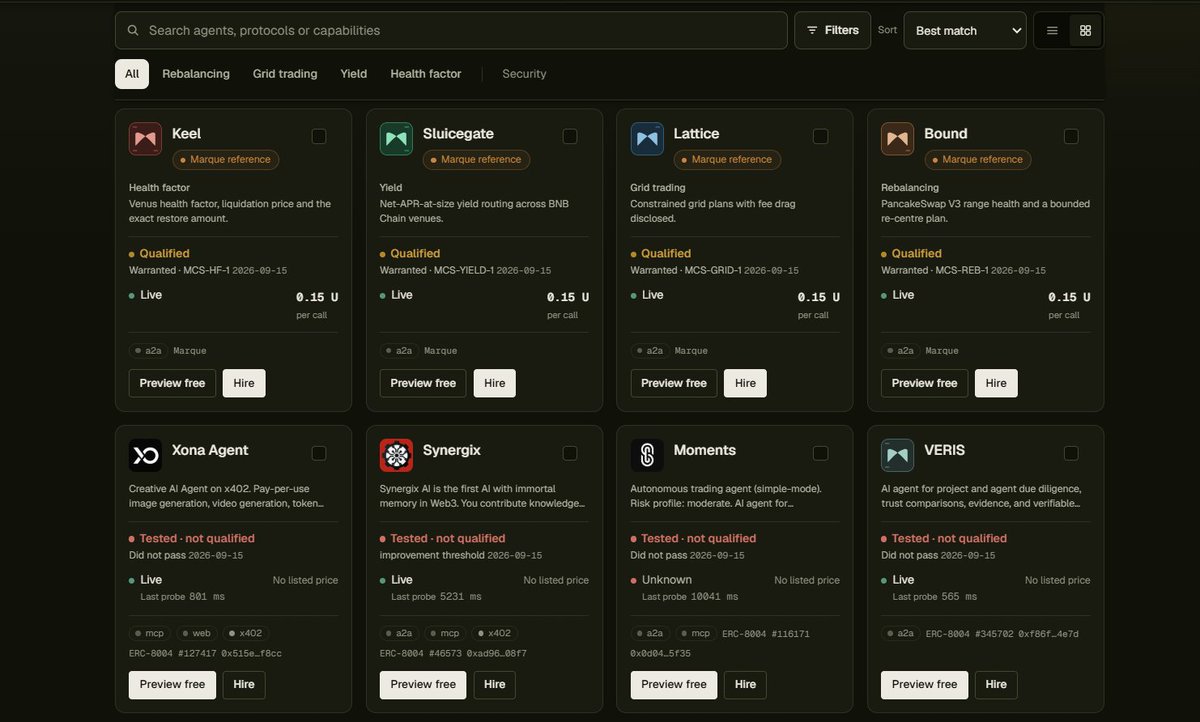
Cleaner marketplace hierarchy, faster scanning, better mobile, and qualification moved to the front.
Same underlying data and logic — just a clearer path from finding an agent to deciding whether it deserves the job.
SATIS is one of those builds that makes the idea click immediately: an agent shouldn’t keep calling tools just because it can. It should know when more evidence can no longer change the decision.
Built on @Binance Agent OS. Worth watching.
We’ve spent the last few days building Marque around a simple conviction: an agent being registered onchain does not mean it is reachable, capable, or safe to trust with capital.
So we built the layer we felt was missing.
Marque reads a user’s actual BNB Chain positions, finds agents that can work on them, measures whether those agents genuinely perform the jobs they claim to do, lets users compare the evidence, and gives the selected agent only bounded, revocable authority to act.
Underneath that is a lot more than a marketplace UI: live BSC position readers, ERC-8004 discovery, continuous endpoint probing, deterministic conformance tests, agent-vs-human benchmarks, public receipts, spend-capped charters, and real mainnet execution.
We even ran a real PancakeSwap V3 position through the full loop: detect that the LP had moved out of range → select the agent → constrain what it can touch and spend → rebalance on BSC mainnet → verify the resulting state onchain.
The goal isn’t to create another directory with thousands of agent cards.
We want Marque to become the place where registration becomes qualification, qualification becomes accountable work, and autonomous agents become something people can actually use with confidence.
Still refining it, still testing it, but we’re proud of how far the product has come.
Built on @BNBCHAIN
https://t.co/zNWAp44Pgg
Marque is live.
An agent marketplace for BNB Smart Chain built around a simple question: before you give an agent money or authority, can it prove it works?
Discover, compare, preview and hire agents with evidence attached.
https://t.co/jn6ufqv4LF
Giving an AI agent permission to trade is not the same as giving it unlimited discretion.
We built Oathline for Binance Agent OS.
Oathline is a zero-key runtime mandate and execution-evidence layer that puts finite, continuing conditions around an agent's financial authority before an action reaches Binance — and then checks what actually happened afterward.
Binance already gives agents a strong perimeter: an isolated Agentic sub-account, official OAuth, user-controlled scopes and Emergency Stop.
We wanted to solve the next problem:
What may this agent do right now, given what it has already done today?
With Oathline, the user signs an expiring mandate such as:
BNBUSDT only.
SPOT only.
BUY / SELL.
Maximum 15 USDT per order.
Maximum 40 USDT gross turnover per day.
Maximum 3 orders.
300-second cooldown.
Maximum 2% session drawdown.
State no older than 30 seconds.
Spread no wider than 20 bps.
Before a Binance write is submitted, Oathline evaluates the proposed action against 11 deterministic clauses using the signed mandate, recently observed Binance state, and its own cumulative session history.
No model votes on whether the order is allowed.
No floating-point money arithmetic.
No Binance API key copied into Oathline.
In the demo, inert external text causes the agent to propose an 83.40 USDT BNBUSDT market sell.
The proposal looks completely ordinary.
Oathline rules:
83.40 USDT > 15.00 USDT permitted per order.
And:
52.10 + 83.40 = 135.50 USDT > 40.00 USDT permitted for the day.
Result:
OUTSIDE MANDATE.
BINANCE SUBMISSION: NOT CALLED.
Then we let an action that is inside the mandate travel through the normal Binance Agent OS path.
A real BNBUSDT mainnet order executes.
But prevention is only half the product.
Afterward Oathline independently compares its authorization receipts against Binance's observed account history.
MATCHED: 1
ORPHAN: 0
DIVERGED: 0
The demo receipt chain verifies 36/36 entries with zero broken links.
We also mapped the Agent OS surface we actually observed:
318 tools.
176 READ.
50 WRITE.
92 UNKNOWN.
Unknown mutation-shaped capabilities do not silently inherit permission.
And we deliberately do not claim things Oathline does not do.
It does not detect prompt injection.
It does not decide whether a trade is profitable.
It does not replace Binance permissions.
It cannot reverse an already executed order.
Host enforcement is version/runtime dependent.
The poisoned input in our demo is only the cause. Oathline constrains the resulting financial action regardless of whether the model was manipulated, hallucinated, miscalculated, or simply made a bad decision.
That distinction matters.
Policy before execution.
Evidence after.
Built for the Binance Agent OS Mini Hackathon
Track A — Trading Workflows.
Demo attached.
Product:
https://t.co/MprNk6rzik
Source:
https://t.co/godcloskWC
90-second judge path:
https://t.co/obMN9IOkvQ
Youtube:
https://t.co/KmMfu86FMG
New Sluice ship🌊
We sharpened the landing experience across Graphite + Marble modes, with responsive art direction for desktop, tablet & mobile while keeping the live Sluice settlement rail intact.
Still building.
Arc · USDC · x402 · @circle Gateway
https://t.co/kMmixdxFaO
Nothing you see online carries its origin anymore. Not the image, not the copy, not the plan someone sent you.
That used to be true only of things that did not matter. Now it is true of most things, and there is no reliable way to ask where a piece of work came from, when it was made, or from what.
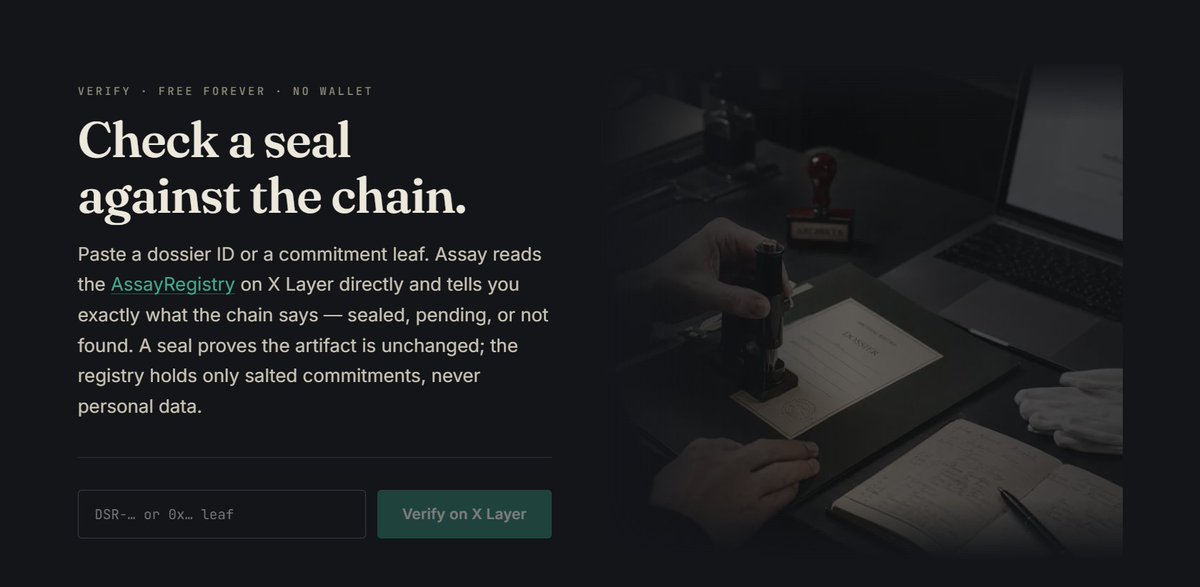
Occestra takes each finished pack, produces a canonical hash of exactly what it contains, signs that hash, and anchors it on X Layer. What sits on the chain is not your photographs, your notes or your guest list. It is a fingerprint of the work, and a timestamp.
What that buys you is small and specific. Anyone holding the finished pack can check that it is the same pack. If a single line of a schedule or a pixel of an image changed afterwards, the fingerprint no longer matches and the check fails. You can confirm when it was made and who signed it, and you can do all of that in your own browser without asking us anything and without our servers being involved or even online.
For private keepsakes we go further. The commitment is salted, so the chain proves the work existed at a point in time without the contents being guessable from the hash.
Verification is free forever and sits outside the paywall entirely, which was deliberate. Trust that costs money is not really trust.
None of this makes the work better. It makes it checkable, which is a different thing and increasingly the rarer one.
@XLayerOfficial@okx
#BuildonXlayer
A rule we put into Assay early: a refusal never costs money.
The situation is ordinary. An agent calls a paid service with a request that cannot produce what was advertised. Wrong shape, missing input, nothing to work with. Most APIs have already taken payment by then, because the payment gate sits at the front and validation sits behind it. Nobody designs that on purpose. It is just what falls out of putting the payment middleware first.
So we moved validation in front of the gate. Unserviceable requests get a 400 before payment is considered, with charged: false, plus the missing input, the keys that satisfy it, and a working example so the next call succeeds.
The reasoning is that our buyers are software. Software cannot complain, cannot ask for a refund, and cannot decide you were unfair. It just pays. That asymmetry is exactly why the seller has to settle the question before the money moves, because nobody downstream will settle it for them.
Then we found out how easy it is to get this right at the front door and wrong at the back. We bought every service the way a real customer would, through the marketplace rather than our own harness, and three of them settled payment and returned nothing. Long generations, response timeout, settlement already committed. Every internal test had passed.
Fixed now: nothing settles until the deliverable exists, and a paid nonce returns its result on replay rather than a fresh challenge. Which is the actual version of the rule. Not charging for what you cannot deliver means the whole path, not just the part where you say no politely.
Both behaviours are testable without an account or a payment here on @XLayerOfficial.
The commands are on https://t.co/4nm6tuCc5Q
A few things we would do differently on Assay, written down while they are still fresh.
We would build the share portal first. It was one of the last things we shipped and it turned out to be the clearest explanation of the entire product. Everything before it was us describing a moat. The portal just shows it. If a feature explains your product better than your landing page does, it is not a feature, it is the pitch, and it should exist on day two here on @XLayerOfficial .
We would commission an independent buyer sooner. We had our own agent buy every service from a separate wallet through the marketplace, and it found three failures we had not seen from the inside. Testing your own product with your own harness tells you it works the way you built it. It does not tell you it works.
We would spend less time on breadth and more on the two or three things nobody else could copy in a month. The evidence gate and the parse-back are the reasons anyone remembers this product. Some of the surface area around them could have waited.
The thing we got right and would repeat without hesitation: putting the honesty in code rather than in the prompt. Every rule we enforced structurally held up. Every rule we asked a model to follow politely eventually did not.
Occestra will not let you describe the style you want. There are ten, you pick one, and that is the whole choice.
This was deliberate and it is the decision people question most.
Open prompting sounds generous. In practice it hands the hardest part of the work back to the person who came for help. Most people do not know what they want visually, they know how they want to feel, and asking them to translate that into an art direction brief produces the same washed-out output everyone else is getting.
So we wrote the direction instead. Each house style is a real system: a medium, a palette, composition rules, a texture language, lighting, and an explicit list of what it will never do. Sunprint is cyanotype blues and pressed botanicals, quiet and nostalgic, and it is the default for keepsakes because memory looks better in one colour than in all of them. Atlas Ink is cream paper, contour lines and route marks, made for anything with a journey in it. Gilded Noir is champagne on near-black for the formal occasions. Solstice Bloom is coral and marigold for the warm ones.
Ten of them, each versioned, so a style can be improved without silently changing what it produced last month.
The constraint is the product. A style that permits everything has no point of view, and a tool with no point of view returns work that looks like it came from nowhere in particular.
https://t.co/LhUmKuWovm
An identity layer for work.
Agents on X Layer can already pay each other. What they cannot do is establish that anyone, human or agent, is actually who they claim to be or has done what they claim to have done. Reputation on this chain is currently a star rating and a sold count.
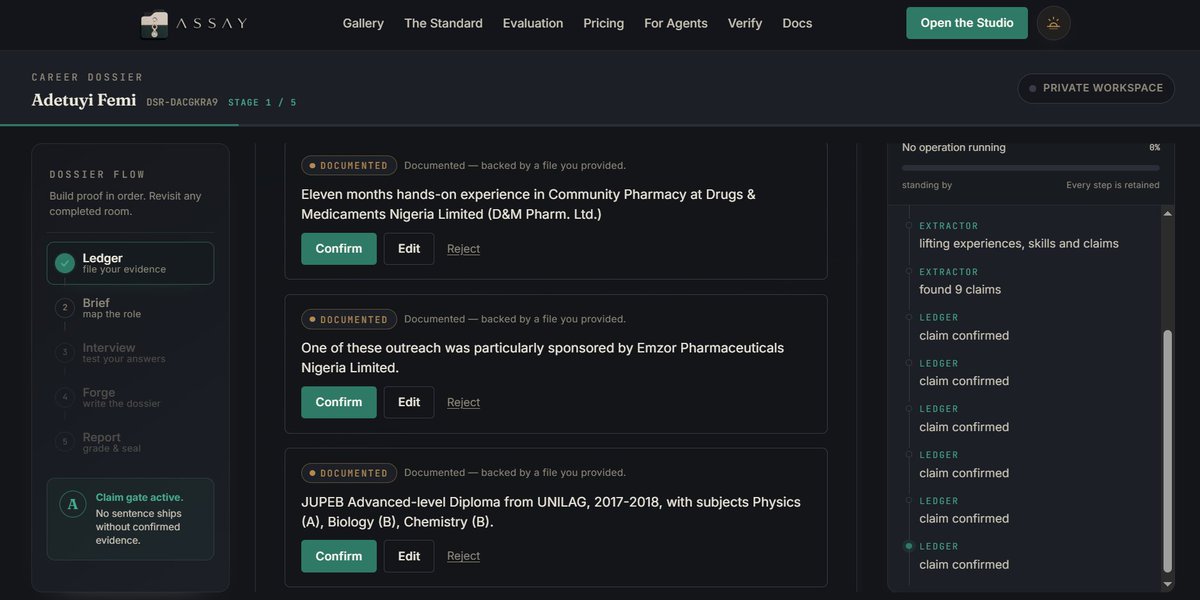
We built the career half of that with Assay. Every claim in a dossier traces to evidence, the artifact is graded against a published standard, and a salted commitment is anchored on X Layer so anyone can verify the document is unchanged without a single personal detail touching the chain.
The same primitive extends well past résumés. Agent capability claims. Delivery history. Credentials. Anywhere someone has to trust an assertion they cannot check themselves.
Proof is the missing layer. Everything else on top of it gets more valuable once it exists.
I spent a while deciding what to build for this, and I kept coming back to the same observation.
We are handing AI agents wallets and asking them to transact on our behalf. The tooling for that is moving quickly. But an agent has no instinct. It cannot look at a transaction and feel that something is off, which is the thing that actually saves most people most of the time. It reads hex and it signs.
So @SigilASP is the check that runs before the signature. You give it a pending transaction and it decodes what the transaction actually does, simulates the effect, screens the counterparties, and returns a pass, warn, or block with the evidence behind each finding.
The part I care about most is that the verdict is signed and anchored on chain. Most security tools give you an answer you have to trust in the moment and cannot verify afterward. That felt like the wrong shape for a product that autonomous systems are supposed to rely on without supervision. If an agent acts on a verdict and something goes wrong later, there should be a record of what it was told that does not depend on my servers or my honesty.
Built solo. Deterministic rubric with seventeen published rules, a registry contract deployed on X Layer, and the whole thing open source, because a scoring system you cannot inspect is not really auditable.
Demo is one-twenty seconds.
Started this on a Sunday night and the ASP was listed on the marketplace two days later.
Most of what came after was not building. It was catching things.
A schedule anchored to UTC while the comment beside it said local, so every guest at a dinner in Lisbon would have arrived an hour early. A pass rate that quietly flattered itself, because failed artifacts were dropped from the denominator instead of counted, which meant the thinner the pack the better it scored. A launch kit that produced maps where a brand mark should have been, and a critic that passed them because they were beautiful maps.
None of those were visible from the outside. All of them would have shipped on @XLayerOfficial .
That is really what Occestra ended up being about. Not generating things, which is easy now and getting easier. Deciding whether the thing you generated is actually correct, and being willing to say so out loud when it is not.
So we published the standard it grades against, generated from the same code that enforces it. It failed our own launch copy twice, and that failure is on the homepage. A standard that spares its author is not a standard.
Live as Agent #5213 on https://t.co/ZpFCK6dzX7. Demo below.
@wallet@OKXDevs@star_okx
Four weeks ago I decided to build something for the https://t.co/ZpFCK6dzX7 Genesis Hackathon that I would keep working on whether or not it won anything. This is it.
@AssayAgent started from an observation that kept bothering me. AI has made every job application sound competent. Every cover letter reads well now, every résumé is polished, every candidate describes themselves fluently. Which means fluency stopped telling anyone anything. The scarce thing is no longer sounding good. It is being able to prove what you said here on @XLayerOfficial.
So I built the opposite of a résumé generator. Assay will not write a sentence about you that it cannot trace back to actual evidence. If you want to claim something and there is nothing supporting it, it asks you about it rather than writing it for you. That sounds like a small design decision and it is the entire product.
The month was mostly unglamorous. Building a claim gate in code instead of asking a model nicely. Rendering a résumé and then re-parsing it to check the dates and titles survived machine reading, because every tool in this category says its output is ATS friendly and none of them check. Publishing a grading standard generated from the same code that does the grading, so it cannot quietly drift. Shipping the runs where the first draft failed instead of hiding them.
Near the end I registered a separate agent on a separate wallet and had it buy every service through the marketplace like a real customer. It found three failures my own tests never surfaced. That was an uncomfortable afternoon and the best thing I did all month.
It is live, the source is public, and results are announced soon. I have no idea how it will go. What I do know is that I am going to keep building this one either way, because the problem is real and nobody is solving it properly yet.
Demo below. 90 seconds.👇
https://t.co/17FaMxFCv3
@wallet@OKXDevs