Warsh made the point at Jackson Hole that financial conditions were not restrictive and that inflation was too high. Everyone who knows that monetary policy is transmitted through financial conditions knows that rate hikes are coming.
Agricultural commodities have just broken decisively above nearly 20 years of resistance.
And this is happening while:
▪️Diesel prices approach all-time highs
▪️Mortgage rates hover near 7%, with housing already deeply unaffordable
▪️Wealth inequality stands near historic extremes
This is precisely the kind of combination that can trigger widespread social unrest, dramatic policy shifts, and intense political pressure.
None of us own enough hard assets.
https://t.co/j8Z4uxDioQ
We need a new Plaza Accord, to revalue the yuan. China's exploding trade surplus hurts everyone else, but it ignores pleas to pivot from exports to consumption. A yuan revaluation, backed w/threat of tariffs, may be the only solution. My latest: https://t.co/grZU8EvnmM
Got gold?
We are living the proof that governments cannot issue all the currency and debt they want.
Developed economies have surpassed all their indebtedness limits.
Economic limit: More government debt leads to stagnation and weak productivity growth.
Fiscal limit: Raising taxes does not reduce debt and weakens the economy more.
Inflationary limit: Erosion of wage purchasing power and social discontent.
More government and higher taxes will just make things worse.
via Bloomberg
U.S. Treasury Secretary warns of sanctions against Irans trade partners the UAE has already suspended its dealings with Iran, and China may become the focus of such sanctions.
While claiming to be the 'strictest sanctions in history,' in reality, not even China is able to take any action against them. These sanctions are more akin to a diplomatic show than anything else.
Energy stocks have rarely seen this much hedge fund demand:
Hedge funds bought the most global energy stocks in almost 4 years last week.
This also marks their 12th weekly purchase over the last 13 weeks.
As a result, hedge funds are now the most overweight energy relative to global stocks since June 2024.
This marks a sharp reversal from their most underweight positioning since 2021, recorded in February 2026.
The only period where hedge funds had a materially larger energy exposure relative to global equities was during the 2022 energy bull market.
The energy trade is becoming increasingly crowded.
Yeah no joke, if France defaults on its debt, you're gonna see some crazy interest rates and a whole lot of financial trouble, especially for those relying on debt-financed pensions and salaries!.
Just think this French left idea through. France defaults on its sovereign debt. What happens next?
1. Interests on new debt go to 10%, at least
2. France cannot pay pensions or government workers' salaries anymore, as they were debt-financed
Other than that, a brilliant idea
Europe's diesel prices soar after years of demolishing refining capacity with insane policies and massive taxes.
Government interventionism does not reduce prices, it increases them.
Kimis move this time is truly impressive! With low costs and high levels of openness, its irresistible for American companies to adopt it this is what true technical confidence looks like.
Although the sanctions seem stringent, Iran has already shifted its trade focus to Asia. Is it truly possible to cut off its economic lifeline through isolationd
@hkuppy Yeah I get why you're grumpy about Lukoil, but on the bright side being "hedged" by accident ain't so bad when oil prices are through the roof!.
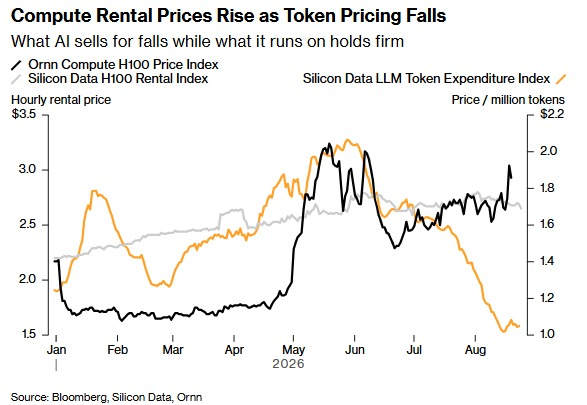
📉 The price of intelligence is collapsing while the cost of the infrastructure required to produce it remains extremely high - Bloomberg
*It seems what companies are willing to pay to consume AI is falling quickly.
➡️ Compute remains expensive, some Nvidia servers shall rise by 15%, Samsung is raising prices for certain advanced capacity, and memory shortages could extend into 2027. Therefore, the final product is getting cheaper while several of the inputs required to produce it remain scarce and expensive. Nvidia is still posting gross margins close to 75% but this may simply mean that the economic rent is shifting away from model providers and toward chips, memory, networking, power and data centers.
⚠️ If OpenAI, Anthropic, Google, Chinese models and open-source alternatives eventually deliver sufficiently similar performance, companies will simply route workloads toward whichever model offers the best performance-to-price ratio and AI could therefore become increasingly difficult to monetize at the model layer.
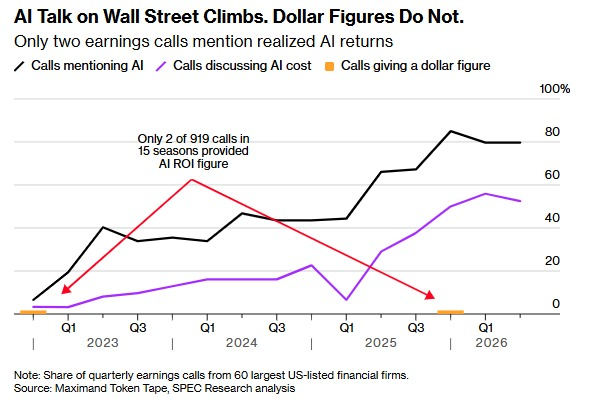
💸 Moreover, across 919 earnings calls from the 60 largest US-listed financial companies, almost 80% now mention AI and more than half discuss its cost, yet virtually none provide a precise figure for the financial return already generated. After several years of massive spending, the fact that the benefits remain so difficult to quantify is becoming a genuine warning signal.
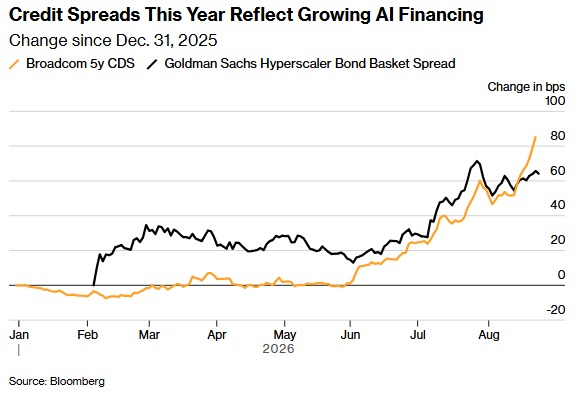
📈 Credit markets are starting to reflect this. Increasingly, debt, private credit, SPVs and various guarantees are being used to fund the next wave of infrastructure. If revenues take longer than expected to materialize, the industry will need either more capital, less capex or lower returns.
If volumes fail to fully offset falling prices while infrastructure remains expensive and increasingly debt-funded, some of today’s valuations will become much harder to justify.
*Bloomberg link: https://t.co/wi7G5RUExT
Sanctions are being imposed on Iran, but the key lies in Chinas stance. As the Sino-US confrontation intensifies, the economic struggle hides a new front in strategic competition.
US housing demand has collapsed.
US new home sales fell -10.5% MoM in July, to 607,000 units, the lowest in 6 months and far worse than the -1.4% decline expected.
Excluding January 2026, this is the lowest level since November 2022.
New home sales have now fallen in 3 of the last 4 months and are down -6.3% YoY.
The Midwest was hit hardest, with sales plunging -42.7% MoM, to 43,000, the lowest level since 2012.
At the same time, sales in the South, the nation's biggest homebuying region, accounting for more than 60% of the total, fell -13.0% to 383,000, the 2nd-lowest level since January.
This comes as the 30Y mortgage rate hit 6.81%, its highest since August 2025, weighing on homebuyer demand.
The housing market is historically unaffordable right now.
“.. By the end of the next president’s first term, Social Security will run out of cash reserves to pay full retirement benefits for tens of millions of retirees
.. we have run out of time, and the required changes will be larger and more abrupt.”
@WSJ
https://t.co/5vLuH2thKG