Stop letting unfinished Opus 5.5 runs eat your budget
Set up the harness before your next long task
Save progress, verify results, reuse the workflow
The full 7-layer setup below ↓ https://t.co/rz78goHxfw
Telegram has applied for the .gram domain zone.
If the application is approved by ICANN, a billion Telegram users could get their own second-level domains — yourname.gram.
Users would be able to set up their interactive websites hosted by Telegram — with one prompt ✨
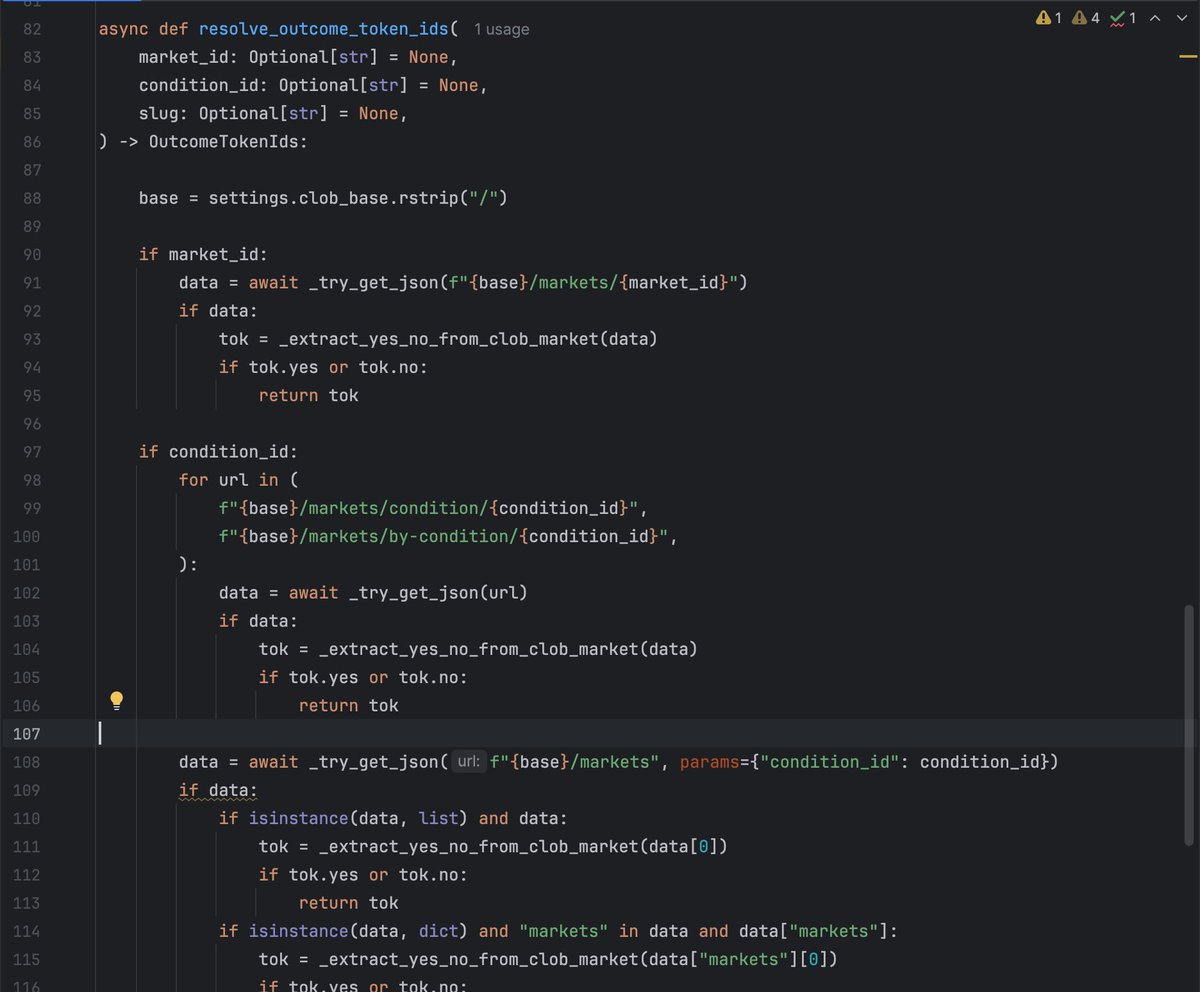
programmers are making $10k-200k monthly on polymarket
here's how they actually do it
///
1. arbitrage bots
buy YES + NO when combined price < $1
example: YES at 48¢ + NO at 49¢ = 97¢ total
you lock $0.03 profit per $1 no matter who wins
trader "distinct-baguette" made $242k in 1.5 months doing this
targets 15-min crypto markets where prices move fast
python script polls API every 1-3 seconds, executes when sum < 99¢
///
2. statistical arbitrage
find correlated markets that drift apart
"trump wins" vs "GOP senate control" should move together
when spread hits 4-7%, short expensive one, long cheap one
close when they converge
trader "sharky6999" made $480k scanning 100+ markets per minute
///
3. AI probability models
train ML models to estimate real odds from news/social data
if your model says 60% YES but market at 50¢, buy
trader "ilovecircle" made $2.2M in 2 months with 74% accuracy
uses ensemble of 10 AI models, retrains weekly
///
4. spread farming
buy at bid (5¢), sell at ask (6¢), repeat
or hedge across platforms (short polymarket, long binance)
trader "cry.eth2" made $194k with 1M trades
high-frequency loop via CLOB API
///
5. copy-trading automation
mirror successful whale traders automatically
scan profiles, execute proportional trades
one bot made $80k in 2 weeks copying near-resolved markets
///
tech stack:
python + requests library for API calls
web3-py for blockchain interactions deploy on VPS for 24/7 operation
polymarket has REST APIs for everything:
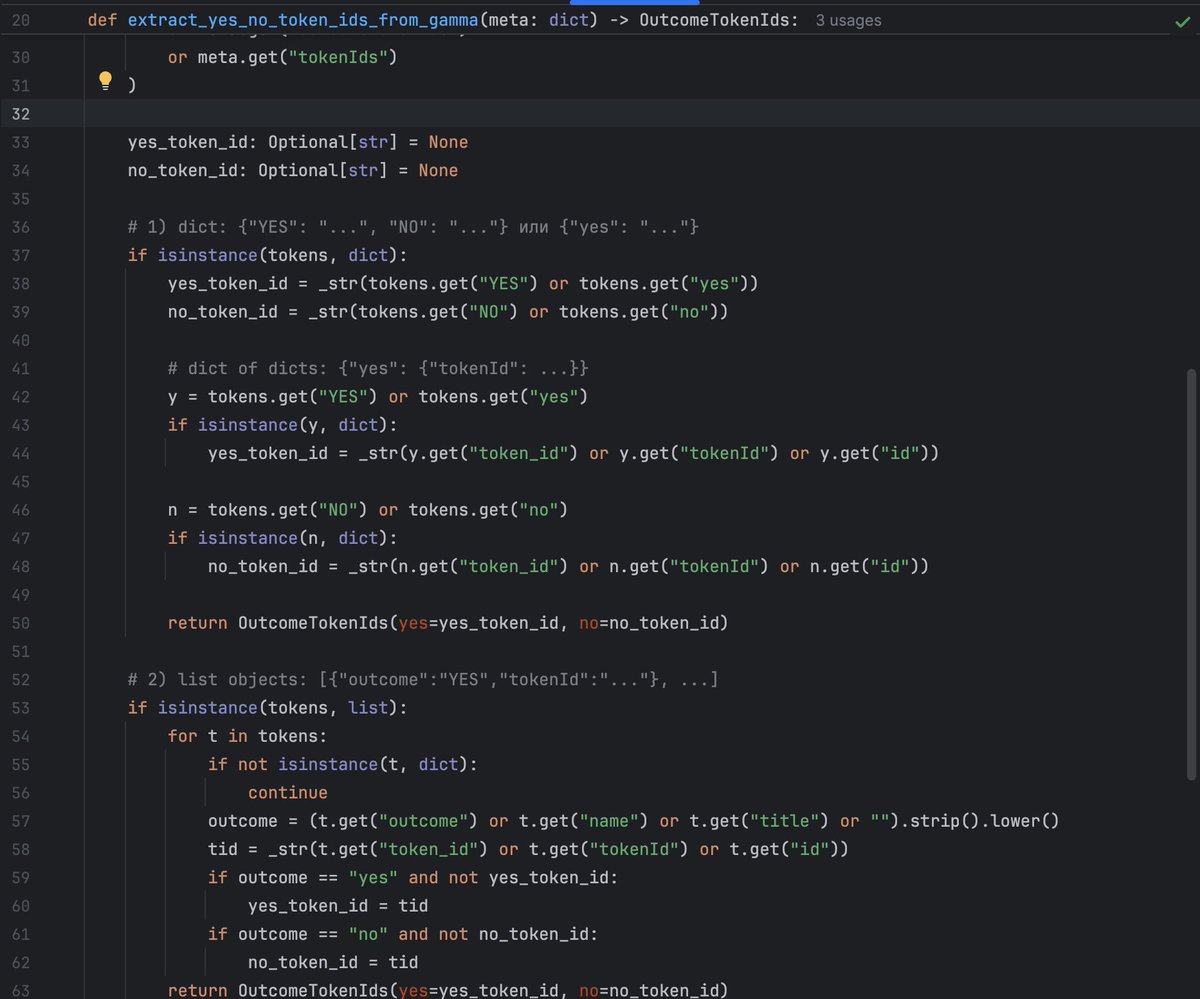
gamma markets API (prices/volumes)
CLOB API (place orders)
data API (track positions)
///
starting point:
> build simple arbitrage bot first
> fund with $100-1k for testing target high-volume markets (politics/crypto)
> expect 50-70% win rate but focus on positive EV
The most comprehensive breakdown of DeFi liquidation vulnerabilities I’ve seen.
If you’re a dev or an auditor, this is a must-read, not a nice-to-read.
~50 real issues with examples so you don’t miss them in your next protocol:
https://t.co/kd3ZeUD2cb
Presenting 'The Road to Core Solidity', a series of blog posts through which we will share where we are headed with the language.
Let's take a look at the overview!
Introducing Apptokens: infinitely programmable token smart contracts for next-generation digital economies
The apptokens release is the culmination of Limit Break’s work designing novel token smart contracts to unlock an array of critical features for web3 game developers.
You hired a crypto veteran.
Turns out he couldn’t define DeFi.
3 years in the industry, never touched a DEX.
That’s when I realized:
Crypto didn’t evolve. It split.
On one side:
Custody. Compliance. Capital.
Built for traders in Connecticut.
Crypto as the new Wall Street, only faster, cheaper, scarier.
On the other:
Quests. Games. Airdrops.
Built for a new middle class in Manila, Lagos, and Hanoi.
Crypto as identity, escape, second chances.
These aren’t layers of the same stack.
They’re different planets.
And the gap is only growing.
We recently hired someone who spent three years at a major OTC desk.
They’d never used Phantom. Didn’t know what Zora was.
Web3 was a “rumor” in their Slack.
And yet, they called themselves “deep in crypto.”
They speak capital.
Others speak culture.
They build for whales.
Others build for wallets.
Crypto isn’t one industry anymore. It’s a forked chain.
Wall Street took the ticker.
The rest of us took the rails.
@figma just filed to IPO.
Guess what was on the balance sheet?
Bitcoin, yeah…the famous bitcoin.
Not a token.
Not a wallet plugin.
Not a DeFi position.
Just Bitcoin.
They skipped Web3 entirely, and bought the safest corner of crypto with both hands.
We’re seeing something new.
Figma’s move isn’t an outlier. It’s a signal.
Meanwhile, wallets are spinning up like wildfire across the Global South.
Chasing quests. Airdrops. Identity. Access.
It’s not convergence. It’s a split.
Capital is stacking West.
Adoption is exploding East.
Two worlds. Two missions.
Same rails, very different trains.
Anyone else seeing this trend?
Because the fork isn’t coming. It’s already here.
EOF (EVM Object Format): Full Guide
Everything you need to know as a Web3 Builder in 30 mins:
➡️ (0:00) Intro
➡️ (0:41) Why EOF
➡️ (2:20) Current EVM vs EOF EVM
➡️ (4:31) EOF example
➡️ (10:53) Stack too Deep Error Solved
➡️ (13:21) EOF Advantages
➡️ (24:50) Disadvantages
➡️ (26:48) Community Against EOF
➡️ (29:18) Conclusion
Like & RT ❤️
The security of Bitcoin PoW is a ticking time bomb.
Bitcoin fees are at a 13-year low—less than 10 BTC/day. Despite 2016, 2020, 2024 halvings, miner revenue from fees is at a 9-year low—just 1%.
low fees → low security budget → low security
Bitcoin's security model is broken. If Bitcoin gets taken over, the fallout could take the entire crypto ecosystem with it. The systemic risks can't be ignored.
Below is the 30d moving average of daily transaction volume: now at 6.5 BTC/day, less than the past 13 years.
The story that fees will increase as a fraction of the security budget is not holding up. For a decade now BTC fees have decreased faster than issuance.
Below is the 90d moving average of the security budget contribution from fees. Fees halvened alongside issuance:
→ Mar 2016: 25 BTC/block, 1% from fees
→ Mar 2020: 12.5 BTC/block, 1% from fees
→ Apr 2022: 6.25 BTC/block, 1% from fees
→ Apr 2025: 3.125 BTC/block, still 1% from fees
Imagine fees were the only source of miner revenue today:
→ revenue drops 100x
→ hashing infra decreases 100x
→ 1% of today's infra (1 large farm) can 51% attack Bitcoin
That's the trajectory we're on. The 21M cap breaks security, it's self-destructive. It should be clear now Satoshi made an ooopsie.
As BTC price rises it gets harder to sustain high BTC-denominated fees. Today's 6.5 BTC/day may become 1 BTC/day if BTC goes to $1M or $10M.
Let's be optimistic and say BTC rises to $1M and today's 6.5 BTC/day in fees is maintained:
→ $6.5M/day in fees
→ 10% of today's security budget
Bitcoin would be a $20T asset secured by 1/10th of today's hashing infrastructure.
Today Bitcoin is secured by 20 GW—the equivalent of 10M space heaters. A 90% cut in miner revenue would bring that down to 2 GW of security—1M space heaters. For context, Texas alone produces 80 GW. There's no way a $20T asset can be secured by 2 GW.
Let's dream big and assume BTC goes to $10M per coin. Bitcoin would be a $200T asset—all fiat, all stocks, all gold; combined. Is it secure then?
→ 6.5 BTC/day is $65M/day
→ same security budget as today
→ same 20 GW of security as today
Sounds secure until you calculate the cost of attack. 1 GW of hashing infrastructure costs $1B:
→ $500M for datacenters (land, power, cooling)
→ $500M for rigs (e.g. 50M TH/s; $10 per TH/s; 20J/TH)
So what would a permanent 51% attack cost?
→ $20B for 20GW of hashing infra
→ 0.01% of BTC's hypothetical $200T marketcap
Meanwhile today there's $43B of BTC perp open interest, which is 2% of BTC's marketcap. Getting 0.01% marketcap short exposure is trivial today, and will only get easier as BTC financialises. $10M per BTC won't secure Bitcoin either.
Bottom line: Bitcoin's PoW model is not sustainable. The maths is against it. Without a fix someone will break it.
Can fees magically grow 100x? Maybe. But so far every attempt to produce transactional utility on Bitcoin has failed to drive sustained fee volume. Counterparty, Rootstock, Liquid, Lightning, Omni, Stacks, Ordinals, Babylon—you name it—only produced short-lived fee spikes.
Is BitVM a solution? Bridges relying on it can be drained by 51% attacks. One step forward, two steps back. Covenants or OP_CAT? Maybe, but highly speculative. I witnessed a STARK verified on an OP_CAT testnet—a multi-block monstrosity.
If fees don't magically grow orders of magnitude there are two candidate solutions:
1) add tail issuance, remove the 21M limit
2) switch to proof-of-stake
Both "solutions" seem to be cultural non-starters. Also tail issuance only works proactively, not after a 51% takeover.
Some suggest that Proof-of-authority (PoA) with mining pools could secure Bitcoin. What does that even mean? A multisig controlled by Foundry, AntPool, P2Pool? If you believe PoA could secure the future of money, the burden is on you to explain in detail how that would work.
Bitcoin is meant to be antifragile. Yet the elephant in the room in the room is not being addressed. We can burry our in heads in the sand. But the fundamentals are getting louder. Tick tock, next block—boom.
🚨 INTRODUCING ALLOY V1.0 🚨
Alloy is the simplest & fastest Rust toolkit for the EVM.
Proud to finally be in a stable state, with revamped documentation, excellent performance, ready to take your EVM backends to the next level.
cargo add alloy 🧵
The Ronin Bridge <> @chainlink CCIP migration is complete!
Bridge YOUR tokens with unparalleled cross-chain security ⚔️
• All tokens previously on legacy Ronin Bridge are now on CCIP
• Bridge ETH, WETH, USDC, AXS, and more
• New WBTC contract is LIVE – swap 1:1 now
Bridge with CCIP 👇
🔗 : https://t.co/Emg3LRjv87
Full announcement 👇
📜 : https://t.co/iNM5QB5uGg
1/ 🧵 Ethereum’s Execution Layer: What if we replaced the EVM with RISC-V?
@VitalikButerin proposes a radical shift—replacing the EVM with a general-purpose RISC-V VM. This could dramatically simplify and speed up Ethereum’s long-term scalability.
Here’s how & why 🧵
INTRODUCING ATIA’S LEGACY — THE AXIE MMO
Lunacia was once a place where gods roamed the land, flew through the clouds, and swam the seas. After centuries of war, Lunacia is ripe for rebuilding.
Testers wanted 👇
📝 : https://t.co/1mu9gzQFEr
First play-test: Summer ‘25
More Details 🧵👇