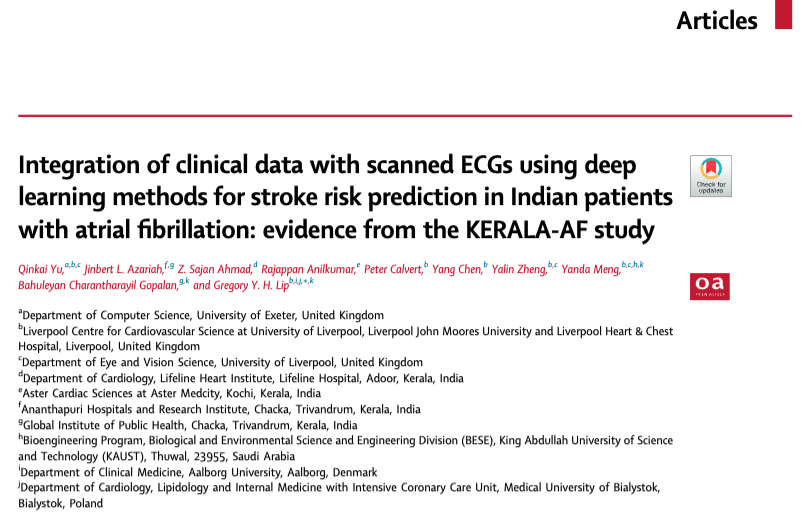
Integration of clinical data with scanned ECGs using deep learning methods for stroke risk prediction in Indian patients with atrial fibrillation: evidence from the KERALA-AF study #Afib@LHCHFT@LivHPartners https://t.co/Q0CNazDlYD
Please join us in welcoming @yanda_meng to KAUST as Assistant Professor of Bioengineering.
His research advances AI for healthcare by developing adaptive, trustworthy computational systems that support biomedical discovery and clinical decision making. By combining machine learning with real clinical needs, his work contributes to BESE’s focus on research that improves human health and strengthens the region’s growing capability in medical innovation.
Learn more about Prof. Meng: https://t.co/6YJKWZPDdp
#Bioengineering #AIinHealthcare #MachineLearning #BiomedicalAI #MedicalImaging #KAUSTResearch
🔥Check out the hy-FSD method for better 3D visual quality! The authors have developed an image-to-3D generation pipeline to create high-quality 3D objects within one minute.
🔗https://t.co/uDnIFg2qg7
#Diffusionmodel#AI@SpringerEng
I am hiring a postdoctoral fellow to work in the Harvard Ophthalmology AI Lab. The postdoctoral fellow will develop machine learning models to improve the diagnosis and prognosis of eye diseases. Please check the link below for more information.
https://t.co/2TSuAMfKvZ
We're seeking a Postdoctoral Research Fellow (with Jianbo Jiao) to work on multi-modal learning for video understanding at @exetercompsci@UniExeterIDSAI@UniofExeter!
The official advert will be available soon, please drop us an email with your CV if you are interested!
📢 Call for papers!
Submissions are open for the article collection "Efficient Artificial Intelligence (AI) in Ophthalmic Imaging"
Edited by Yanda Meng, Yalin Zheng, Haoyu Chen, and Meng Wang
Contribute or find out more ➡️ https://t.co/TWvrphby3b
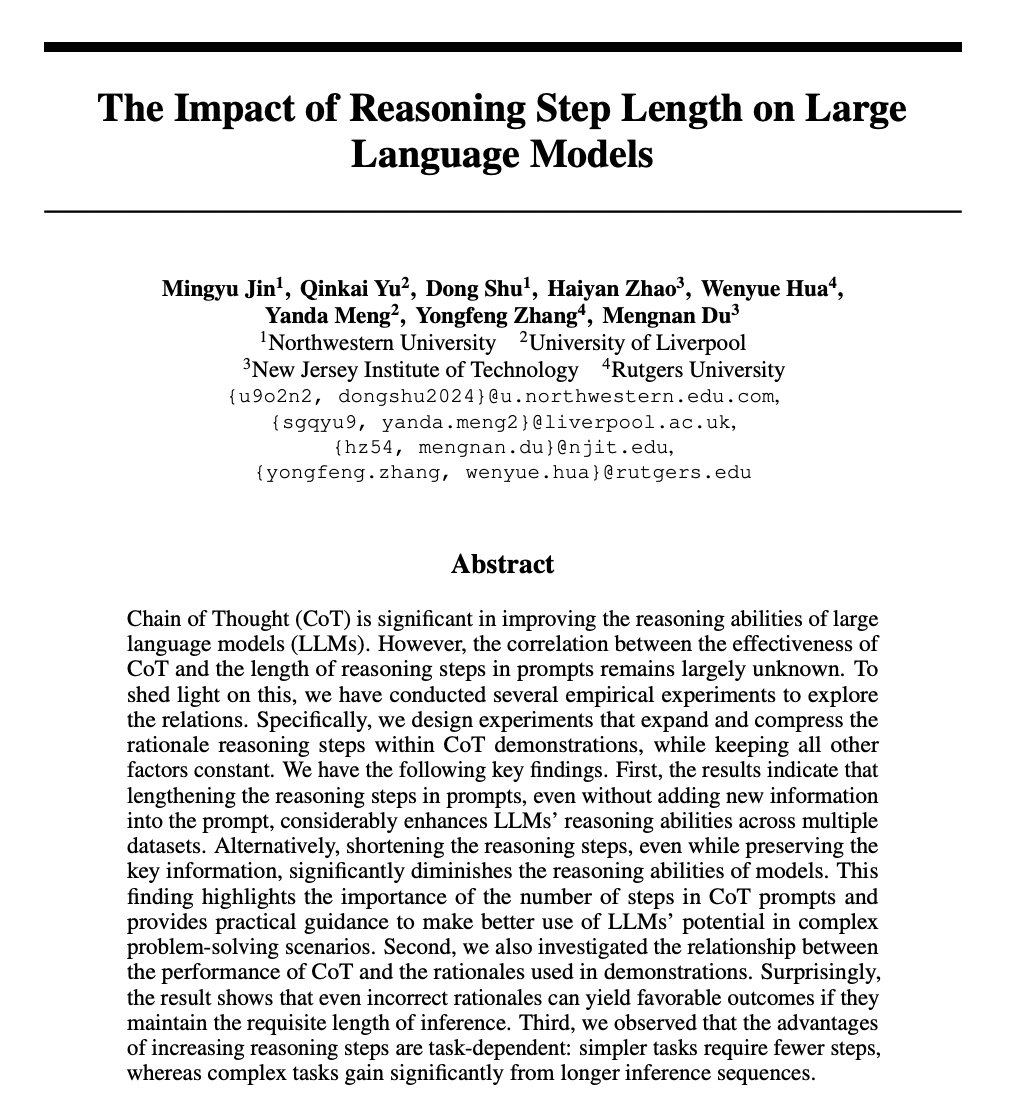
The Impact of Reasoning Step Length on Large Language Models
paper page: https://t.co/EXqgzMwRr4
Chain of Thought (CoT) is significant in improving the reasoning abilities of large language models (LLMs). However, the correlation between the effectiveness of CoT and the length of reasoning steps in prompts remains largely unknown. To shed light on this, we have conducted several empirical experiments to explore the relations. Specifically, we design experiments that expand and compress the rationale reasoning steps within CoT demonstrations, while keeping all other factors constant. We have the following key findings. First, the results indicate that lengthening the reasoning steps in prompts, even without adding new information into the prompt, considerably enhances LLMs' reasoning abilities across multiple datasets. Alternatively, shortening the reasoning steps, even while preserving the key information, significantly diminishes the reasoning abilities of models. This finding highlights the importance of the number of steps in CoT prompts and provides practical guidance to make better use of LLMs' potential in complex problem-solving scenarios. Second, we also investigated the relationship between the performance of CoT and the rationales used in demonstrations. Surprisingly, the result shows that even incorrect rationales can yield favorable outcomes if they maintain the requisite length of inference. Third, we observed that the advantages of increasing reasoning steps are task-dependent: simpler tasks require fewer steps, whereas complex tasks gain significantly from longer inference sequences.
Scientists from @livuni & @ManMetUni have been awarded £1.4m to create an early test for Diabetic Peripheral Neuropathy (DPN), a complication caused by diabetes and which costs the NHS billions.
Read more➡️https://t.co/0Kur5sLBKT
@livunihls@LivuniILCaMS @livuniresthemes
Our work has been accepted by the top AI/Medical Image Analysis Journal. We propose a weakly/semi supervised method for optic disc and cup segmentation and glaucoma diagnosis with fundus images.
Thanks to all the co-authors! @LivuniILCaMS@StPaulsNews
We're pleased as punch to note that one of our supervisors has been promoted to 'Professor of Computer Science' here at the University of Liverpool.
Congratulations to @xiaoweih from all of us here at the CDT! Xiaowei supervises on our project with @CollinsAero 🥳
#professor
Proud that our paper made the front cover of the @DiabetologiaJnl March issue!
Images include corneal confocal microscopy #CCM images and images of the attribution-based explainability methods we used to help explain the #AI algorithm
@AlamUazman @GroupENA@LivuniILCaMS