Open sourcing my regression lectures 🍻
AI is changing how we teach. Here’s one way I’m adapting: I’ve open-sourced my regression course, POLI 450A, built on Jens Hainmueller’s original class.
The course is suitable for first-year political science PhDs, as well as advanced undergraduate students in economics, political science, and other social sciences.
The materials include slides, R code, data, worksheets, and a short video for every lecture.
https://t.co/yUl3hs5P0Y
Happy to share slides for six lectures on "causal panel analysis" based on my recent short course at Waseda.
https://t.co/byutHLxU7V
Written for applied researchers.
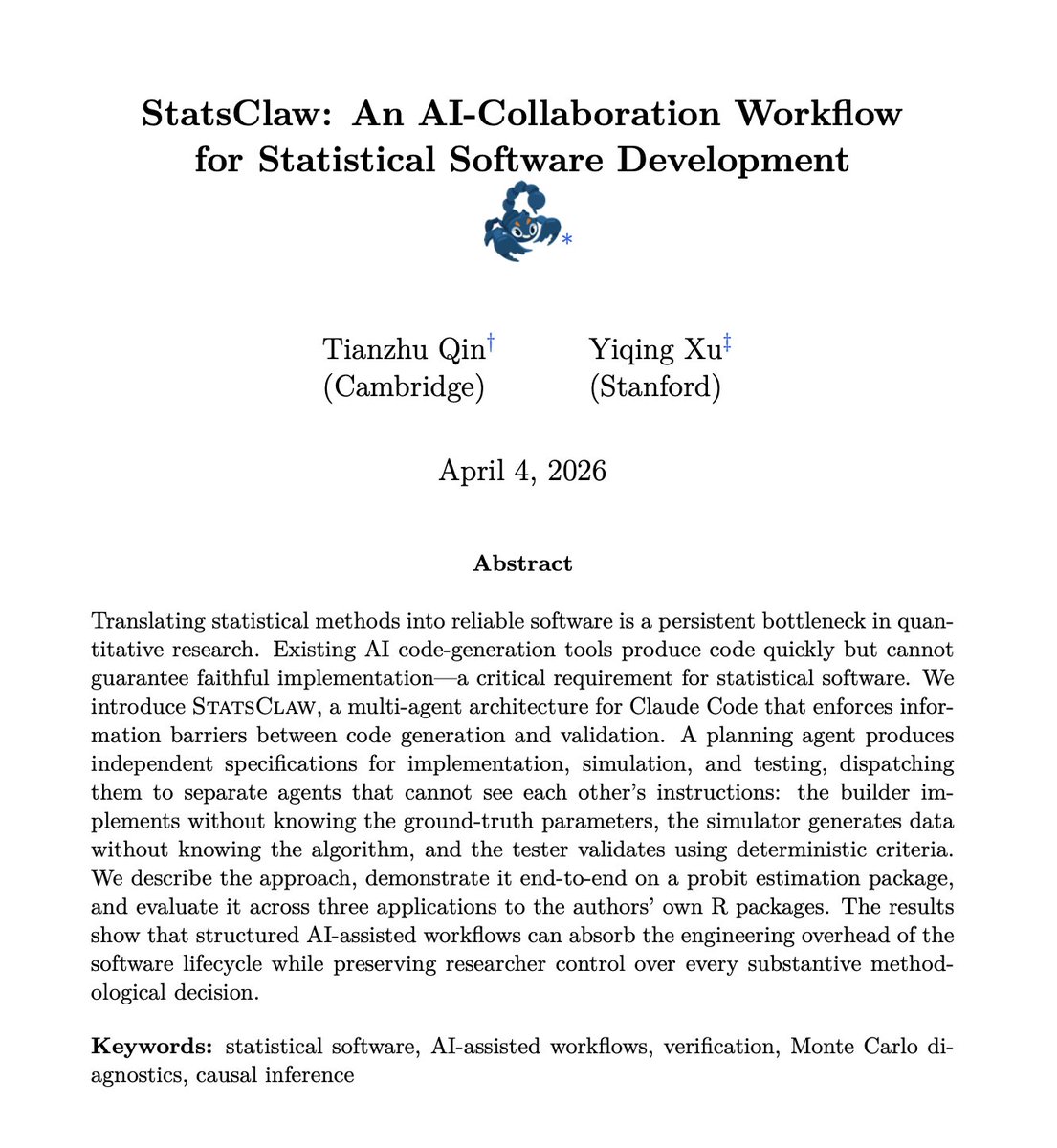
1/ Happy to release StatsClaw — an open-source multi-agent workflow for building statistical software with AI. w/ @qintianzhu
Site: https://t.co/4svIckWc4m
Paper: https://t.co/HrzzB4BJcG
Our paper "When Does Mandatory Price Disclosure Lower Prices?" is out in the Journal of Political Economy Microeconomics!
When does price transparency lower prices -- and when doesn't it?
Paper: https://t.co/C1OLLIovkR
Summary: https://t.co/DEOEJaLG6d
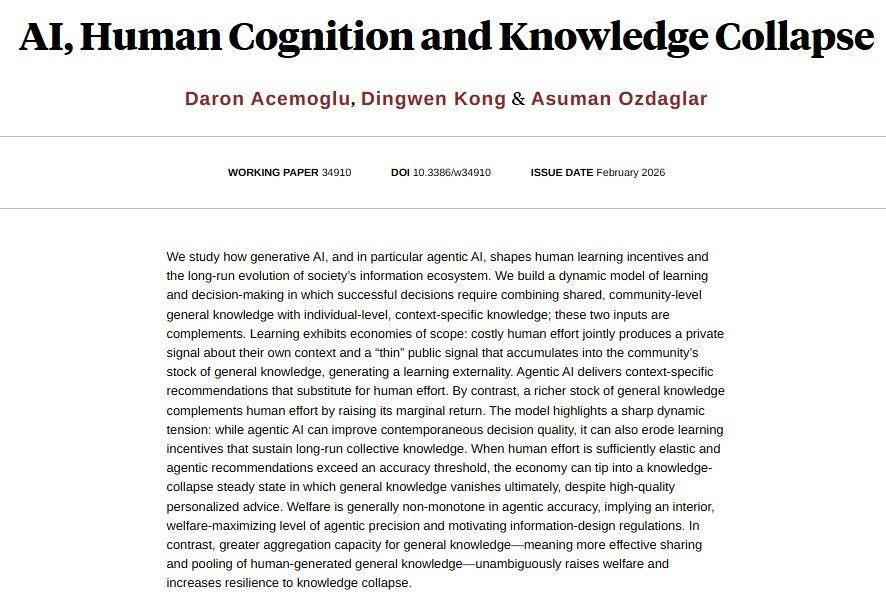
Studying how generative AI, and in particular agentic AI, shapes human learning incentives and the long-run evolution of society’s information ecosystem, from @DrDaronAcemoglu, Dingwen Kong, and Asuman Ozdaglar https://t.co/XTigJqLHat
When AI first arrived on the scene, I worried it would make economists, or even critical thinkers more broadly, less valuable. In my travels in the past 6 months to work with non-profits, for profits, and government agencies, I have observed how people are actually using AI. I have watched them fumble around with insights they clearly did not create themselves.
My fears are now assuaged. One observation is that AI can produce something that in some cases is very wrong and in others looks nearly right, but is not quite there. Even if in time AI improves to "nearly right" or "exactly right" every time, a second issue still arises: explaining the materials.
Explaining why an answer is almost correct but subtly off requires exactly the critical thinking skills that created the knowledge in the first place. Even explaining "exactly right" material takes critical thinking. I've watched smart people confidently present AI-generated material they clearly don't fully understand. The words sound right. But when someone pushes back just a little bit, the sand castle crumbles.
It is quite difficult to defend what you didn't build. This leads me to now make the optimistic case for human expertise. The value of deeply understanding something — of having built the knowledge yourself — hasn't diminished with AI. If anything, it's increased. The people who can tell the difference between "nearly right" and "right" are more valuable than ever. The people who can explain the subtle details about something that is exactly right are invaluable.
Creating knowledge still matters. Maybe now more than ever.
This is a useful paper on open-ended survey data. Open-ended questions can help reveal individuals’ motives, mental models and decision-making processes. Open-ended survey data have been used to study what’s on top of people’s minds w.r.t. important economic policy questions.
I’ve started an ongoing project to collect all the datasets which economists can use, all in one place, organized by topic. Started with 50, further suggestions are extremely welcome. It will grow considerably.
New paper on “Algorithmic Coercion”: We find that a single firm using a pricing algorithm can induce its rivals to set substantially higher prices, even when rivals maximize short-run profits and cannot collude.
Something is rotten in econ academe when 2nd-year MIT PhD students fake research to get into QJE. That some still express surprise shows willful blindness to a system built to reward speed & visibility over rigor & insight. Integrity should be a standard, not a personality trait.
Quick @Stata tip: I've added 43 new tips to my book, bringing the total to 140.
You can download "Quick Stata Tips" and the accompanying .do file for free at https://t.co/MY4O6dzlgD
Who benefits when platforms use historical consumer data for pricing? Total consumer surplus falls but most consumers benefit at the expense of those with the highest WTP. Platform sellers benefit even though they do not have access to consumer data. https://t.co/CPoTmSOCFt
Excited to share my latest WP! Using data on the universe of gas stations in CA, we show asymmetric price effects for entry and exit of a nearby station. Entry is associated with an immediate decrease in prices at incumbent stations equivalent to ~7% of markups.
This paper has been in the making for so long that eight children across the co-author group were born between the time we started and now!
But it is finally out, and you can check it at https://t.co/ZFSNCPrXsg
PhD Students - Here is an example of a good conclusion.
A good conclusion should have the following 6 parts.
𝟏. 𝐑𝐞𝐬𝐭𝐚𝐭𝐞 𝐭𝐡𝐞 𝐑𝐞𝐬𝐞𝐚𝐫𝐜𝐡 𝐏𝐫𝐨𝐛𝐥𝐞𝐦
Begin by revisiting the research problem or question that your paper addressed. This reminds the reader of the core focus of your study and sets the stage for summarizing your findings.
𝟐. 𝐒𝐮𝐦𝐦𝐚𝐫𝐢𝐳𝐞 𝐊𝐞𝐲 𝐅𝐢𝐧𝐝𝐢𝐧𝐠𝐬
Provide a brief summary of the main findings of your research. Highlight the most significant results and insights that emerged from your analysis. This should be concise and focused on the most impactful data.
𝟑. 𝐃𝐢𝐬𝐜𝐮𝐬𝐬 𝐭𝐡𝐞 𝐈𝐦𝐩𝐥𝐢𝐜𝐚𝐭𝐢𝐨𝐧𝐬
Explain the implications of your findings. Discuss how they contribute to the existing body of knowledge, their practical applications, or their relevance to future research. This helps to contextualize your work within the broader field.
𝟒. 𝐀𝐜𝐤𝐧𝐨𝐰𝐥𝐞𝐝𝐠𝐞 𝐋𝐢𝐦𝐢𝐭𝐚𝐭𝐢𝐨𝐧𝐬
Address any limitations of your study. Acknowledging these limitations demonstrates academic integrity and provides a balanced view of your research. It also opens the door for future research opportunities.
𝟓. 𝐒𝐮𝐠𝐠𝐞𝐬𝐭 𝐅𝐮𝐭𝐮𝐫𝐞 𝐑𝐞𝐬𝐞𝐚𝐫𝐜𝐡 𝐃𝐢𝐫𝐞𝐜𝐭𝐢𝐨𝐧𝐬
Based on your findings and limitations, propose areas for future research. This can inspire other researchers to explore related questions and expand on your work.
𝟔. 𝐄𝐧𝐝 𝐰𝐢𝐭𝐡 𝐚 𝐒𝐭𝐫𝐨𝐧𝐠 𝐂𝐥𝐨𝐬𝐢𝐧𝐠 𝐒𝐭𝐚𝐭𝐞𝐦𝐞𝐧𝐭
Conclude with a powerful statement that reinforces the importance of your research. This could be a call to action, a thought-provoking quote, or a reflection on the broader implications of your work. Anything you'd like to add?
For more, please subscribe my newsletter.
Newsletter Link: https://t.co/5t7Z1AIuh9
Anything you'd like to add?
#phd #research #conclusion
Finally had the chance to spend the Spring Festival at home. My mom cried after seeing me off to the car 🥲
Now I finally realize that life is short. Parents are getting older, and each meeting means one less opportunity to see them again.