Navigating the future of nano‐pesticides: A perspective on design, efficacy, mechanisms, and environmental stewardship
🌱Nano-pesticides are reshaping crop protection toward sustainable agriculture.
https://t.co/NDmfs46wiL
https://t.co/HRfP6N2jYa
Navigating the future of nano‐pesticides: A perspective on design, efficacy, mechanisms, and environmental stewardship
🌱Nano-pesticides are reshaping crop protection toward sustainable agriculture.
https://t.co/zeT5XEpC8r
🚀 DeepSeek-V4 Preview is officially live & open-sourced! Welcome to the era of cost-effective 1M context length.
🔹 DeepSeek-V4-Pro: 1.6T total / 49B active params. Performance rivaling the world's top closed-source models.
🔹 DeepSeek-V4-Flash: 284B total / 13B active params. Your fast, efficient, and economical choice.
Try it now at https://t.co/GCdiMzk1Dl via Expert Mode / Instant Mode. API is updated & available today!
📄 Tech Report: https://t.co/drlDrxkYtp
🤗 Open Weights: https://t.co/T13Y8i7SDM
1/n
One Thousand SARS-CoV-2 Antibody Structures Reveal Convergent Binding and Near-Universal Immune Escape
1. A comprehensive analysis of over 1,100 SARS-CoV-2 antibody structures reveals how antibodies recognize and adapt to viral evolution. This dataset represents 16% of all known antibody–antigen complexes, marking the largest structural biology effort for a single pathogen.
2. The study finds that human IgGs and camelid single-chain antibodies dominate the dataset, collectively mapping 99% of the receptor-binding domain surface. Despite remarkable sequence and conformational diversity, antibodies exhibit striking convergence in their paratope structures.
3. Structural and functional analyses reveal near-universal immune escape of antibodies, including all clinical monoclonals, by advanced variants such as KP3.1.1. On average, over one-third of antibody epitope residues are mutated, supporting the need for multi-epitope targeting strategies.
4. The research highlights that camelid nanobodies (Nbs) preferentially target conserved and cryptic epitopes through distinct binding strategies, including electrostatic interactions and recognition of conformationally gated surfaces.
5. The study provides a roadmap for designing next-generation therapeutics with improved durability by integrating large-scale structural mapping, computational epitope profiling, and experimental validation.
📜Paper: https://t.co/Po4sGqoiAA
#StructuralBiology #SARSCoV2 #AntibodyRecognition #ImmuneEscape #NextGenTherapeutics
The genetic diagnosis and typing of pig diseases provide tools for clinical disease prevention and control. We are excited to announce the launch of our Pathogen Identity via Genomix Sequencing (PIGS) website. Please visit us!https://t.co/vba842DGcB
Exploring genetic signatures of zoonotic influenza A virus at the swine-human interface with phylogenetic and ancestral sequence reconstruction https://t.co/iqBnmvNqxJ
@environmicrobio @nanopore I often encounter this issue in China as well. It is usually related to the transportation and storage of the chips, with significant differences in each batch. Please check if the distribution of the library fragments is too small, which may be causing the issue.
8 of history's worst experiments:
1. Unit 731: During World War II, the Imperial Japanese Army conducted extensive chemical & biological warfare research on human test subjects. An estimated 200,000 people died from these cruel experiments.
Victims were intentionally exposed to anthrax, the bubonic plague, cholera, syphilis, typhus and other pathogens. Other experiments included vivisection, controlled dehydration, biological weapons testing, hypobaric pressure chamber testing, organ harvesting amputation, and standard weapons testing, all without anesthesia or a care of whether the victim lived or died.
Unit 731 victims included men, women, children, and even infants that were born after victims were r*ped by the staff. Unit 731 was led by General Shirō Ishii who was granted immunity & then hired after WWII by the United States government.
Ooh yea! @miles_benton from @nanopore giving us a tech update.
Info on dorado, duplex, and accuracy. Things are looking really good accuracy wise now.
In my opinion it's probably time for researchers to retire the story of accuracy issues
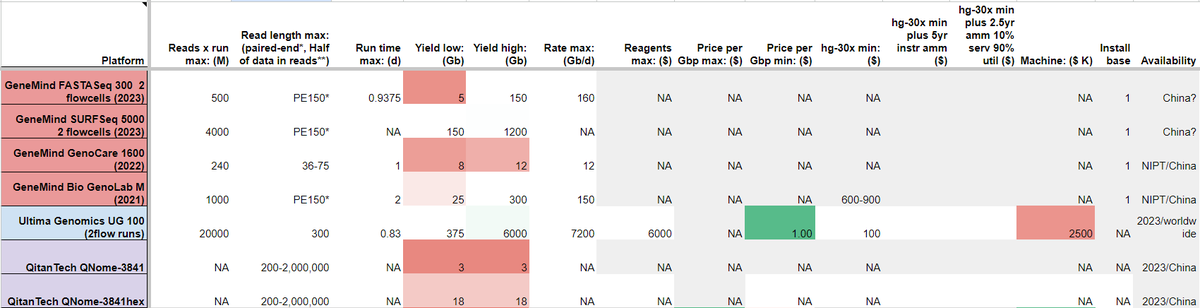
The Chinese NGS company GeneMind presented the new SURFseq 5000 instrument, which uses patterned surface flowcells to achieve higher density of clusters and thus higher-throughput, up to 1.2Tb per run (2 flowcells).