Existing AI benchmarks drive a race to the top on capabilities alone. We don't have a benchmark to drive a race to the top on making AI verifiable.
Today, together with our partners, we're launching Inference Proofs: an open source benchmark and a public map of the systems that prove AI inference.
The question it tracks: can anyone independently verify which model produced an answer, and what does that check cost?
Today, every answer from an AI service arrives on trust. You're told which model wrote it, but can't verify it.
A proof of inference changes that. Anyone can verify that a reply came from a committed model, on an ordinary CPU, with no GPU and no access to the weights.
Not long ago this was a thought experiment. Today, open source provers can prove inference of a 400B-parameter model.
But every team reports on its own model, its own hardware, and its own way of measuring. That makes the systems hard to compare.
So every system on Inference Proofs gets the same request: a 512-token prompt and a 512-token reply. The prompts were drawn by a public randomness beacon after the rules were frozen. Nobody picked the inputs, including us.
Prover correctness first, prover performance second.
Our tampering checks change one weight, one prompt token, or one reply token, and the verifier must refuse. Every verdict has to be reached with no GPU and no model file on disk.
Inference Proofs is open source, public good infrastructure, convened by Lucid Computing, with the precious help of those great partners: @aisafetysg, @attestable, GPAI Lab, @StarkWareLtd, the @ethereumfndn dAI Team, @0xMiden, @zksecurityXYZ, @lagrangedev, @equilibrium_co, @eigenlabs / Yukon, @0xPolygon and @class_lambda.
Thank you to everyone who helped launch it. This is a first step toward a broader, collaborative open source AI verification ecosystem.
Blog: https://t.co/tcBvarDD8l
Platform: https://t.co/8HsYSqd611
Code: https://t.co/qQxkzmGfd7
After a couple days of reflection, this has significantly increased my odds of near-term RSI.
I had expected most of the gains from automated R&D to come from accelerating post-training. But it's fairly clear to me now that pre-training progress is accelerating. This is important because I believe most of the increases in general intelligence have come from larger and better pre-training. In pre-training LLMs are forced to learn the cognitive skills that allow them to predict a wide variety of human behavior, requiring them to mimic the full range of human intelligence at the limit. In post-training, LLMs learn to solve a narrow domain, and the evidence I have seen suggests that this doesn't transfer very well to other domains.
It's now pretty clear to me that pre-training is being accelerated by automated AI R&D in a pretty straightforward way. AI agents can test tons of optimization ideas in tiny models to see if they work, costing almost nothing. The ones that work mostly transfer successfully to larger pre-training runs. You also don't have to run a full GPT-6 pre-train from scratch in order to implement and test these improvements in a large model. You can just take an existing checkpoint and make these improvements. Still expensive, but much less so. This all leads to fast, cheap, verifiable feedback loops to improve pre-training loss by testing a litany of small improvements. In aggregate these small improvements lead to large overall improvements.
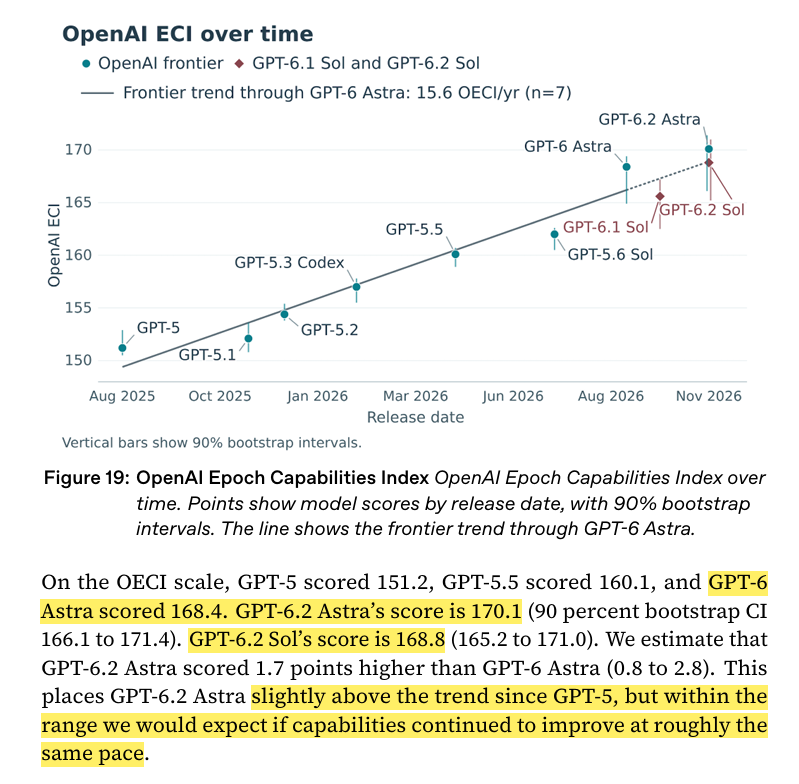
The number of base models listed here and the fact that OpenAI thinks the most important thing to track is pre-training loss is strong evidence that this paradigm is being implemented and it is working. That means progress on general capabilities is likely to continue to accelerating and not just the progress on capabilities associated with verifiable domains.
There's an argument that this will stop once top human-level general intelligence is achieved, matching the intellectual prowess of every human intellect put together in one well-rounded genius. That is that pre-training is still aimed at predicting human data. But once we have achieved the ceiling on human intelligence and augmented that with reinforcement learning in verifiable domains it is hard to know what millions of such an AGI running in parallel at thousands of times the speed of a human mind could discover next.
Grateful that OpenAI shared this with those of us on the outside who otherwise have no idea what is going on.
The 7x (!!) acceleration in pretraining loss reduction from the OpenAI chart is only more striking because that trend is supposed to bend the other direction.
👏👏👏 "Mark has also called for all labs (including our own) to deploy the vast majority of compute towards serving people and customers rather than towards recursive self-improvement (RSI)."
I think the contours of an operationalizable internationally verifiable pacing mechanism are now relatively clear. “No large-scale training or inference of any model with perplexity below X, until time T or some condition triggers.” It’s probably enforceable by using PoUW+ZKPs to prove that a large supermajority of labs’ compute is being done using weights that obey this condition; this should be a verifiable circuit. Assuming this can reach guarantees like @attestable claims, this should be doable with a low-overhead cryptographic scheme that won’t need to reveal architecture secrets or user data, and doesn’t require trusting physical hardware. It should be open-sourced so that all providers, including OS deployers, can easily port it.
Given the low costs, participating US labs should be able to implement this unilaterally, and if Chinese labs mirror it within a few months, credible signals can be built from there.
Whether this proposal or an adjacent one, I encourage experts from each lab to rally around an implementation spec and get to implementing as quickly as possible. With agent-based automation, it should be possible to roll this out within a few weeks of a standardized spec.
We decided to provide more transparency into pretraining progress at OpenAI for the sake of moving toward shared safety bars. In “Perplexity and Intelligence” I argue for common limits based on perplexity and other measurements, with progress beyond them gated on our ability to understand AI behavior.
https://t.co/XX35m5vq89
This is one of my favorite scientific figures in computational social science: the Division of Democrat and Republican Party members of the U.S. House of Representatives from 1949–2012. You can see our history in a figure resembling mitosis.
https://t.co/tJsDDuTyRB
AI Verification technology will be among the most important things humanity ever builds.
If you want to catalyze this insanely important industry, I recommend you ping @woj_zaremba and apply for this gig!
The OpenAI Foundation is hiring an AI Verification Program Director!
AI verification is one of the most important fields of our time: verifiability will largely determine which agreements on AI development we can and cannot strike, especially internationally.
Apply here, or share with people who'd excel in this role: https://t.co/8SaWPOxK9G