There is something incredibly powerful about physically writing something down.
And there is real neuroscience behind it. Handwriting engages the brain very differently from typing, creating much broader patterns of connectivity associated with learning, memory and encoding information.
I’ve written down my goals for years. Some of them seemed completely unrealistic when I first put pen to paper.
Looking back at the goals I’ve written down over the years, I’d say around 80% have actually become reality.
Maybe the act of writing makes the goal more deeply embedded. Maybe you start noticing opportunities differently and making hundreds of small decisions that move you towards it.
Whatever the mechanism, my own experience has made me a huge believer in writing down what you want.
And yes, preferably with a good pen.
Shopify billionaire co-founder & CEO Tobi Lütke — one of the most analytically rigorous founders alive — uses affirmations.
His exact words:
"If you tell yourself or write down something about yourself 100 times, it writes into the neurofrontal cortex at such a deep level that your brain will start reconciling you to that. It just works."
His personal example:
He was terrified of public speaking.
For one week he sat down every day for 10 minutes and wrote: "I love public speaking."
A week later the fear was gone.
"It's not like a placebo. You just actively change your neurofrontal cortex in this moment."
Your brain starts shaping your behavior around the identity you rehearse most.
Feeling particularly proud to be Canadian today.
Canada and the US are neighbours, friends and deeply connected. I have enormous affection for America and for the many Americans I know and work with.
But friendship doesn’t mean agreeing to a deal at any price. Sometimes you have to be willing to say no.
There are things about Canada that frustrate me too. I’ve sometimes rolled my eyes at how much importance we give to French, particularly when I’ve been in international meetings where everyone speaks English and almost nobody speaks French.
But the older I get, the more I appreciate why it matters.
French Canada isn’t an inconvenience or a historical footnote. It’s part of what made Canada Canada. From the beginning, we had to work out how different languages, cultures and identities could belong to the same country without one simply disappearing into the other.
I think that helped lay the foundations for the multicultural country Canada later became. The idea that you can be Canadian without giving up your language, culture or heritage is deeply embedded in who we are.
We don’t always get it right. But that willingness to accommodate our differences while still having a strong shared identity is something very special.
Proud of my country today. 🇨🇦
This is what luxury minimalism means to me.
Not owning more, but owning fewer, better things. Things chosen carefully, made well, and kept long enough to become part of your life.
As someone who makes pens for a living, I love the idea that one pen, used for years, can simply become “your pen.”
Real luxury isn’t abundance. It’s having exactly what you need, and loving what you have.
There is a Japanese practice of owning one very good version of something rather than several adequate ones.
One knife, kept sharp. One pen that writes exactly as you want. One bag chosen carefully and used for years.
This is not minimalism as aesthetic. This is minimalism as relationship.
You learn the object. You know its weight. You know how it responds to your hand.
The object becomes, over time, an extension of you.
That cannot happen with things you do not stay with long enough to know.
Test driving a Ferrari today.
We actually take a surprising amount of inspiration from the automotive world.
Justin has always loved cars. British Racing Green was inspired by Jaguar. Midnight Blue by Porsche. We’re constantly drawn to the materials, finishes and precision you see in great automotive design.
Felt fitting to have two new pocket pen prototypes in my pocket today.
#Ferrari #ProductDesign #Craftsmanship #Scriveiner #PocketPen
It’s good to be home.
I spent the last two weeks back in Edmonton, where I grew up. Normally, summer there means blue skies, warm sunshine and long evenings outdoors. This year, somehow, it rained almost every day, with more mosquitoes than I can ever remember.
Meanwhile, London decided to have one of its hottest spells while I was away. I came home just in time for a friend’s BBQ yesterday, with beautiful sunshine, great food and lovely company.
It was also fun following the World Cup from both sides of the Atlantic. Canada and England have both performed surprisingly well, which made it even more enjoyable.
One of the biggest highlights of the trip was spending time in my parents’ Tesla Model Y using Full Self-Driving. I had already experienced similar technology in China back in April with BYD and other manufacturers, but seeing how it could help my parents made it feel much more personal.
For them, it is not about a new gadget. It is about freedom, mobility and confidence. It could allow them to keep driving safely for many more years.
I cannot wait for this technology to be legal and widely available in the UK.
Here’s to sunshine, good friends, exciting football and technology that genuinely makes life better.
Today, Justin and I spent Day 3 of the England vs New Zealand Test at Lord’s.
I’ve concluded that Test cricket may be the most gloriously inefficient sporting format ever invented.
Play stopped for rain.
Fair enough.
Then, during a period of perfect sunshine, they stopped for lunch.
And just as the forecast showed heavy, continuous rain approaching… they restarted play.
A few overs later, everyone walked off again.
Five days.
Rain breaks.
Lunch breaks.
Tea breaks.
Bad light.
By every modern measure, it makes no sense.
And yet Lord’s was full.
It reminded me of writing with a proper pen.
Neither activity survives because it’s efficient.
They survive because people still value craftsmanship, ritual, patience, and the simple pleasure of slowing down.
Some things are worth preserving precisely because they refuse to optimize themselves.
🏏✒️
#Lords #TestCricket #EnglandCricket #Scriveiner #WritingInstruments #FountainPen #LuxuryPens #Craftsmanship #AnalogLife
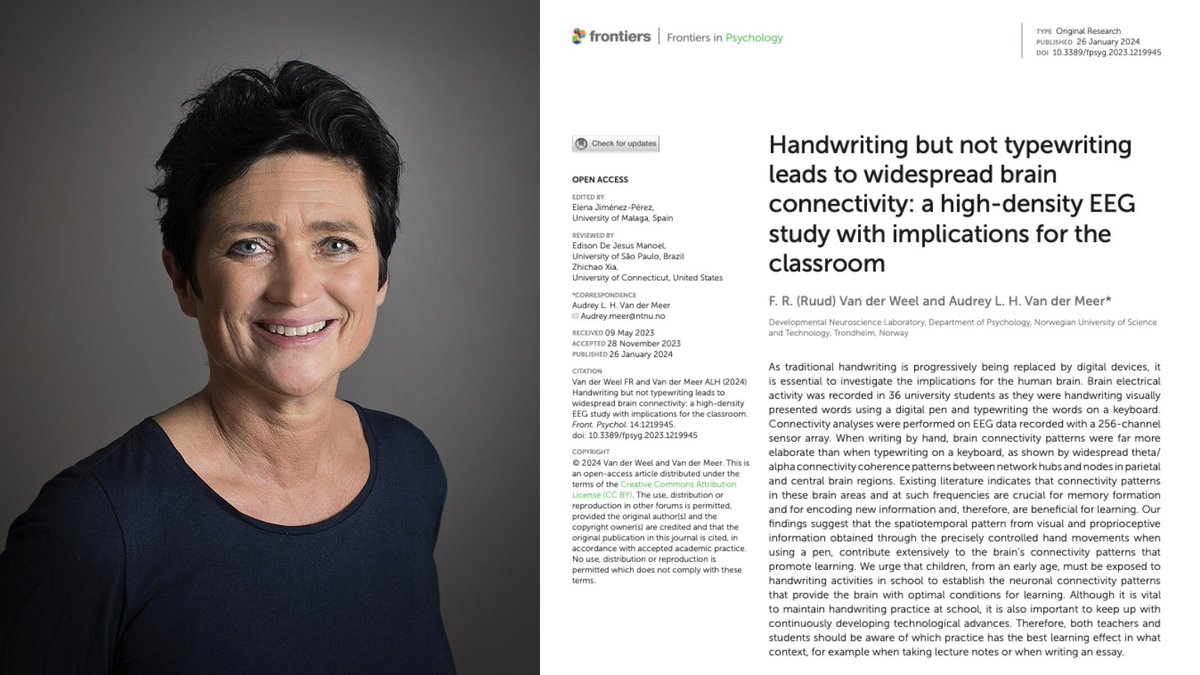
A Norwegian neuroscientist spent 20 years proving that the act of writing by hand changes the human brain in ways typing physically cannot, and almost nobody outside her field has read the paper.
Her name is Audrey van der Meer.
She runs a brain research lab in Trondheim, and the paper that closed the argument was published in 2024 in a journal called Frontiers in Psychology. The finding is brutal enough that it should have changed every classroom on Earth.
The experiment was simple. She recruited 36 university students and put each one in a cap with 256 sensors pressed against their scalp to record brain activity. Words flashed on a screen one at a time.
Sometimes the students wrote the word by hand on a touchscreen using a digital pen, and sometimes they typed the same word on a keyboard. Every neural response was recorded for the full five seconds the word stayed on screen.
Then her team looked at the part of the data most researchers had ignored for years, which is how different parts of the brain were communicating with each other during the task.
When the students wrote by hand, the brain lit up everywhere at once.
The regions responsible for memory, sensory integration, and the encoding of new information were all firing together in a coordinated pattern that spread across the entire cortex. The whole network was awake and connected.
When the same students typed the same word, that pattern collapsed almost completely.
Most of the brain went quiet, and the connections between regions that had been alive seconds earlier were nowhere to be found on the EEG.
Same word, same brain, same person, and two completely different neurological events.
The reason turned out to be something nobody had really paid attention to before her work. Writing by hand is not one motion but a sequence of thousands of tiny micro-movements coordinated with your eyes in real time, where each letter is a different shape that requires the brain to solve a slightly different spatial problem.
Your fingers, wrist, vision, and the parts of your brain that track position in space are all working together to produce one letter, then the next, then the next.
Typing throws all of that away. Every key on a keyboard requires the exact same finger motion regardless of which letter you are pressing, which means the brain has almost nothing to integrate and almost no problem to solve.
Van der Meer said it plainly in her interviews.
Pressing the same key with the same finger over and over does not stimulate the brain in any meaningful way, and she pointed out something that should scare every parent who handed their kid an iPad.
Children who learn to read and write on tablets often cannot tell letters like b and d apart, because they have never physically felt with their bodies what it takes to actually produce those letters on a page.
A decade before her, two researchers at Princeton ran the same fight using a completely different method and ended up at the same answer. Pam Mueller and Daniel Oppenheimer tested 327 students across three experiments, where half took notes on laptops with the internet disabled and half took notes by hand, before testing everyone on what they actually understood from the lectures they had watched.
The handwriting group won by a wide margin on every question that required real understanding rather than surface recall.
The reason was hiding in the transcripts of what the two groups had actually written down.
The laptop students typed almost word for word, capturing more total content but processing almost none of it as they went, while the handwriting students physically could not write fast enough to transcribe a lecture in real time, which forced them to listen carefully, decide what actually mattered, and put it in their own words on the page.
That single act of choosing what to keep was the learning itself, and the keyboard had quietly skipped the choosing and skipped the learning along with it.
Two studies. Two countries. Same answer.
Handwriting makes the brain work. Typing lets it coast.
Every note you have ever typed instead of written went into your brain through a thinner pipe. Every meeting, every book highlight, every idea you captured on your phone instead of on paper was processed at half depth.
You did not forget those things because your memory is bad. You forgot them because typing never woke the part of the brain that would have made them stick.
The fix is the thing your grandmother already knew.
Pick up a pen. Write the thing down. The slower road is the faster one.
Over 1.2 million people have chosen to write with a Scriveiner pen.
That still humbles me, every single day.
People often ask, “Why start a pen company in a digital world?”
Because writing by hand still matters.
It slows us down. Grounds us. Connects us to something real.
That’s why we started. And we’re just getting started. 🖋️
#WritingMatters #Scriveiner #FounderThoughts
When we started Scriveiner, we had one goal: to bring luxury writing back to everyone.
Not behind glass cases. Not just for collectors. But for real people, real moments, and real stories.
Because fine craftsmanship should be felt, not just admired. #Scriveiner
@tferriss Well said, Tim. Service isn’t about scale—it’s about impact. A single piece of music, a well-written letter, or even the right tool in someone’s hand can change their day. Creating something meaningful, no matter how small, is a form of service.
We never wanted to create just another pen.
We wanted to build something that feels right in your hand.
Something that lasts.
Something that makes you pause and appreciate the moment.
That’s what Scriveiner is about. Not just writing, but feeling.
#LuxuryPens
@jaredatincite @TheLuxusGroup @tedkouri@darrentonn@incitestrat Congratulations my brother! We are setting up an UK asset management platform and running a UK property fund together with a large Chinese conglomerate. Let’s talk soon.