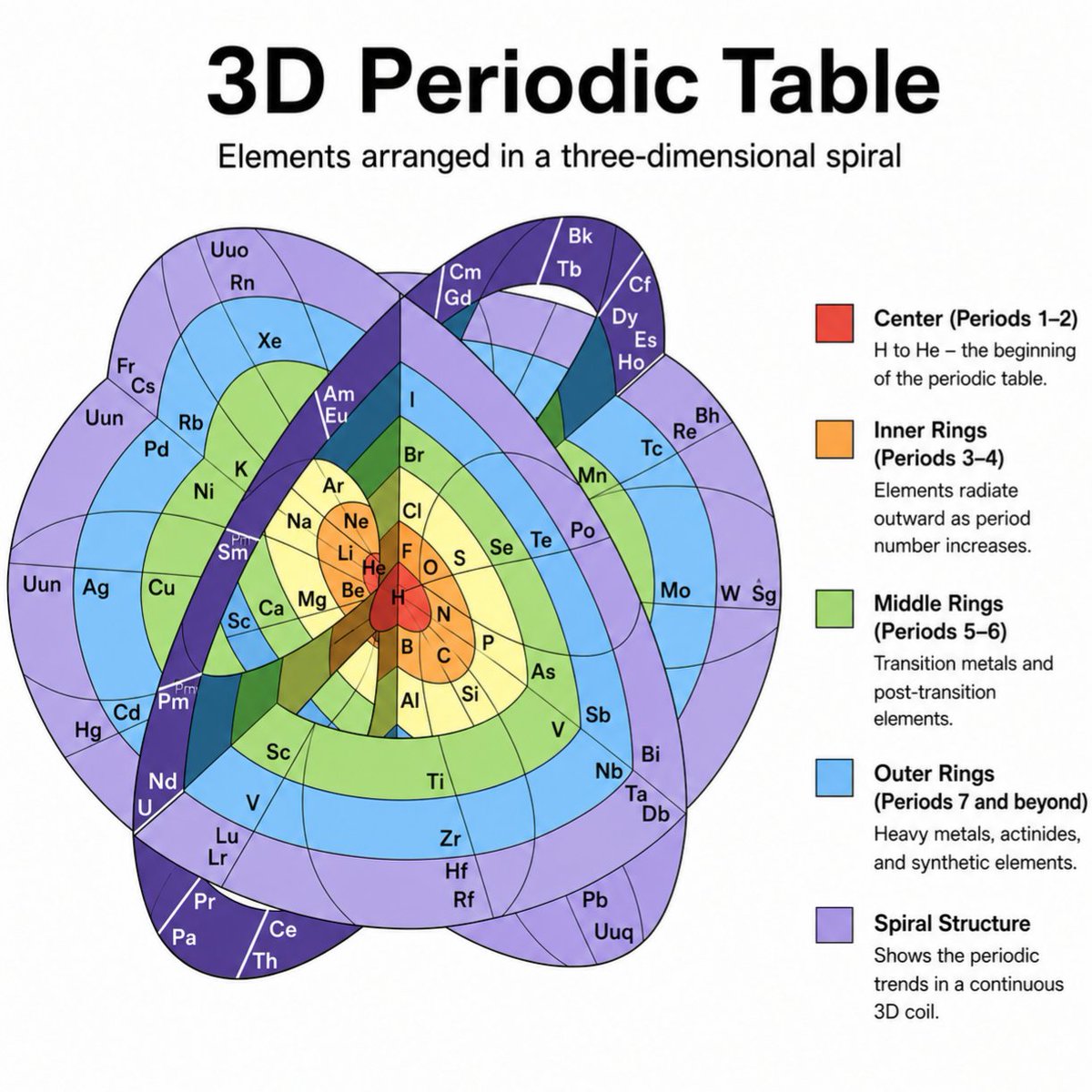
A different way to visualize the building blocks of matter.
This 3D spiral arranges the elements in order of increasing atomic number, forming a continuous path from the lightest elements at the center to transition metals, lanthanides, actinides, and the heaviest known elements toward the outer layers. The color-coded regions highlight periodic patterns and relationships, making the structure of the periodic table easier to explore from a new perspective.
Accumulated quantities like areas or totals are found by integrating rates of change using these standard formulas.
Ten core ones are
∫ dx = x + C for constants,
the power rule ∫ xⁿ dx = x^{n+1}/(n+1) + C (n ≠ -1),
∫ dx/x = ln|x| + C,
∫ e^x dx = e^x + C,
∫ sin x dx = -cos x + C,
∫ cos x dx = sin x + C,
∫ sec² x dx = tan x + C,
∫ csc² x dx = -cot x + C,
∫ sec x tan x dx = sec x + C, and
∫ csc x cot x dx = -csc x + C, each with its graph.
They are used to compute the total work done by a force that varies with position in classical mechanics.
Black holes aren't completely black.
Stephen Hawking predicted that black holes emit a tiny amount of thermal radiation due to quantum effects near the event horizon. This phenomenon is known as Hawking radiation.
Tₕ = (ħc³) / (8πGMkᵦ)
Where:
• Tₕ = Hawking temperature
• ħ = Reduced Planck constant
• c = Speed of light
• G = Gravitational constant
• M = Black hole mass
• kᵦ = Boltzmann constant
The equation shows that a black hole's temperature is inversely proportional to its mass. More massive black holes are colder, while smaller black holes are hotter and emit more radiation.
As energy escapes through Hawking radiation, the black hole gradually loses mass. Over incredibly long timescales, it can eventually evaporate completely, linking quantum mechanics, gravity, and thermodynamics in one of physics' most profound predictions.