The Cockroach Janta Party has called off its 36-day agitation at Jantar Mantar, a day after Union Education Minister Dharmendra Pradhan resigned.
The demand it began with was fair. However, most of what it protested against is still in place. 🧵
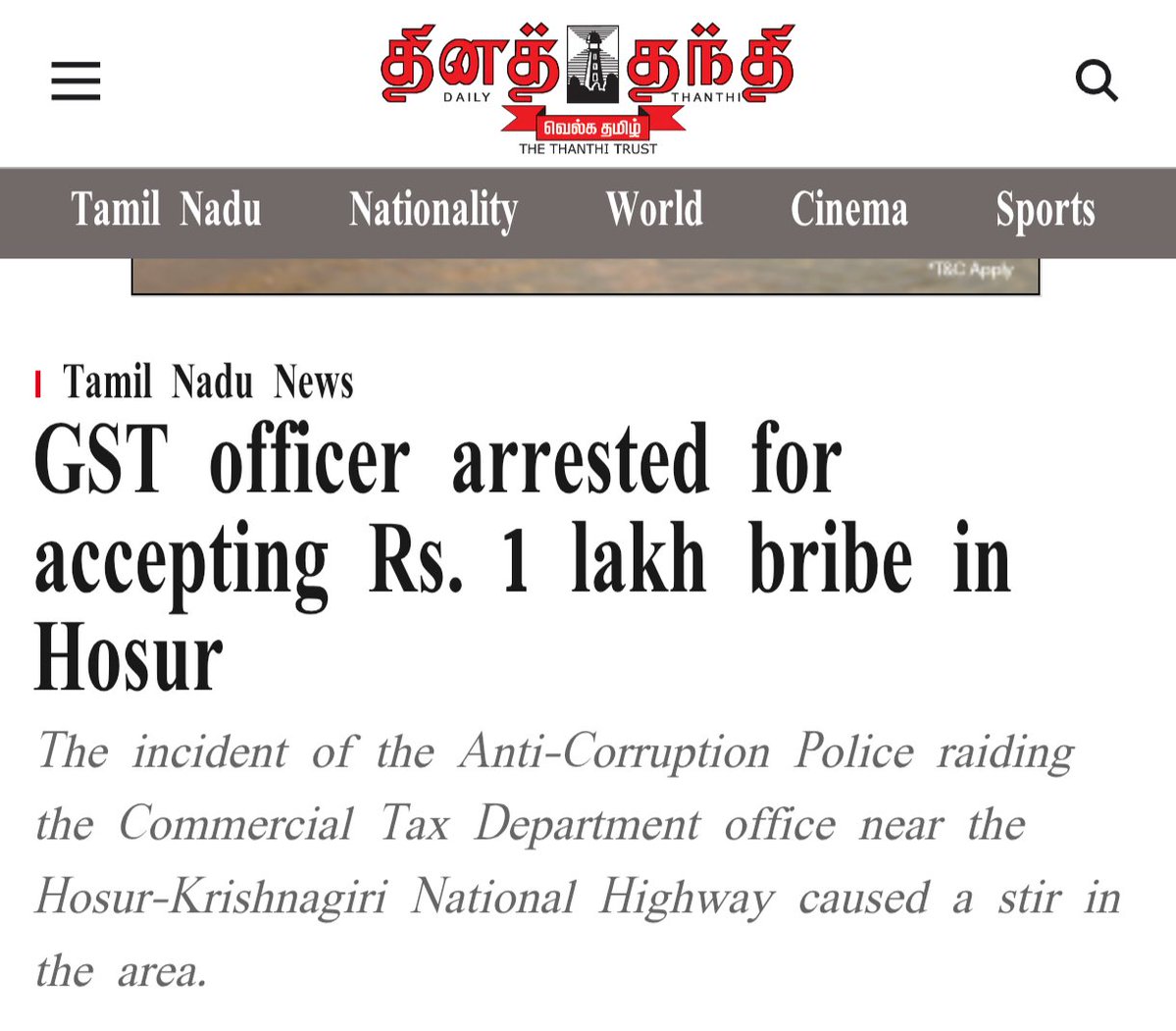
The second incident in TN of a GST officer being arrested for taking bribes under Vijay's govt. Apparently strict instructions have gone to officers that they should not collect bribes and TVK doesn't need any "party funds". Panic creeping up amongst tax babus.....
We were told that we need to hike up a mountain with a 40kg backpack when we suggested this a few years back when army was taking weekly Ls in jungle terrain
A functioning state makes space for dissent and protests while at the same time cracking down on hooligans who damage public property. A state which can't punish hooligans, can't be expected to reform education.
Which world do these guys live in? Why taxpayer funded social science colleges shd be shut - they are singularly useless for anythng other than being sinecures of mediocre chaps looking to waste daddy/taxpayer $ on 10-15 yr higjer education...
Biggest difference - PAF ordered 150 JF17. A full aluminium aircraft w/ltd/no FBW, powered by a single RD93(!), Chinese radar, Chinese avionics and a reported MTBO/F of low 3 digits. IAF ordered 16 + 18 + 10 + 83, over 7 yrs...
I agree. India's intellectual elite has become both morally and intellectually bankrupt. Too often, it substitutes ideological conformity for critical inquiry, partisan loyalty for intellectual honesty, and performative activism for rigorous scholarship. Rather than defending the autonomy and impartiality of the state, influential sections of this elite have often encouraged the politicization of public institutions, treating the bureaucracy, universities, regulatory bodies, and other state institutions as instruments for advancing ideological or partisan agendas rather than as neutral institutions serving the public interest.
In doing so, they have contributed to the erosion of state autonomy and institutional credibility. The result is an intellectual culture that too often privileges ideological commitment over empirical analysis, leaving India with fewer independent voices capable of offering rigorous, evidence-based solutions to its economic, educational, and governance challenges.
there are no rules in this world. that is how art is born, how breakthroughs happen, how new possibilities arise. go against the rules or ignore the rules. that is what invention is about.
Mehta is right that India's education system faces a profound crisis, but his explanation is remarkably selective. The current government deserves criticism for administrative failures, examination leaks, and an inability to restore confidence in public examinations. Yet these failures did not emerge in 2014. They are the cumulative product of decades of political neglect under governments led by leaders with impeccable academic credentials, including prime ministers holding PhDs. Academic excellence at the top did not translate into competent governance or educational reform
Equally troubling is the article's romanticisation of street protests as the primary vehicle of democratic accountability. Peaceful protest is a democratic right, but elevating extra-institutional pressure above constitutional processes risks legitimising mobocracy. Universities cannot function if vice-chancellors, faculty, or administrators are governed by intimidation rather than law. The repeated targeting of vice-chancellors at institutions such as the killing of Gopal Sen at Jadavpur University, where administrators have faced physical assaults, intimidation, and virtual confinement by student groups, illustrates the dangers of allowing coercive protest to replace institutional governance. Democracy requires accountability, but it also requires the rule of law.
The essay also ignores the corrosive effects of decades of ideological capture within sections of Indian higher education. Long before the BJP came to power, many universities suffered from excessive politicisation, declining academic standards, patronage in appointments, tolerance of campus violence, and an intellectual culture that often privileged political conformity over academic excellence. The erosion of educational quality cannot be attributed solely to the RSS or the current government; it reflects a much longer institutional decline in which Left-dominated campus politics also played a significant role.
Finally, the deeper problem is not simply ideology but state capacity. India has consistently failed to build the professional, autonomous institutions required to administer a world-class education system. Exam leaks, weak regulation, politicised universities, and poor learning outcomes are symptoms of a state that is too thin and too weak to govern effectively. Replacing one minister or one ideology with another will not solve this problem. India needs stronger institutions, professional administration, merit-based recruitment, independent examination authorities, and universities insulated from political capture—whether by the Left, the Right, or any other partisan interest. Only then can higher education become both accountable and genuinely excellent.
opus 5 is a VERY interesting release for a few reasons
1. it showed that the general benchmarks we use today are almost completely useless now
opus 5 is nowhere near fable in practical use, not even close. anyone who’s used it meaningfully can tell this very quickly after a few tasks. yet opus beats fable on many benchmarks
i now trust domain specific benchmarks built with private datasets a lot more than the popular ones. perhaps the future is everyone running their own evals because the public ones are really not telling us much
2. it seems with the 5 series, anthropic is trying a new way of training models
previously, the same generation of sonnet and opus were often released at the same time or sonnet comes out before opus, which indicates sonnet and opus were trained by separate pipelines in parallel
with the 5 series, it was very clear that they trained mythos first, and then distilled it into sonnet and opus. it seems this approach has a big influence on the models
seeing sonnet 5 being a flop and opus 5 getting pretty mixed reviews already, i’m not sure this is working out
3. “how pleasant is it to work with the model” used to be a strength in claude, but now it’s not. honestly, grok is my favorite right now on the “pleasant” dimension. kimi is not bad either
it feels like both anthropic and openai are giving RLHF less care, in favor of scalable RL that’s machine verifiable
this almost looks like AI is directing humans to build a world that’s more friendly for machines rather than humans, and most humans don’t even realize they are being manipulated to help with that
almost every new generation of frontier models now talk more jargons, need more steering to do what you want, and are just less fun to work with
if this continues, AI will start to speak their own language that looks like English but average humans can’t understand. they will choose to do things that their human user never asked for. are we already failing at alignment?
@ZhangSupremacy He has previously delivered on initiatives like UPI, UIDAI, and ONDC. The primary purpose of the task force is to deliver CBT. It isn't looking into bureaucratic reforms and humanities literature filtering.