The MOST PRODUCTIVE STUDY METHOD: Even USA think about banning it:
> Begin by picking a concept you want to learn. Write it down as if you were about to teach a lesson.
> Next, explain that idea using very simple words, like you're teaching a child or a complete beginner.
> As you explain, you'll quickly spot the parts where your explanation becomes confusing or too complex.
> Those confusing parts reveal where your understanding is lacking. Go back and study those areas again.
> Keep repeating: learn, simplify, explain. This process helps your brain convert complex knowledge into clear, well‑grasped understanding.
A HARVARD psychologist says: “if you’ve achieved nothing by 25, you’ve avoided the most destructive illusion of youth”
> In 2021, a Harvard psychologist surprised a lecture hall with an unexpected statement:
“If you haven’t accomplished much by 25, you may have escaped one of youth’s biggest illusions.”
At first, the room laughed.
She wasn’t kidding.
> The illusion of early success.
In your early 20s, the brain seeks quick proof of worth ~status, attention, rapid achievements.
But psychologists warn that chasing recognition too soon can lock people into roles or paths they never consciously chose.
They decide too early… and spend years trying to undo it.
> The exploration phase.
Research on career development suggests that people who explore more before 30 often build stronger long-term directions.
Testing ideas.
Making mistakes in public.
Changing course.
At 25 it looks like confusion ….but by 35 it often turns into clarity.
People who feel “behind” in their mid-20s frequently gain something others miss:
Perspective.
Patience.
And a clearer sense of what truly matters to them.
That foundation often leads to better decisions later on.
At the end of the lecture, the psychologist left the students with one final thought:
“You’re not meant to have life fully figured out at 25.”
“You’re meant to discover who you’re not.”
Steve Jobs: The difference between good people and great people is 50-to-1
“I’ve always considered part of my job was to keep the quality level of people in the organizations I work with very high. I mean that’s what I consider one of the few things I can contribute individually myself — versus the team that work with — is to really try to instill in the organization the goal of having only A players.”
Steve argues this is especially important in technology where there’s a huge range between the best person and the worst person:
“In a lot of fields, the difference between, say, the worst taxicab driver and the best taxicab driver to get you across town in Manhattan might be 2-to-1. The best one will get you there in 15 minutes, the worst one will get you there in half an hour… Or the best cook and the worst cook, maybe it’s 3-to-1… But in the field that I’m in. In software in particular. The difference between the best person and the worst person is about 100-to-1 or more.”
He continues:
“The difference between a good software person and a great software person is probably 50-to-1 or 25-to-1. Huge dynamic range. And therefore, I have found — and not just in software but in almost everything I’ve done — it really pays to go after the best people in the world.”
But as Steve points out, this isn’t always easy:
“It’s very painful when you have some people that are not the best people in the world, and you have to get rid of them. But I’ve found that my job has sometimes been exactly that, to get rid of some of the people that didn’t measure up. And I’ve always tried to do it in a humane way, but nonetheless it has to be done and it’s not ever fun.”
Sam Altman literally explained why most startups fail in just 16 minutes.
He broke down:
• Product-market fit
• Team building
• Market selection
• Competitive moats
Here are 14 lessons worth more than a $200K MBA:
1. 80% of startup success comes from one thing
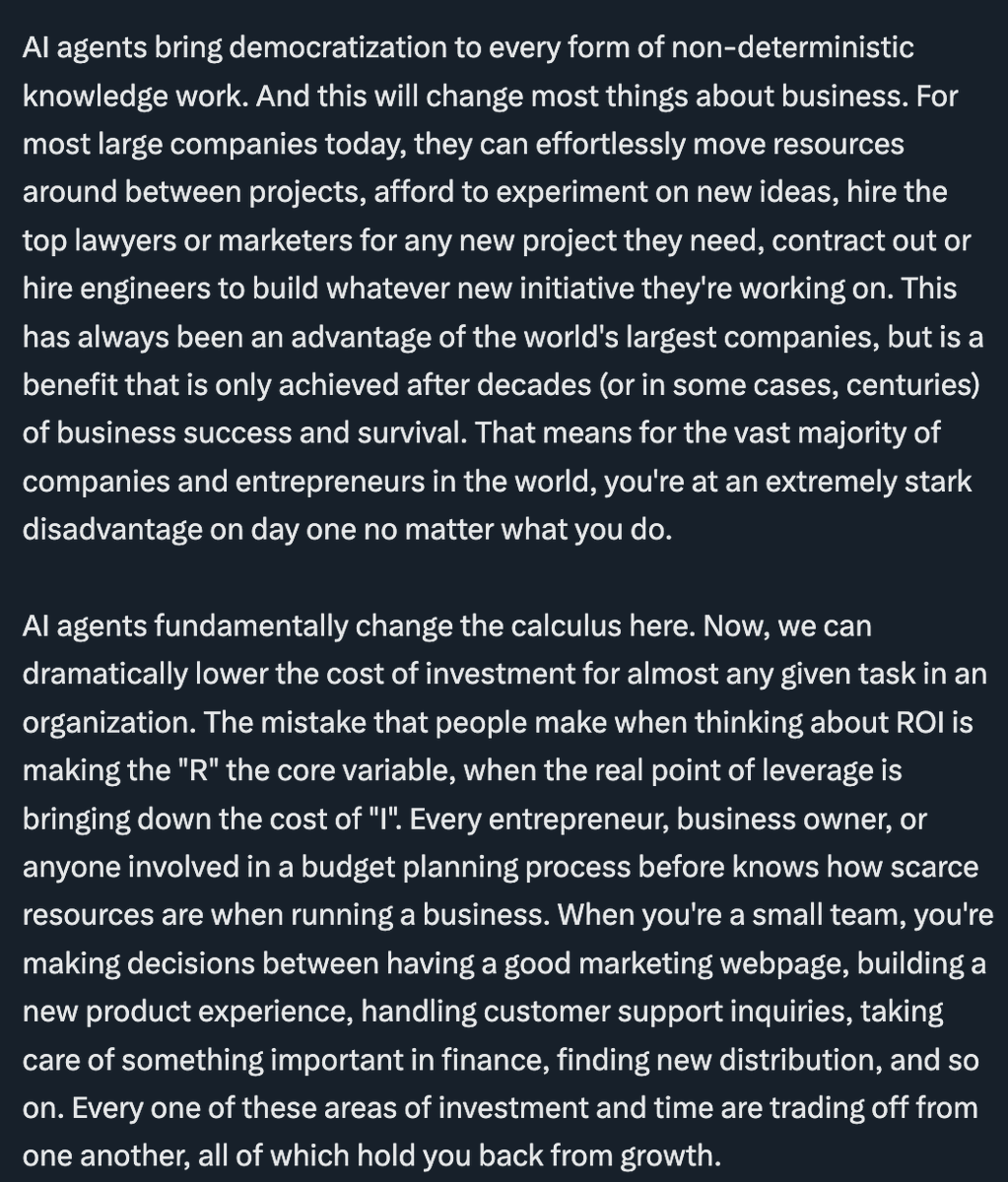
People have been dropping these really thoughtful X articles on the future of AI. Been a goldmine of good ideas.
Here - Aaron argues that AI agents slash task costs for everyone, creating competitive parity where small teams get access to same leverage as large organizations.
The real unlock is lowering investment costs (we always focused on maximizing the R in ROI when lowering the I also has immense value), enabling simultaneous experiments across marketing, product, support, and distribution without subsequent resource tradeoffs.
Jobs shift from executing tasks to orchestrating AI workflows, integrating agent outputs into value creation. Human judgment remains a critical in-the-loop function today until we get to more fully autonomous workflows.
Steve Jobs on what separates the successful founders from unsuccessful ones
Steve is asked what the factors of success and common pitfalls are for young entrepreneurs. He responds:
“I get asked this a lot, and I have a pretty standard answer. A lot of people come to me and say, ‘I want to be an entrepreneur.’ And I go, ‘Oh, that’s great, what’s your idea?’ And they say they don’t have one yet. And I say I think you should go get a job as a busboy or something until you find something you’re really passionate about, because it’s a lot of work.”
Steve continues:
“I’m convinced that about half of what separates the successful entrepreneurs from the non-successful ones is pure perseverance. It is so hard. You pour so much of your life into this thing, and there are such rough moments in time that most people give up. I don’t blame them. It’s really tough, and it consumes your life. I mean, if you’ve got a family and you’re in the early days of a company, I can’t imagine how one could do it. I’m sure it’s been done, but it’s rough because it’s pretty much an 18-hour-a-day job, 7 days a week for a while. So unless you have a lot of passion about this, you’re not going to survive. You’re going to give it up.”
He concludes:
“You’ve got to have an idea or a problem or a wrong that you want to right that you’re passionate about. Otherwise, you’re not going to have the perseverance to stick it through. And I think that’s half the battle right there.”
Most people have no idea what it actually takes to be a founder. They talk about vision, grit, or passion. Those words are props.
What you really sign up for is a life where every decision feels like it costs something real. You will spend years being misunderstood. By your team, your family, even the people you hire to help you. You will fail in public and still need to keep the energy up in private. Every founder lives with the weight of knowing that you can do everything right and still get crushed by luck, timing, or somebody else’s mistake.
Founders aren’t braver than anyone else. They just get used to uncertainty, then stop waiting for clarity. Most of your wins won’t feel like wins at all. The first revenue will be too small. The first team will outgrow you or leave. The first product that feels right will barely matter to the market. You will doubt yourself in private, sometimes every week. The founders who last figure out how to keep moving while the ground shifts underneath them.
Most outsiders want the founder badge but none of the scars. They want the upside, not the drag. The hardest part is sticking around after every plan gets blown up and you have to rebuild with less optimism and more scar tissue. What makes it work isn’t relentless hustle or some mythical trait. It’s learning to make peace with constant discomfort, and then making decisions anyway.
If you need constant reassurance, you’ll give up before the real work begins. If you want everyone to like you, you’ll never make the calls that matter. If you can’t handle months where nothing feels certain, this life will eat you alive.
But if you can hold your own in chaos, get better at being wrong, and still want to show up and try again, you just might have a shot at building something that matters.
That’s what it actually takes. And nobody cares until you make it work.
@geekyranjit hi, do you think you can do a review of the new Bose QC earbuds II,as now they are available in India and compare it against the Sony xm4 earbuds?