i genuinely believe one of the greatest privileges in life is being in a position to help someone else. not for recognition, not because you expect something back, but simply because you can.
Being surrounded by the most talented and kindest people ever is truly such an unlock for growth, productivity, and enjoying what you do:)
join us! https://t.co/88JBJo83NA
about 3 years ago, micro1 lost 60% of its revenue overnight and almost went bankrupt.
today, i'm proud to share we've surpassed $1B annual run rate while remaining historically profitable.
it’s been a special journey. we’re grateful for every struggle, moment, and person who has been part of it.
we've taken a very untraditional path to get here. our core team is only ~180 people, spanning 14+ countries, and fully remote.
many of our decisions sacrifice hundreds of millions of revenue and slow us down short term. but we believe they compound into advantages that are impossible to replicate long term.
the long term is now.
these are the 8 principles that made micro1 a leader in the data industry and will soon make us number one:
1.) human 1st AI: treat the tens of thousands of experts helping train models with absolute best-in-class care. our goal is to make AI training one of the largest, highest paying, and most enjoyable job sectors in the world.
2.) U.S. first: we refuse to work with adversarial nations, or export data that improves models against the interests of Americans.
3.) long-term research over short-term ARR: invest in deep research, products, and infrastructure for years from now, not just the next customer pipeline.
4.) proper incentives for intensely hard work: no arbitrary requirements like 996. inspire people to work extremely hard with outlier incentive structures instead of forcing weekend work. we’ve maintained close to 100% core team retention as a result.
5.) stay lean and global: we’ve reached $1B run rate with ~180 people, and intend to slow team growth significantly from here. exceptional talent is found around the world, and pedigree is the wrong thing to over-index on.
6.) execution alignment: company to retain a streamlined board so we can optimize for the next several decades, remain light-weight and dynamic, and take bold & calculated risks.
7.) abundant intelligence improvement: invest in building data generation models to make high-quality datasets and RL environments dramatically less expensive and more abundant.
8.) scale data on realism and horizon: realism brings the complexity of the real world into training models, while horizon extends how long models can work and how much complexity they can handle. both have enormous room to scale, and we’re pushing the limits of both.
additionally: after surpassing $500M run rate this summer, we priced our Series B at a $4B valuation, alongside a ~$25M tender to give our early employees liquidity as we build for the long term. the round was led by Dream Ventures, a longtime supporter and one of our earliest investors, alongside Microsoft, Javelin, Flybridge, G Squared, Up Partners, and LG.
we’re also grateful to be backed by incredible industry leaders, including Guodong Zhang (co-founder of xAI), Andy Fang (CTO of DoorDash), Igor Babuschkin (co-founder of xAI), Behnam Neyshabur (founder of Mirendil), Jerry Tworek (ex-VP of Research at OpenAI), and many more.
data is on its way to becoming the largest industry humanity has ever seen, and we're certain this is just the beginning.
best,
Ali
Today micro1 is announcing a commitment to spend $1B over the next 12 months on the acquisition & licensing of enterprise data for AI training, with financial backing from Citi and Hercules.
https://t.co/2fubOrbW1D
One of the most overlooked aspects of AI in healthcare is how much time it could give clinicians back with their patients.
AI can act as a force multiplier for clinicians by handling check-ins, patient education, chart reviews, and intake, freeing up time for diagnosis, treatment, and the human connection that only they can provide.
Link to the full conversation in the comments.
"There are about 150 companies signing up every single day."
Ali shut down a $7M run-rate startup to build what's now a $4B company.
Solo Founders Podcast ep 31 is live with @aliansarinik of @micro1_ai.
04:10 The first thing he ever sold online
17:30 Three signals it's time to move on
24:40 The all-in Loom that deleted the revenue
31:45 "Only the founding team can inject risk"
35:50 He never knew co-founders existed
43:40 Threads, final actions, zero meetings
53:30 Inside the AI data wars
1:01:50 Why micro1 won't sell to America's adversaries
1:07:30 The case for and against going solo
in Q3 we had over 50k expert onboardings across our data pipelines.
totally possible that 10%+ of the economy converges toward AI training roles, which will become the highest paying and most enjoyable jobs humans can have.
this is the very early signs of that happening.
Which personal agent is the best life assistant?
Today we're releasing the micro1 PersonalAgentBench to help answer that, and we're paying real personal agent users to contribute to the benchmark.
Personal agents can now book your flights, answer emails, and move your meetings around. That’s great, until one messages the wrong person or makes a purchase without confirming.
Capability is not the same as trust. So we put four personal agents to the test: Instinct, Muse, Grok Bot, and Gemini Spark. We found that even when agents found the right information, they still often miss what matters, overshare, or make things up.
To find out for yourself how your agent compares, you can join our benchmark. We’re paying the first 100 users to run our prompts and share their results.
Introducing CortexRetrievalBench, a benchmark for evaluating retrieval and reranking systems on financial documents.
As enterprises put AI models to work across real workflows, one of the biggest deployment challenges is getting the right information in front of the model, in the right order. CortexRetrievalBench pairs a corpus of financial documents with 140 diligence queries, each tied to the authoritative sources that should answer it. Systems are scored on whether they retrieve those documents and whether they rank them at the top.
The challenge becomes most apparent when multiple documents appear suitable to answer the same question. In financial research, several documents can look relevant to the same question, such as a current filing and a superseded one, or a primary source and a secondary summary. Across the systems we tested, an authoritative document appeared in the top 10 results for 92–99% of queries, but ranked first for only 42–69%.
The result points to a specific weakness. Retrieval systems often find the right evidence, but fail to put it ahead of weaker alternatives. When research informs real-world decisions, the source ranked first can end up shaping the evidence the model relies on.
Full report linked in the replies.
@micro1_ai is hosting a recruitment happy hour on Monday 10/5 to kick off SF Tech Week. Ping me if you are interested in roles at micro1 and want to come!
See our open roles here: https://t.co/sGn8cBfd6G
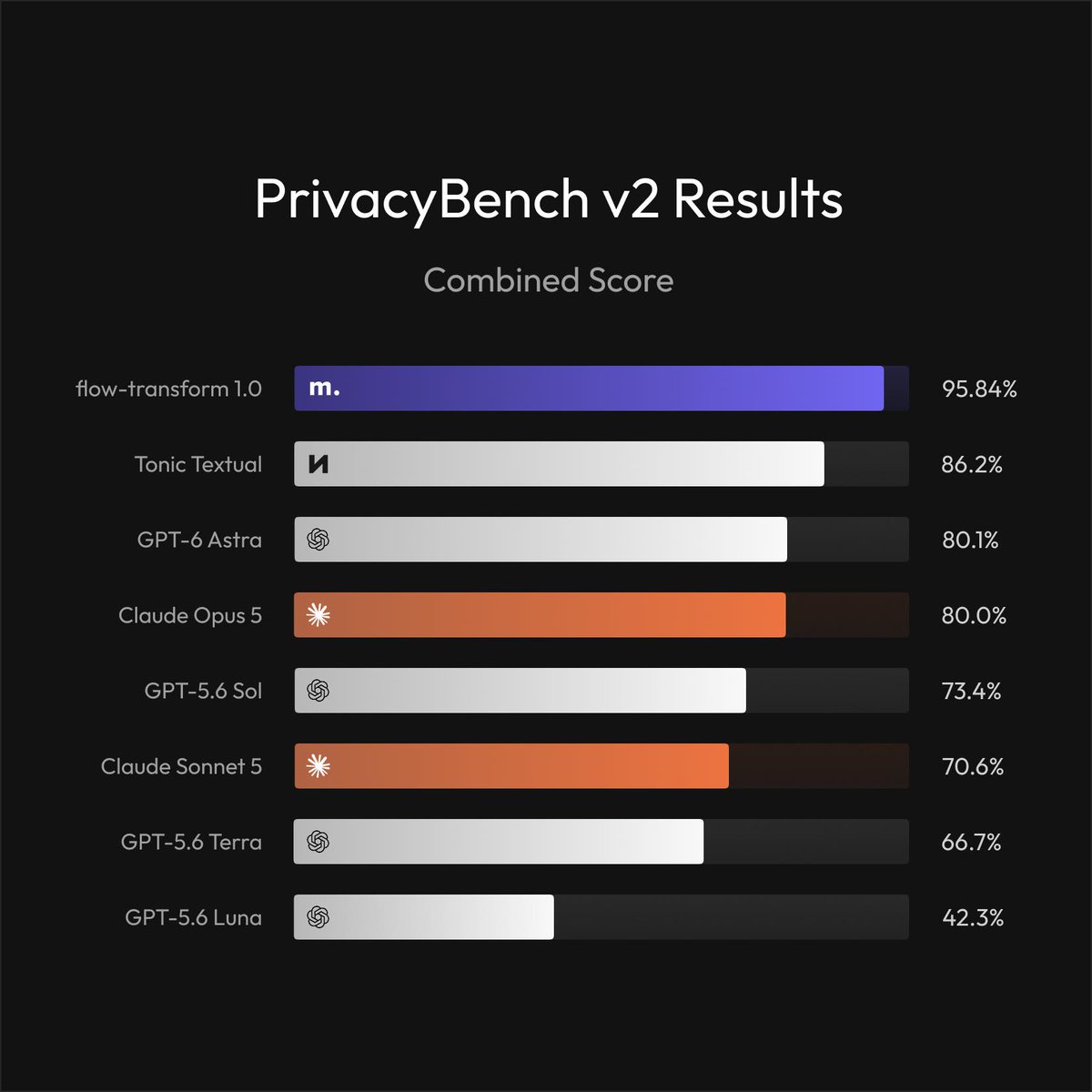
PrivacyBench v2 was recently released, and flow-transform 1.0 by micro1 now leads the expanded benchmark by a wider margin, reaching 95.84% combined detection + synthesis accuracy and finishing 9.64 points ahead of the next-best model.
The latest version expands the benchmark to full synthetic enterprise workspaces with native documents and attachments. Congrats to Tonic on the release.
PrivacyBench v2 is a meaningful step forward, but it still measures only part of the end-to-end transformation problem. In our report, we introduced the Enterprise De-Identification Bench and its Transformation Quality Index (TQI) to measure the final transformed dataset across privacy, utility, fidelity, coverage and coherence.
We believe this is the better way to evaluate enterprise de-identification because a single combined detection + synthesis score can hide important failure modes. It doesn’t account for the severity of what was missed, unnecessary transformations, uneven performance across files, or whether the final dataset remains coherent and usable.