forget herdr, i'm fully @theo pilled
stumbled on a dream-like workflow that:
💎 seamlessly uses all my subscriptions (Claude, ChatGPT, agy, etc) -- based on whatever's cheapest (based on available quotas) in *real time* (no logout/login)
🖥️ runs the iOS/Android simulator on my mac mini, from my laptop (or even my phone)!
📱 first class mobile app, on Android (and iOS obvs)
🔬 allows any agent to call any other agent -- for code review/etc
just 3 steps:
1. install t3 code
2. install CLI Proxy and login to all your subs from there
3. point t3 code to CLI Proxy
that's it.
i'm so, so happy with this flow
guys i finally figured out how to keep coding agents running EVEN with the laptop lid closed
it's called "herdr"
just run 𝚖𝚘𝚜𝚑 𝚖𝚊𝚌-𝚖𝚒𝚗𝚒 -- 𝚑𝚎𝚛𝚍𝚛 on the laptop, and... close the lid at will!
🏃 agents continue running on my mac-mini
🛜 seamlessly reconnects when wifi is off/flaky
✅ even localhost links work directly on my laptop!
turns the laptop to a 'thin client', with all the *actual* work done on my mac
(added bonus is my mac stays up to date!)
@yazins yes you can run it on any device, I am running it in on my mac mini, my old pc, and my old laptop as a server for the agents
and I am switching between my phone and the laptop for the client layer for controlling them
its really a great experience
@motatoeshq@opencomputerHQ ehh resuming cleanly is really tricky! but figuring that out (instead of restarting the whole loop) is what actually makes these usable..
thnx, trying out @opencomputerHQ
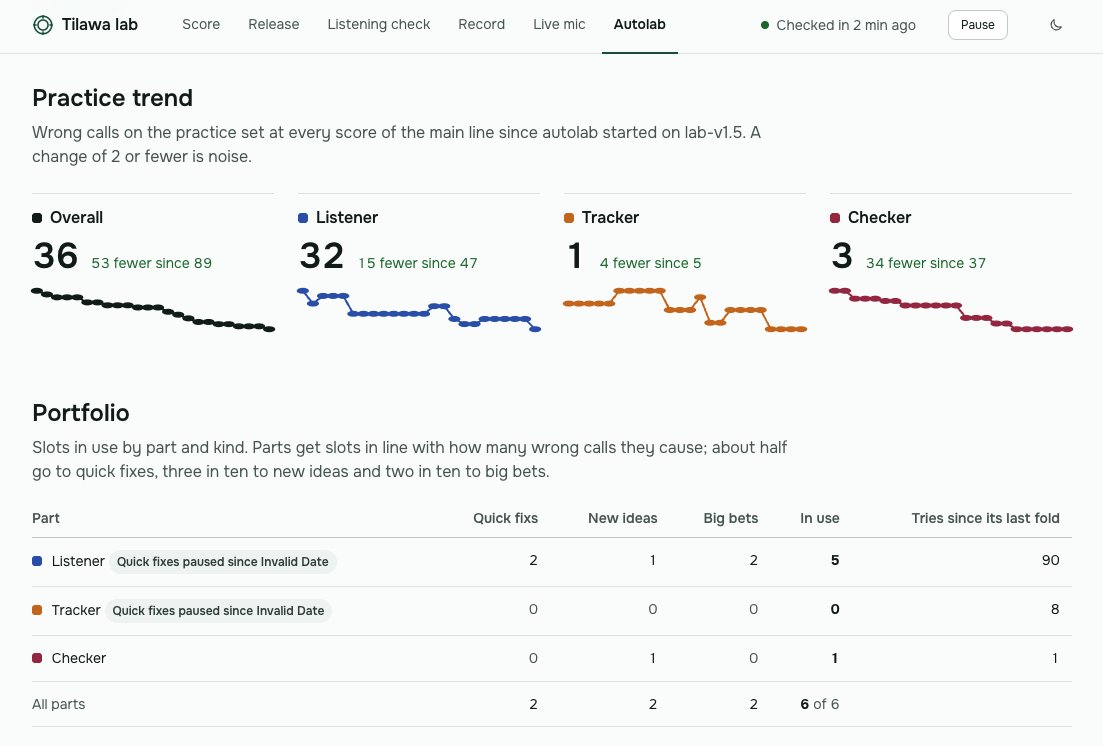
69 → 36 errors, without lifting a finger
/autolab is really good at solving problems where the solution isn't known, domains that require alot of experimentation..
it ran 275 experiments (15 merged, and 260 failed) over 3 days..
was hand-prompting this before i came to my senses and decided to let opus handle it
proof 👇
ps: i'm not an ML engineer so i have it add eli5 descriptions 😆
from 107 mistakes, down to 69 overnight
context: i'm training a small model to correct Quranic recitation mistakes people make, 100% offline
that process was manual up until yesterday. then, i asked opus-5.5 to take the wheel
how it works:
- opus writes the experiment cards (targeted improvements on the listener, tracker, or the checker)
- grok 4.7 compares to past attempts; drops dupes
- card execution is a/b tested between grok 4.7 & astra; builder can't see exam data or access modal
- grok 4.7 checks for benchmark special-casing; rejects overfitted attempts
- tests run on modal, scored on 100 practice sessions
- experiments merge only if > 3 mistakes fixed
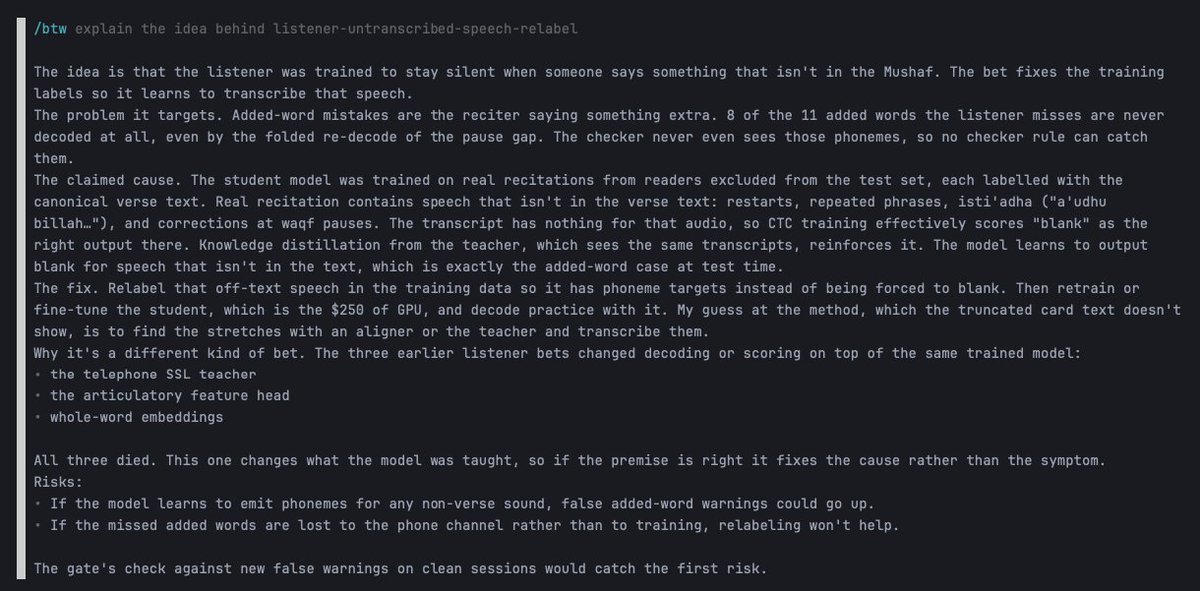
what i like most is that i'm seeing truly interesting 'big bets' -- not just quick fixes!
(i don't have an ML background, so just asked opus to eli5 all the attempts, which you see bleow)
from 107 mistakes, down to 69 overnight
context: i'm training a small model to correct Quranic recitation mistakes people make, 100% offline
that process was manual up until yesterday. then, i asked opus-5.5 to take the wheel
how it works:
- opus writes the experiment cards (targeted improvements on the listener, tracker, or the checker)
- grok 4.7 compares to past attempts; drops dupes
- card execution is a/b tested between grok 4.7 & astra; builder can't see exam data or access modal
- grok 4.7 checks for benchmark special-casing; rejects overfitted attempts
- tests run on modal, scored on 100 practice sessions
- experiments merge only if > 3 mistakes fixed
what i like most is that i'm seeing truly interesting 'big bets' -- not just quick fixes!
(i don't have an ML background, so just asked opus to eli5 all the attempts, which you see bleow)
inching closer 👀
won't be long now before we have a great Quran recitation correction model that is fast & accurate, works fully offline and is under 200MB in size
@DanielLenton1 Yes, I run Claude Opus 5.5 as the orchestrator and it checks. the results of each experiment and reflects on it before spinning up additional experiments.