Major preprint just out!
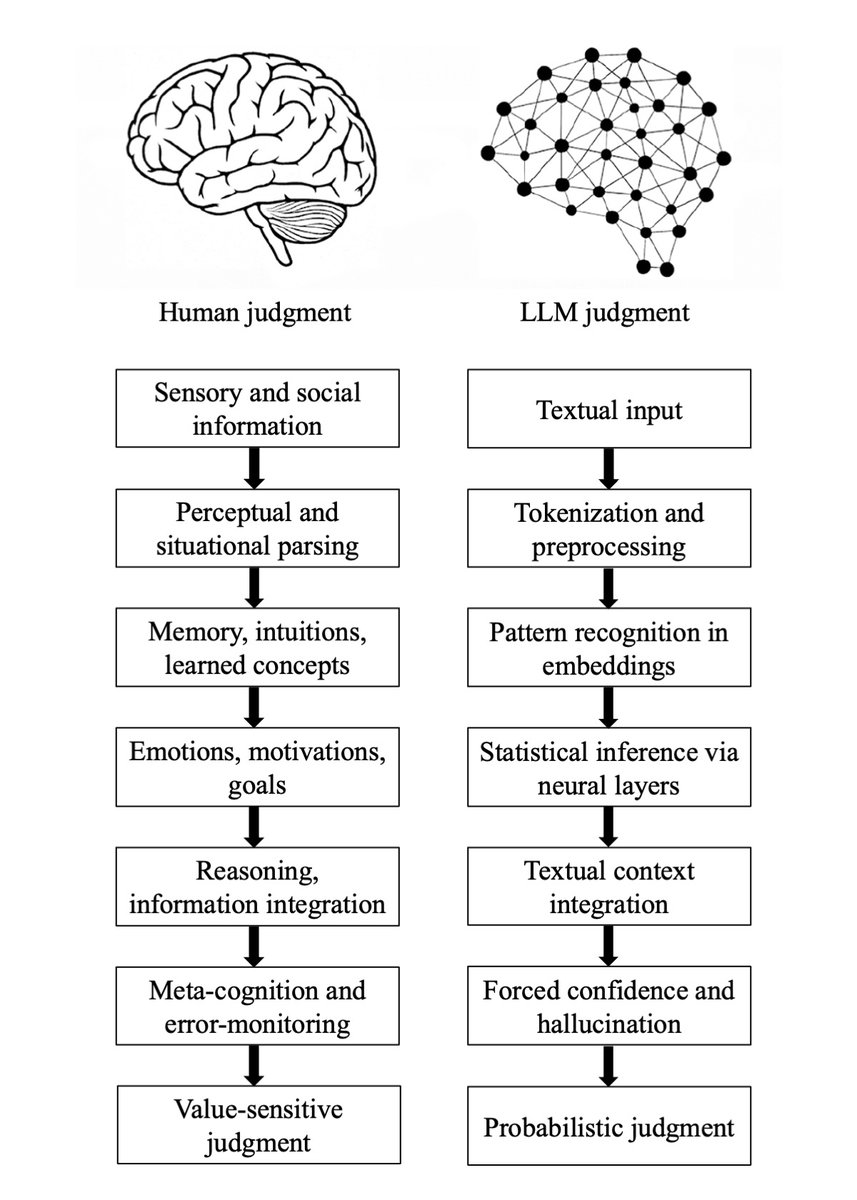
We compare how humans and LLMs form judgments across seven epistemological stages.
We highlight seven fault lines, points at which humans and LLMs fundamentally diverge:
The Grounding fault: Humans anchor judgment in perceptual, embodied, and social experience, whereas LLMs begin from text alone, reconstructing meaning indirectly from symbols.
The Parsing fault: Humans parse situations through integrated perceptual and conceptual processes; LLMs perform mechanical tokenization that yields a structurally convenient but semantically thin representation.
The Experience fault: Humans rely on episodic memory, intuitive physics and psychology, and learned concepts; LLMs rely solely on statistical associations encoded in embeddings.
The Motivation fault: Human judgment is guided by emotions, goals, values, and evolutionarily shaped motivations; LLMs have no intrinsic preferences, aims, or affective significance.
The Causality fault: Humans reason using causal models, counterfactuals, and principled evaluation; LLMs integrate textual context without constructing causal explanations, depending instead on surface correlations.
The Metacognitive fault: Humans monitor uncertainty, detect errors, and can suspend judgment; LLMs lack metacognition and must always produce an output, making hallucinations structurally unavoidable.
The Value fault: Human judgments reflect identity, morality, and real-world stakes; LLM "judgments" are probabilistic next-token predictions without intrinsic valuation or accountability.
Despite these fault lines, humans systematically over-believe LLM outputs, because fluent and confident language produce a credibility bias.
We argue that this creates a structural condition, Epistemia:
linguistic plausibility substitutes for epistemic evaluation, producing the feeling of knowing without actually knowing.
To address Epistemia, we propose three complementary strategies: epistemic evaluation, epistemic governance, and epistemic literacy.
Full paper in the first reply.
Joint with @Walter4C & @matjazperc
Join our team at IIT Bombay's Psychophysiology Lab! We have openings for Research Assistants and a Post-Doctoral Fellow on various projects.
#ResearchAssistant#Postdoc#Psychology#Neuroscience#Cognition
Details & application link below!
Apply here: https://t.co/kBhVuc6kMW
論文が掲載されました👏わーい👏顔の上半分と下半分で違う感情を示すような不確定な顔を見たとき、知覚した感情に対応して、自分の顔をわずかに動かしていることを示しています。何卒
Facial mimicry depends on the emotion we recognize in others' faces https://t.co/YJI6tGNVeQ
@vishnusreekr Post my masters end sem of philosophy of mind a bunch of us started a discussion which went on for hours and the same topic would restart for few days. None of us were interested in how good we did in the exam, the questions and topics were absolute fun, that’s it.
@vishnusreekr I agree with the trap of comfort zone but I am not making the assumption of fun being comfort zone. In contrary I feel the challenges of exams and research can be quite fun and one can indulge in them. Comfort zones are never fun.
@vishnusreekr Exams are are supposed to be fun, fortunately my teacher made them fun for me. I also liked the perspective of article titled “Assessment as pedagogy: inviting authenticity through relationality, vulnerability and wonder” https://t.co/l3N6cgKCon
Congratulations to @cogsonnet28 and @MaitreyiRedkar on their new publication, "Timing matters: investigating the interplay of presentation duration and congruency in approximate number processing"! 🎉
Check it at: https://t.co/LV25GFucUt
#Cognition#MathematicalCognition#ANS
Our lab's latest paper, "Dimensional versus categorical approach: A comparative study of mathematical cognition" by Ankit Mishra, is now out! 🎉
Check it at: https://t.co/Nwj6xT9ug2
#mathematics#cognition#psychology
So happy to see our(@themandalab) first paper out🎉🎉. Even more special for me because it's the first paper of my PhD journey! The experience of seeing it through was amazing. Many many thanks to @vishnusreekr to have given us so many valuable writing lessons. #myfirstdoi
It's about TIME we celebrate! Huge congrats to @shaminiwarda on absolutely smashing her PhD defence on "Predictive Processing in Time Perception". Tears (of joy!) in lab as "Dr. Shamini" became Official. We are all very proud of you. Keep inspiring!
#Timeperception#PhDdefence
Are theories of consciousness (ToCs) about the same thing?
Yes✅
To show this, we unify 6 ToCs, arguing that they each capture unique aspects of temporal phenomenology. Putting experience first, helps collective theorizing. Out now🧵:
https://t.co/bppJiBlcXD
Thrilled to host @Debaleena_Basu at our lab! She shared fascinating insights into "Sequence processing mechanisms in the brain" While parallel programming for sequential saccades is awesome, her work opens new avenues!
#CognitiveNeuroscience#Cognition
Delighted to extend invitation for "Indo-Finnish Workshop: Electroencephalographic Insights into Bilingualism and Developmental Dyslexia" @iitbombay with @JarmoHamalainen and @ailesors from @uniofjyvaskyla
Deadline - 20th March
Follow the details in the thread
#EEG#Dyslexia
New paper in Imaging Neuroscience by Russell A. Poldrack, Krzysztof J. Gorgolewski, et al:
The past, present, and future of the brain imaging data structure (BIDS)
https://t.co/97QyI12fsX
Ended the International Workshop on Neuro-Cognitive Markers of Alzheimer’s Disease at @iitbombay Thanks to Prof. Nikolai Axmacher from @ruhrunibochum for the fascinating work on grid cells and spatial navigation as early-marker for Alzheimer's disease
#neuroscience#cognition
completed day 1 of International Workshop on Neuro-Cognitive Markers of Alzheimer’s Disease at @iitbombay followed by a short hike. It was an absolute pleasure hosting Prof. Nikolai Axmacher from @ruhrunibochum#neuroscience#cognition#Alzheimer