You have Claude Fable for only a few days. Here's how to make the most of it.
Introducing /improve: use your most capable model to audit your codebase and write plans for cheaper models to execute later.
Studies your code, figures out bugs, perf, tech debt, missing tests, what to build and writes plans any agent can run.
Want to stand out on social media? Try these strategies and optimize your content game today! 💼🔥
✅ Got other tips for growing followers? Share them in the comments!
📌 Save + Follow me for more insights into social media strategies!
As indie creators, we all know the X platform (formerly Twitter) algorithm can either make or break you. To grow quickly and attract traffic, you need to learn how to “hack” the algorithm. Here are some practical tips gathered from top creators:
4️⃣ Never include links in your first post
The X algorithm penalizes posts with outbound links. If you need to include a link, add it in the second comment instead of the main post to preserve your post’s weight!
3️⃣ Maintain a 60% follower-to-following ratio
Following too many people makes you seem less “valuable,” but following too few limits your social reach. Aim for the golden ratio of 60%.
1️⃣ Encourage engagement, especially replies and profile clicks
Research shows that replies and profile clicks carry 13.5 times more weight than likes! Make your content thought-provoking or slightly controversial to encourage people to reply or check out your profile.
Revolutionize your Vue apps with silky-smooth, production-ready animations. — powered by Motion.
✨ Highlights:
• Cinematic Animations
• Dynamic Variants for ultimate control
• Interactive Gestures that respond like magic
• Stunning Path Animations
🧵1/2
🚀 Just published a new blog post: Exploring Native HTML Form Validation
🛠️Diving into the quirks of HTML forms, setCustomValidity, and how to manage edge cases to create a smoother UX. Check it out and share your thoughts! 👇
🔗 https://t.co/6yTQCoYcBA
#HTML#FrontEnd#WebDev
Ditch your subscription.
I killed 3 startups because of recurring payments:
1. IndiePage:
✅ It makes $4,000/month on autopilot ($45 for lifetime access).
❌ It made $0/month when I priced it at $15/year.
2. MakeLanding:
✅ It made $100/day when I launched ($19 per landing page generated).
❌ It made $0 with a $5/month subscription.
3. HabitsGarden:
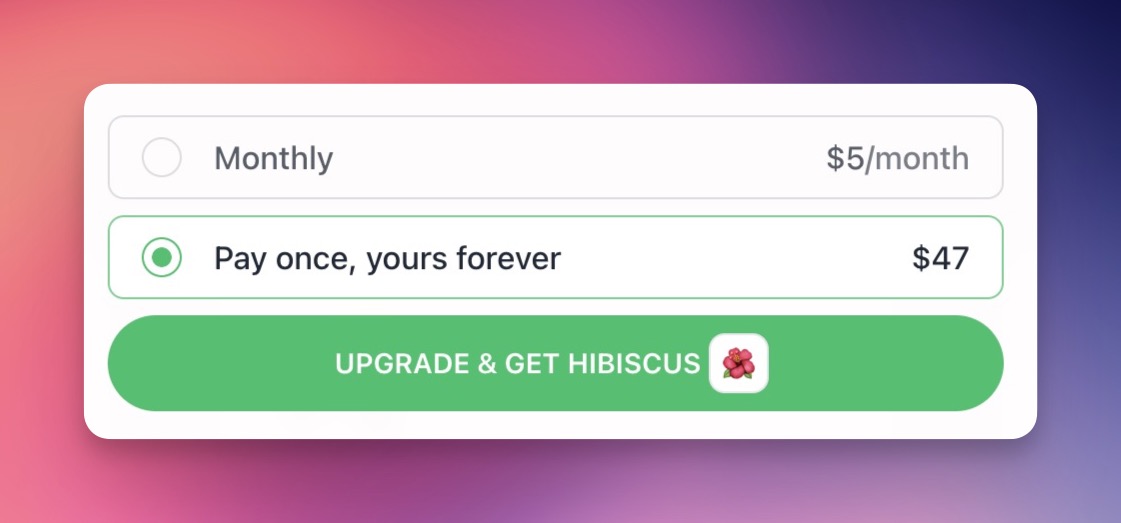
✅ 100% of users chose the $47 lifetime deal.
❌ Nobody buys the $5/month plan.
Business owners love subscriptions. Customers hate them.
Here’s the invisible cost of charging recurring payments:
- Conversion rate drop: People are reluctant to commit to another subscription, which triggers objections and hesitation.
- Fighting churn: People lose interest soon after signing up. Instead of a steady income, you’re constantly replacing customers who cancel.
Selling a $10/month monthly subscription is as hard as selling a $100 one-time payment.
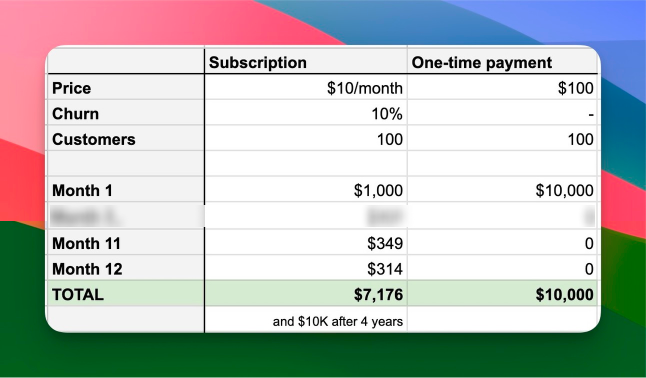
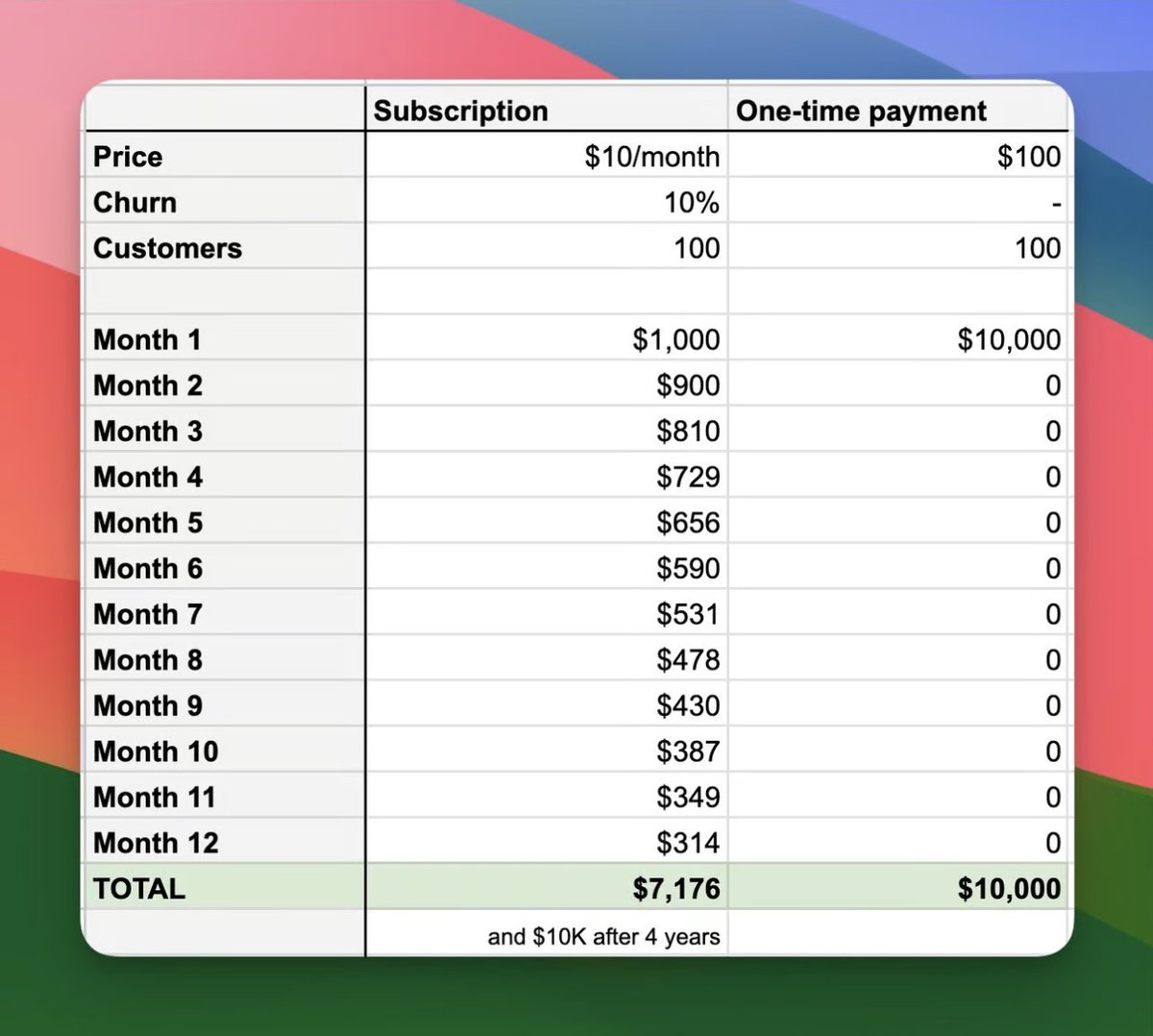
Let’s assume you built an excellent SaaS (10% churn = 10% of your customers cancel at the end of the month).
Imagine you get 100 customers today:
- You’ll earn $7,176 with subscriptions, after 365 days.
- You earn $10,000 with one-time payments, right now.
Subscription doesn’t mean recurring revenue. If you’re working solo, in 99% of cases you’re better off financially with one-time payments.
One-time payments alternative
Sometimes, your business has recurring costs, and you can’t afford one-time payments. I’m not talking about bandwidth (that’s negligible) but things like AI credits or database costs.
Then try credits-based pricing:
- Let your customers pay upfront for what they’ll use. Generate 10 AI photos for $5.
- Then, add a Good-Better-Best package. 100 AI photos for $20 ($.2/photo looks cheap now).
This removes the subscription friction (which boosts your conversion rate) and helps you avoid constantly fighting churn.
When subscriptions make sense
👔 B2B: If you’re selling to businesses, subscriptions make sense because the end goal of any business is to make money.
🤕 Complex credits: When tracking credits is too complex or it’s hard to quantify what your customers use.
Subscriptions serve a specific purpose. Recurring payment = Recurring value according to my friend @DanKulkov.
Just because competitors charge recurring payments doesn’t mean you should. Remember, people are tired of subscriptions, and purchase behavior is changing. Not charging a subscription can be a competitive edge.
Oh, and entrepreneurs flex on each other with MRR charts. It’s a status game, don’t fall for it. In the end, the customer is king.