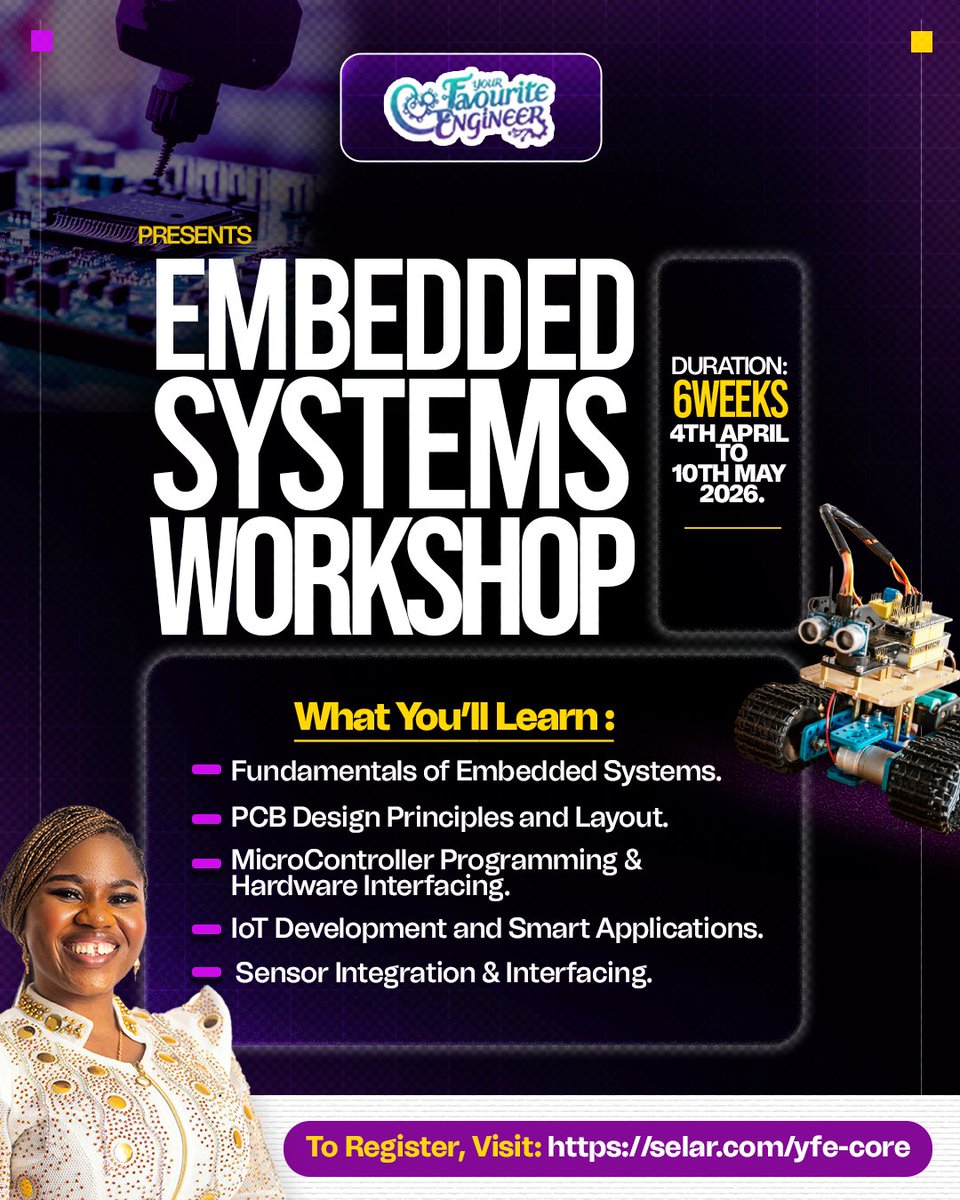
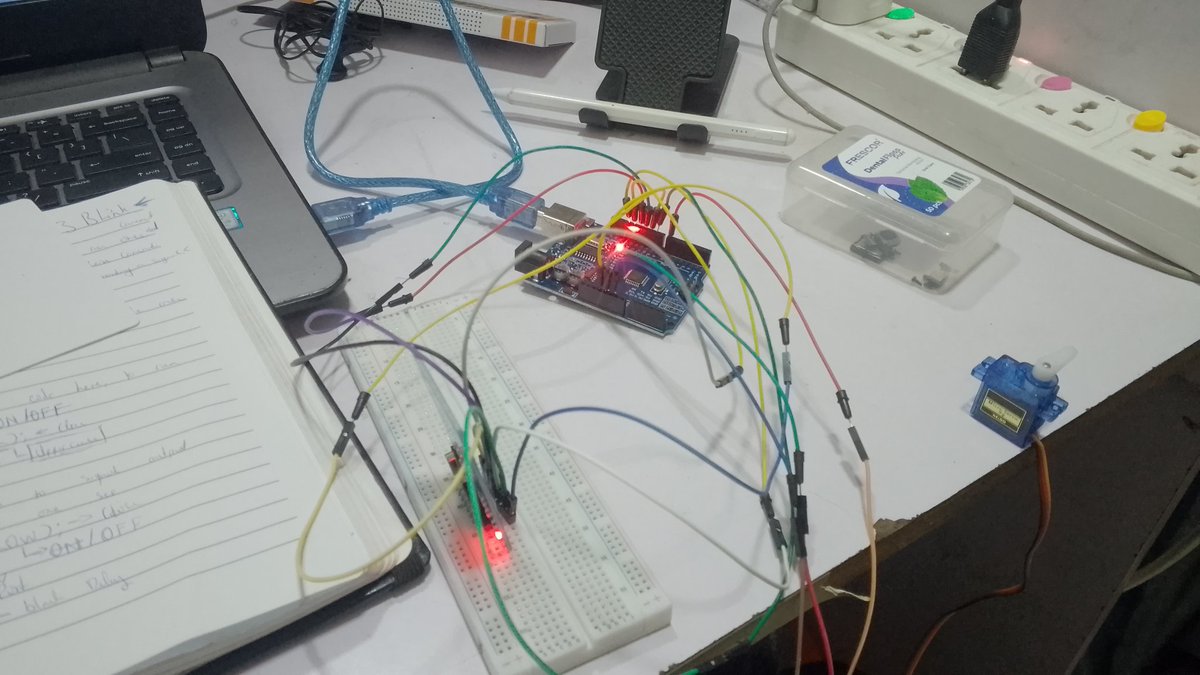
We didn’t create our Embedded Systems Workshop because it sounded like a good idea.
We created it because something is broken.
Too many engineers can:
• Write code.
• Follow tutorials.
• Build “projects.”
But can’t explain why their system works or fix it when it stops.
That’s the problem.
Because real engineering isn’t:
“Write → Run → It works”
It’s:
• Code meets circuits
• Logic meets noise
• Ideas meet constraints
And that’s where most people get stuck.
It's not because they’re not smart, but because no one taught them how things actually connect.
So they stay here:
→ Copying code
→ Guessing fixes
→ Hoping things work
That’s not engineering.
That’s trial and error.
At YFE, we’re building something different.
We’re training engineers who understand:
• Why systems fail
• How sensors, power, and timing behave
• How software becomes physical action
• How real devices are actually designed
Embedded systems isn’t just a skill.
It’s the bridge between software and reality.
And once that clicks:
• You stop guessing.
• You stop copying.
• You start building with intent.
If you’ve ever felt like:
“I can code, but I don’t really understand systems.”
You’re not alone.
That gap is exactly what we’re fixing.
Not with more tutorials.
But with real system thinking.
Sign up for our Embedded Systems Workshop
🔗 https://t.co/9awAxyo2Zx
Now let’s build! 🦾
Over the past few weeks, Silicon & Systems has taken us down some interesting roads.
We started with emerging trends in Embedded Systems and Robotics.
Then we explored:
• Edge Computing
• Edge AI
• IT vs OT (Information Technology vs Operational Technology)
• How modern intelligent systems are changing industries
We even opened the floor completely during our Town Hall Edition.
No presentations.
No slides.
Just engineers, students, builders, and curious minds asking questions, sharing experiences, and helping each other find clarity.
Then last week's conversation took a turn none of us expected 😅
There were laughs.
There was banter.
There were honest conversations about the current state of the nation.
But somewhere in the middle of all of that, something important happened.
People started discussing solutions.
Not just problems.
Ideas.
Initiatives.
Ways engineers can contribute meaningfully to the challenges around us.
It reminded us that engineering has always been bigger than circuits, code, and hardware.
Engineering is ultimately about solving problems.
Which brings us to today's conversation.
Because every smart device, every industrial machine, every automated system depends on one thing:
Communication.
Data has to move.
Sensors have to talk.
Controllers have to respond.
Machines have to coordinate.
And none of that happens by accident.
Today, we'll be exploring:
⚡ How Data Travels in Industrial Systems ⚡
We'll break down:
• Industrial communication protocols
• How machines exchange information
• Why protocol selection matters
• Where technologies like CAN, Modbus, Ethernet/IP, and others fit into modern systems
If you've enjoyed any of our previous conversations, you're going to love this one.
Join today @ 8p.m. WAT (UTC+1) 📌
Bring your questions.
Bring your curiosity.
And if you're serious about understanding how modern systems actually work beneath the surface, this is one conversation you don't want to miss.
Click the link below and set a reminder
🔗 https://t.co/o6RSV1JdD5
See you then ✨
A lot of engineering students are struggling to get internships.
And the frustrating part?
Many of them are doing everything they know how.
Sending applications.
Updating their CVs.
Asking around.
Yet nothing happens.
A few months ago, we started noticing the same pattern inside our community.
Students kept asking:
"Where do I even apply?"
"How do I write a CV that recruiters will actually read?"
"How do I stand out when I have little or no experience?"
And honestly, these are fair questions.
Nobody teaches you how to navigate the industry.
Most people are expected to figure it out themselves.
The result?
Talented students miss opportunities they were fully capable of getting.
That's exactly why we created the YFE Internship Resource Kit.
Not another motivational PDF.
Not another generic checklist.
A practical resource designed to help engineering students move from confusion to action.
Inside, you'll find:
✅ An ATS-optimized resume template
✅ A professional resume template for remote and international opportunities
✅ A directory of companies with locations and contact information
✅ The YFE Ultimate Internship Playbook — a step-by-step guide on how to maximize your internship experience, build valuable relationships, and position yourself for future opportunities
Because getting the internship is only half the battle.
What you do during that internship can shape your career for years.
The engineers who stand out aren't always the smartest in the room.
They're often the ones who prepare better.
The ones who understand how industry works.
The ones who know how to create opportunities instead of waiting for them.
If you're an engineering student preparing for SIWES, IT, industrial training, or even remote opportunities, this resource was built for you.
A new month is a good time to start moving differently.
More intentional.
More prepared.
More industry-ready.
The opportunities are out there.
Make sure you're ready when they arrive.
Get access here
🔗 https://t.co/9SbYVwhClE
Many engineering students are carrying questions they rarely get the chance to ask openly.
That's one thing we've realized.
They aren't technical questions alone.
They're real questions.
Questions about growth.
Direction.
Consistency.
Confidence.
What it actually means to become an engineer beyond passing exams.
And the truth is, many people are trying to navigate engineering quietly on their own.
Trying to figure out:
• Where to start
• What skills matter
• How to build projects
• How to stay motivated
• How to balance learning with life
That isolation is more common than people think.
Over the past few months, Silicon & Systems has slowly become a space where those conversations can happen honestly.
Not polished.
Not performative.
Just engineers learning from other engineers.
Some people join to learn about embedded systems.
Some come for robotics.
Some are curious about Edge AI or industrial technology.
But somewhere in the middle of those technical conversations, something else has been happening:
People have been finding clarity.
And that matters.
Engineering grows faster in environments where people feel comfortable asking questions, sharing experiences, and learning publicly without fear of looking inexperienced.
That is the energy behind today’s session.
Silicon & Systems, Town Hall Edition 🩵💚
No rigid structure.
No pressure to “sound smart.”
Just open conversations around:
• Engineering growth
• Career direction
• Building projects
• Consistency
• Learning challenges
• Navigating the industry
If you’ve been looking for a space to ask questions, connect with people who genuinely care about engineering, and grow alongside others on a similar journey, this session is for you.
Join us today @ 8pm WAT (UTC +1) 📌
Click on the link to set a reminder
🔗 https://t.co/VOHBcWV6U7
The future of engineering will not only be shaped by brilliant individuals.
It will also be shaped by strong communities that learn and build together! 🤝🏽🔥
@KylezResearch You are absolutely right, Kyle.
And in the end, the hardware used will either increase the system's efficiency or reduce it.
That's why choosing the right one has to be top priority.
Most people use Edge AI every single day.
They don’t realize they’re interacting with one of the most important shifts in modern engineering.
• Your phone unlocking with facial recognition
• A drone avoiding obstacles mid-flight
• A factory camera detecting defects instantly
• A medical wearable monitoring abnormal vitals in real time
None of these systems can afford to send every decision to the cloud and wait because in the real world, latency changes everything.
A delayed Netflix recommendation is annoying.
A delayed response from an autonomous system can destroy equipment.
Or worse.
That’s why Edge AI matters.
For years, AI has mostly lived inside massive cloud infrastructure.
Devices collected data.
Sent it somewhere else.
Waited for instructions.
But modern systems are changing the model completely.
Now, intelligence is moving directly onto the device itself, which means embedded systems are no longer just sensing and transmitting data.
They are:
• Interpreting environments
• Recognizing patterns
• Making decisions locally
• Responding in real time
And they’re doing all of this under brutal constraints:
• Limited power
• Limited memory
• Limited compute resources
• Real-time timing requirements
That changes engineering completely.
Now optimization becomes everything.
• Can the model run efficiently?
• Is inference fast enough?
• Can the device operate without internet access?
• Is the system thermally stable?
• Does the power budget still hold?
This is why Edge AI is becoming one of the most valuable intersections in engineering today:
AI × Embedded Systems × Real-Time Engineering × Hardware Optimization
And the engineers who understand all four are becoming increasingly rare.
At YFE Embedded, this is exactly the direction we’re building toward.
Because the future will not belong to intelligent systems.
It will belong to systems that are intelligent, efficient, secure, and capable of surviving real-world conditions.
@princess_yfe That's the beauty of edge.
Everything lives right on the chip.
That makes processing faster, which equals higher efficiency, which is what we're after in the end.
The next billion-dollar AI systems may never touch the cloud.
They’ll live inside wearables.
Inside drones.
Inside factory equipment.
Inside low-power embedded hardware operating quietly in the real world.
That shift is already happening.
A patient in a remote village has no hospital nearby.
No cardiologist.
No stable internet.
No cloud infrastructure.
But there’s a wearable device on their wrist.
And that device just detected an irregular heartbeat before the patient even experienced any symptoms.
It didn’t send the data to a server in another country.
It didn’t wait for the cloud.
It made the decision locally.
On a chip smaller than your fingernail.
That is Edge AI.
And it’s becoming one of the most important shifts in embedded systems engineering.
For years, AI depended heavily on massive cloud infrastructure.
Devices collected data.
Sent it somewhere else.
Waited for instructions.
That model works until latency, reliability, privacy, or connectivity become real engineering constraints.
Because in the physical world, systems often cannot afford to wait.
• A drone cannot pause mid-flight waiting for cloud feedback.
• A medical wearable cannot delay anomaly detection.
• An industrial monitoring system cannot wait for internet access before reacting to failure.
This is why intelligence is moving closer to the edge.
Closer to the device.
Closer to reality.
And the engineering behind that shift is changing what embedded systems are capable of.
Machine learning models that once required powerful servers can now run directly on embedded hardware under strict constraints:
• Limited memory
• Limited power
• Limited compute
• Real-time timing requirements
That means embedded systems are no longer just sensing and transmitting data.
They are:
• Recognizing patterns
• Making decisions locally
• Responding in real time
This is not simply AI becoming smaller.
It is hardware becoming intelligent.
At YFE Embedded, this is the frontier we are building toward.
Because the future will belong to engineers who can make intelligent systems survive in the real world.
𝘐𝘮𝘢𝘨𝘦 𝘢𝘤𝘲𝘶𝘪𝘳𝘦𝘥 𝘧𝘳𝘰𝘮 𝘣𝘭𝘰𝘨.𝘶𝘮𝘦𝘳-𝘧𝘢𝘳𝘰𝘰𝘲.𝘤𝘰𝘮
A drone flying at high speed cannot afford to “wait for the cloud.”
Not for one second.
Because by the time data travels to a server and comes back?
The drone has already crashed.
That is the reality Edge AI is solving.
For years, most AI systems worked the same way:
Collect data.
Send it somewhere else.
Wait for instructions.
That model works until systems start operating in the real world.
Because the real world does not pause while your system thinks.
Cars keep moving.
Machines keep running.
Robots keep navigating.
Reality does not care about buffering.
So engineering started pushing intelligence closer to the hardware itself.
Right there on the device.
That means systems now have to:
• Sense
• Process
• Decide
• Respond
All in real time.
And this is where Edge AI becomes fascinating.
Because engineers are now trying to run intelligent systems under real-world constraints:
• Tiny memory budgets
• Limited power
• Strict timing requirements
• Thermal limits
We can no longer throw massive cloud infrastructure at every problem.
Efficiency now matters.
Deeply.
At YFE Embedded, this is the frontier we are building toward:
Intelligent systems that survive outside perfect lab conditions.
Real hardware.
Real constraints.
Real-world intelligence.
𝘐𝘮𝘢𝘨𝘦𝘴 𝘢𝘤𝘲𝘶𝘪𝘳𝘦𝘥 𝘧𝘳𝘰𝘮 𝘗𝘯𝘨𝘵𝘳𝘦𝘦 & 𝘭𝘢𝘷𝘪𝘤𝘵𝘰𝘳𝘪𝘢.𝘦𝘤