🩺 Community Question: Is the “AI five layer cake” framework sufficient to power healthcare AI systems?
(The “AI five layer cake” framework: Energy → Chips → Infrastructure → Models → Applications, introduced by Jensen Huang of NVIDIA)
Viewpoint A: Yes
Healthcare AI aligns with the stack. Energy, chips, and infrastructure enable intelligence generation at scale. Medical models, trained on clinical and biomedical data, interpret complex signals; applications then deliver value through radiology assistance, drug discovery, and clinical workflow automation.
Viewpoint B: Not entirely
The stack shows how capability is produced, but impact depends on translating that capability into clinical use. Strict validation, regulation, and the need to integrate with hospital workflows slow translation; consequently, healthcare applications often scale more slowly than the underlying AI stack.
👇Drop A or B and share your perspective
🩺 Community Question:
Elon Musk recently said that, based on current human constraints, AI-powered robotics could become better surgeons than the best human surgeons within three years at scale.
Do you agree with him?
Viewpoint A:
Agree. With few great surgeons, slow and costly human training, and unavoidable human error, AI and robotics could learn faster and scale surgical skill beyond human limits.
Viewpoint B:
Disagree. Even acknowledging the human constraints Elon Musk points out, surgery is not only about speed, scale, or error reduction. It also depends on judgment, responsibility, and trust in high-stakes situations, which remain difficult to validate and deploy safely at scale.
Is this a near-term breakthrough or a vision that overestimates how quickly surgical autonomy can be safely scaled?
👇 Drop A, B, or share your perspective.
🩺 Community Question:
Elon Musk recently said that, based on current human constraints, AI-powered robotics could become better surgeons than the best human surgeons within three years at scale.
Do you agree with him?
Viewpoint A:
Agree. With few great surgeons, slow and costly human training, and unavoidable human error, AI and robotics could learn faster and scale surgical skill beyond human limits.
Viewpoint B:
Disagree. Even acknowledging the human constraints Elon Musk points out, surgery is not only about speed, scale, or error reduction. It also depends on judgment, responsibility, and trust in high-stakes situations, which remain difficult to validate and deploy safely at scale.
Is this a near-term breakthrough or a vision that overestimates how quickly surgical autonomy can be safely scaled?
👇 Drop A, B, or share your perspective.
💊 Community Question:
Can AI help discover and develop new medicines much faster and cheaper than traditional methods?
Viewpoint A:
Yes. AI can rapidly test millions of drug ideas, cut early research time and costs dramatically, and in some cases bring medicines to patients years faster.
Viewpoint B:
Not fully. AI helps at the start, but human trials are still slow, expensive, and unpredictable, keeping overall drug development costly and time-consuming.
If AI is expected to change how medicines are made, is the impact already real or mostly promise?
👇 Drop A, B, or share your perspective.
🩺 Community question:
Where will the next major breakthrough in healthcare come from?
Viewpoint A:
From established systems like the US and UK where world-class institutions, funding, and decades of research infrastructure continue to drive innovation.
Viewpoint B:
From outside traditional power centers where emerging regions, new models, and fewer legacy constraints enable faster experimentation and unexpected breakthroughs.
Which side do you believe in and why?
👇 Drop A, B, or share your perspective.
Tag someone who should weigh in on this.
🩺 Community Question:
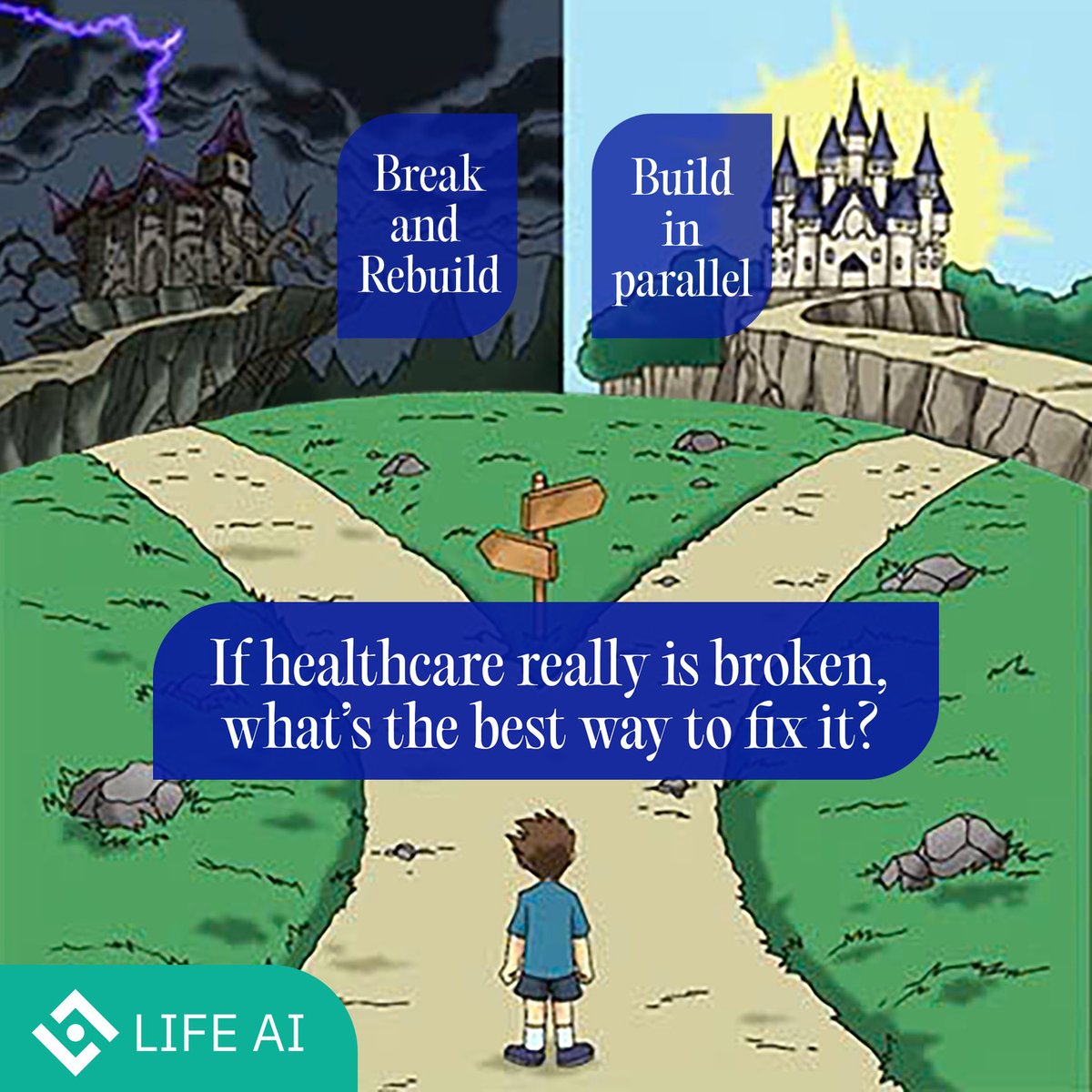
If healthcare really is broken, what’s the best way to fix it?
Viewpoint A:
Break the current system and take on the big players, including drug companies, hospitals, and insurers, to change the rules and rebuild healthcare from the ground up.
Viewpoint B:
Build a new healthcare system alongside the old one, simpler, more human, and tech-driven, and let it grow until it becomes the better default.
Your perspective can help shape the future of healthcare. Which path would you support?
👇 Drop A, B, or share your perspective.
Tag someone who should weigh in on this.
🩺 Community Question:
Will AI in healthcare improve care and safety or entrench bias and threaten privacy?
Viewpoint A:
AI can improve detection, efficiency, and access when validated and regulated
Viewpoint B:
AI carries risks such as bias, poor generalization, and privacy and security concerns.
Now make it personal:
How do you see the role of AI in healthcare today?
👇 Drop A, B, or share your perspective.
Tag someone who should weigh in on this
🩺 Community Question:
Will AI in healthcare improve care and safety or entrench bias and threaten privacy?
Viewpoint A:
AI can improve detection, efficiency, and access when validated and regulated
Viewpoint B:
AI carries risks such as bias, poor generalization, and privacy and security concerns.
Now make it personal:
How do you see the role of AI in healthcare today?
👇 Drop A, B, or share your perspective.
Tag someone who should weigh in on this
This isn't a "complete task and wait" testnet.
It's "speak up and get rewarded."
Jump in @LifeNetwork_AI: https://t.co/iSetVRrlh7
Code: OI352B4
#LifeAITestnet#HealthcareAI
Your Life Line is here.
A space for the conversations we rarely get to have, the ones about our health, our choices, and the systems that too often work against us.
Episode 1 opens with a discussion about AI, the tech at the heart of our work:
The agentic internet and the future of healthcare
📅 Dec 16 | ⏰ 5pm CET | 📍 Live on X
Set your reminders.
Your Life Line is here.
A space for the conversations we rarely get to have, the ones about our health, our choices, and the systems that too often work against us.
Episode 1 opens with a discussion about AI, the tech at the heart of our work:
The agentic internet and the future of healthcare
📅 Dec 16 | ⏰ 5pm CET | 📍 Live on X
Set your reminders.
@LifeNetwork_AI We're asking apps to solve problems the system creates. The real value is in being a 'system interpreter'—translating medical jargon, clarifying bills, and tracking referrals across a fragmented landscape. That reduces harmful errors.
@LifeNetwork_AI Doctors are drowning in admin. An app that gives patients a clear portal to manage referrals, pre-visit forms, and follow-up instructions doesn't just help the patient—it gives clinicians crucial time back for actual care.
@LifeNetwork_AI People abandon transactional apps (book, manage, done). They stay engaged with apps that provide continuous value and self-knowledge—showing them their trends, predicting their slumps, and celebrating their healthy streaks.
Why do we invest billions in treatment but so little in staying healthy? Debate to earn with @LifeNetwork_AI and challenge the system.
Join me: https://t.co/iSetVRqNrz
Code: OI352B4
#LifeAITestnet#HealthcareAI
@LifeNetwork_AI We celebrate prevention for predictable, slow-moving conditions. But what about the burst appendix, the sudden sepsis, the traumatic brain injury? A system optimized for prevention is dangerously unprepared for the unpreventable.
@LifeNetwork_AI Prevention requires a functioning primary care network. Ours is collapsing because those doctors are overworked and underpaid. Bolstering hospitals can help stabilize the entire medical ecosystem, making prevention possible later.
A smarter healthcare system starts with smarter conversations.
Let's create them together.
Jump in and debate to earn: https://t.co/iSetVRqNrz
Code: OI352B4
#LifeAITestnet#HealthcareAI